
 English
 中文简体
中文简体 Español
 English
 中文简体
中文简体 Español
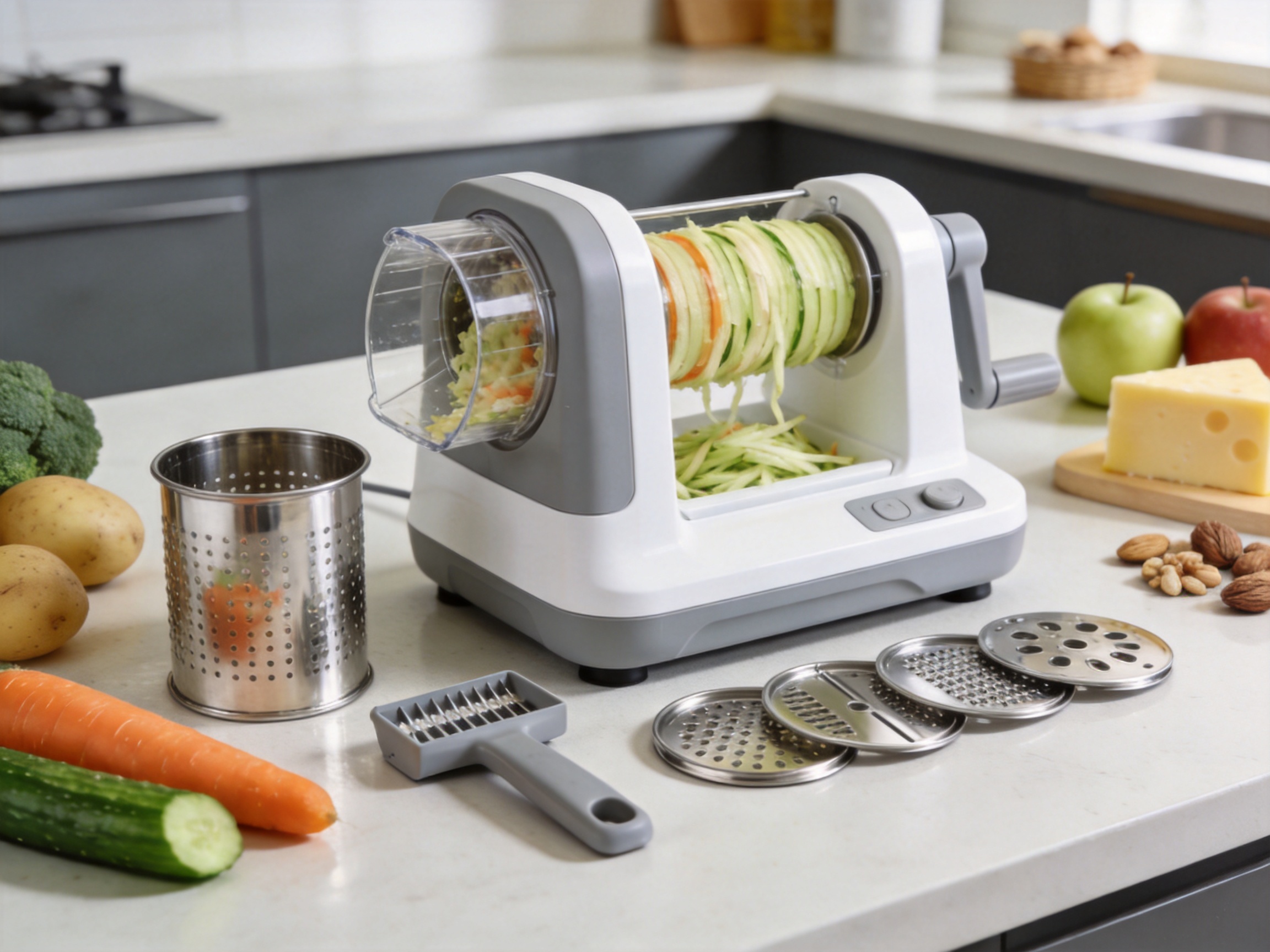
The multifunctional electric drum slicer is a practical kitchen appliance designed to simplify everyday food preparation by slicing, shredding, and grating ingredients quickly and consistently. Built for fruits, vegetables, nuts, cheese, and other common kitchen foods, it combines electric power, interchangeable cutting functions, and user-friendly operation in a compact countertop format. For households, restaurants, hotels, supermarkets, catering teams, and TV-shopping product channels, this appliance offers an efficient alternative to manual graters and conventional slicers.
In modern kitchens, speed and consistency matter. A salad station needs uniform vegetable strips, a family kitchen needs fast preparation for dinner, and a food-service counter may need to process cheese, carrots, cucumbers, potatoes, or nuts in repeated batches. Manual tools can do the job, but they often require strength, time, and careful handling. The electric drum slicer reduces hand fatigue, improves output uniformity, and creates a safer, more convenient preparation experience when used according to instructions.
The product discussed here is an electric drum grater, item number GSE002, with a rated power of 120W and a construction based on ABS, SS430 stainless steel, PP, and PCTG materials. It is manufactured for wholesale and OEM/ODM kitchen appliance markets by CIXI GSTAR ELECTRIC APPLIANCE CO., LTD., a manufacturer specializing in small electric kitchen appliances and practical household preparation tools. The company’s background in developing food processors, slicers, choppers, blenders, air fryers, air ovens, grills, hot pots, and hospitality products gives the electric drum slicer a strong manufacturing foundation.
Product Concept and Market Position
The multifunctional electric drum slicer is positioned between a simple manual grater and a larger food processor. It is not intended to replace every kitchen machine, but it fills an important gap: quick, visible, continuous processing of ingredients without the bulk, complicated assembly, or large bowl systems often associated with full-size food processors. This makes it attractive to users who want everyday convenience and to buyers looking for a product that is easy to demonstrate, easy to package, and easy to sell through retail or promotional channels.
Traditional manual graters are affordable, but they are labor-intensive and can lead to uneven results. Full-size food processors are powerful, but many users avoid them for small tasks because they require more counter space, more cleaning steps, and more accessories. The electric drum slicer offers a balanced solution: it uses a motorized drum blade system to pull ingredients through the cutting surface, giving users faster results while keeping the appliance relatively compact and intuitive.
This type of product is especially suitable for meal-prep households, busy parents, elderly users, small commercial kitchens, and anyone who prepares vegetable-based dishes regularly. It helps create shredded carrots, sliced cucumbers, grated cheese, chopped nuts, potato shreds, and other ingredients used in salads, casseroles, desserts, soups, pizzas, sandwiches, and side dishes. The ability to process multiple ingredient types increases the product’s value and makes it more versatile than single-purpose tools.
For distributors and private-label buyers, the electric drum slicer is also appealing because it belongs to a category with strong visual demonstration potential. Consumers can immediately understand its benefit when they see an ingredient transformed into clean slices or shreds within seconds. This makes it suitable for supermarket promotions, e-commerce videos, TV shopping, social commerce, and in-store product demonstrations.
Core Working Principle
The appliance typically consists of a motor base, a feed chute or hopper, a pusher, and a drum-shaped cutting blade. The user places food into the chute, uses the pusher to guide it safely toward the rotating drum, and the processed ingredient exits through the outlet. Depending on the installed drum, the appliance can slice, shred, or grate ingredients in different textures.
The drum design is one of the main reasons this product is convenient. Unlike flat blades that require a wide working area or manual pressure over an open surface, the drum blade rotates inside the appliance body, allowing continuous cutting in a contained format. This structure supports more controlled processing and can reduce direct contact with sharp edges during operation.
A 120W motor provides suitable power for routine household slicing and shredding tasks. In a product like this, power is not only about wattage; it is also about matching the motor torque, gear transmission, blade sharpness, feed chute shape, and material strength. A well-designed 120W unit can deliver smooth everyday performance when used with appropriate ingredient sizes and textures.
The appliance’s material combination supports both function and durability. ABS is commonly used for appliance housings because it offers good toughness, molding stability, and impact resistance. SS430 stainless steel is used for cutting components or structural metal parts requiring corrosion resistance and food-contact reliability. PP is practical for food-contact plastic components, and PCTG offers clarity, toughness, and suitable performance in transparent or semi-transparent parts. Together, these materials create a product that is practical for regular kitchen use and wholesale distribution.
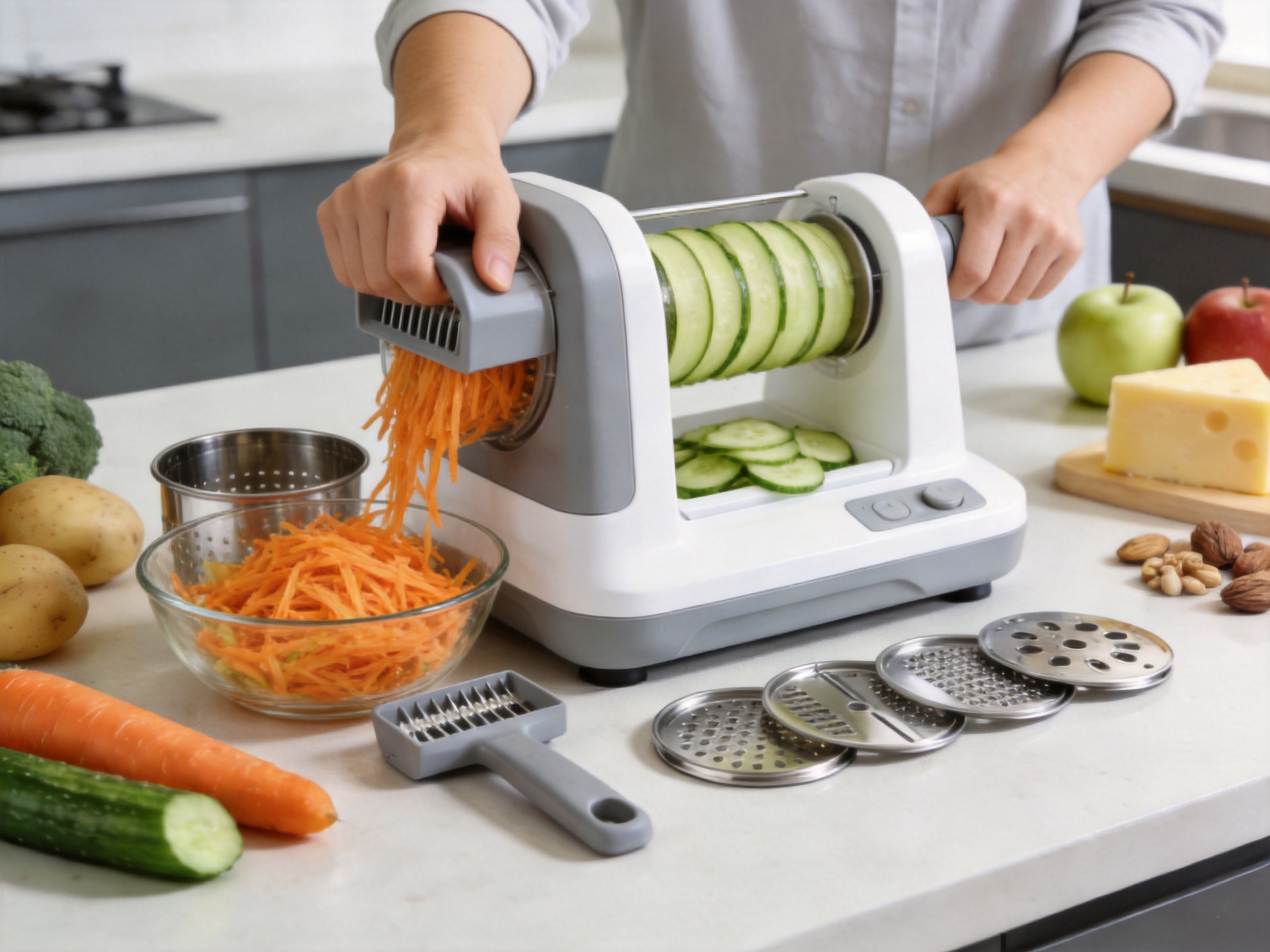
Key Specifications
| Item Number | GSE002 |
| Product Name | Electric Drum Grater / Multifunctional Electric Drum Slicer |
| Product Category | Food Processor |
| Rated Power | 120W |
| Main Materials | ABS, SS430, PP, PCTG |
| Packaging Quantity | 6 pieces per carton |
| Carton Measurement | 54.6 x 23.6 x 51.2 cm |
| Net Weight | 10.8 kg per carton |
| Gross Weight | 12.0 kg per carton |
| 20-Foot Container Loading | 2320 pieces |
| 40-Foot Container Loading | 4800 pieces |
| 40HQ Container Loading | 5616 pieces |
| MOQ | 2000 pieces |
| Certifications | CE, GS, CB, ETL, RoHS, LFGB, FDA |
Main Advantages for Users
Fast Preparation with Less Manual Effort
The greatest advantage of a multifunctional electric drum slicer is the reduction of manual work. When using a traditional hand grater, the user must press ingredients against a sharp surface repeatedly. This can be tiring, especially when preparing large quantities of carrots, cheese, potatoes, cabbage, or cucumbers. The electric drum slicer allows the motor to do the repetitive cutting work, while the user simply feeds ingredients through the chute with the pusher.
For families, this saves time during busy meal periods. For elderly users or people with reduced hand strength, it makes food preparation more accessible. For commercial users, it supports repeatable output during daily service. The appliance helps turn food preparation from a physically demanding task into a more controlled, convenient process.
Consistent Cutting Results
Consistency is essential in food presentation and cooking performance. Ingredients cut to similar size cook more evenly, mix more attractively, and improve the appearance of finished dishes. Manual cutting depends heavily on the user’s skill and energy, which can vary from batch to batch. The drum slicer improves consistency by using a rotating cutting surface designed for a defined slicing or shredding style.
Whether the user prepares salad toppings, vegetable shreds, pizza cheese, soup ingredients, or dessert garnishes, the appliance can help create a more uniform texture. This is particularly useful for families that value presentation and for hospitality users who need standardized results.
Compact Countertop Convenience
Large food processors are powerful but may be inconvenient for quick everyday tasks. They often include bowls, lids, locking systems, internal blades, and multiple parts that must be washed after use. The drum slicer is designed for direct processing: ingredients go in through the feed chute and come out through the outlet. This reduces the feeling of complexity and makes the product more likely to be used frequently.
Because the appliance occupies less space than many full-size processors, it can remain accessible on a countertop or be stored easily in a cabinet. Its practical size supports regular use, which is one of the most important measures of success for any kitchen appliance.
Versatility Across Ingredients
A multifunctional electric drum slicer can be used for many types of food, including vegetables, fruits, nuts, and cheese. This makes it more valuable than a single-purpose slicer. Users can prepare shredded carrots for salads, grated cheese for pasta, sliced potatoes for baked dishes, cucumber ribbons for cold plates, chopped nuts for desserts, and many other combinations.
Versatility increases the product’s appeal in retail markets. Consumers are more willing to purchase an appliance when they can imagine using it several times per week rather than only for one special recipe. For distributors, this broad usability creates stronger selling points and more flexible marketing content.
Improved Safety Compared with Open Manual Blades
All cutting appliances require careful use, but an electric drum slicer can reduce direct contact with sharp cutting surfaces when compared with open manual graters. The feed chute and pusher help guide ingredients into the drum while keeping fingers away from the blade during normal operation. This design improves user confidence and is especially valuable for people who dislike using exposed hand graters.
Safety also depends on correct assembly, stable placement, proper cleaning, and following the instruction manual. When used responsibly, the product offers a practical safety advantage over open manual cutting tools.
Advantages Over Competing Products
Compared with Manual Graters
Manual graters are simple, low-cost, and familiar, but they require continuous hand movement and pressure. They can cause fatigue, inconsistent results, and accidental cuts. The electric drum slicer offers a clear improvement by motorizing the grating process. It processes ingredients faster, reduces physical effort, and offers a more comfortable experience for users preparing repeated batches.
Another advantage is cleanliness. Manual graters often scatter small food particles around the cutting area. A drum slicer with a guided outlet can help direct processed food into a bowl or plate. This supports a tidier working process and reduces cleanup time.
Compared with Full-Size Food Processors
Full-size food processors can perform many tasks, but they may be excessive for quick slicing and grating. They often require users to assemble a bowl and lid, process food inside a container, and then remove the finished ingredients. The drum slicer provides more direct output, making it ideal for tasks where users want processed food to fall directly into a serving bowl, mixing bowl, pan, or plate.
The electric drum slicer also offers a simpler visual workflow. Users can see the ingredient entering and exiting, making operation intuitive. This advantage matters in retail demonstrations, where a product must communicate its value quickly.
Compared with Low-Power or Poorly Built Slicers
Not all electric slicers are equal. Products with weak housings, poorly fitted drums, dull blades, unstable motor performance, or low-quality plastics can disappoint users. The GSE002 model benefits from a practical material structure, food-contact certifications, and manufacturing experience in the small electric kitchen appliance field. The use of ABS, SS430 stainless steel, PP, and PCTG reflects a balance of strength, hygiene, and usability.
The 120W power rating is suitable for the appliance’s intended function, and the product’s certification coverage, including CE, GS, CB, ETL, RoHS, LFGB, and FDA, supports entry into multiple regulated markets. For buyers, these certifications are not merely labels; they help reduce sourcing risk and simplify market compliance planning.
Compared with Single-Function Slicers
Many kitchen tools perform only one cutting style. A simple mandoline slicer, for example, may slice vegetables efficiently but cannot grate cheese or shred nuts in the same way. The multifunctional drum slicer provides broader food preparation functions through its drum cutting system. This makes it more useful in real kitchens, where recipes change daily.
For wholesalers, a multifunctional product is easier to position as a high-value appliance. It can be promoted for salads, cheese, vegetables, side dishes, desserts, and meal preparation, giving sales teams more ways to address consumer needs.
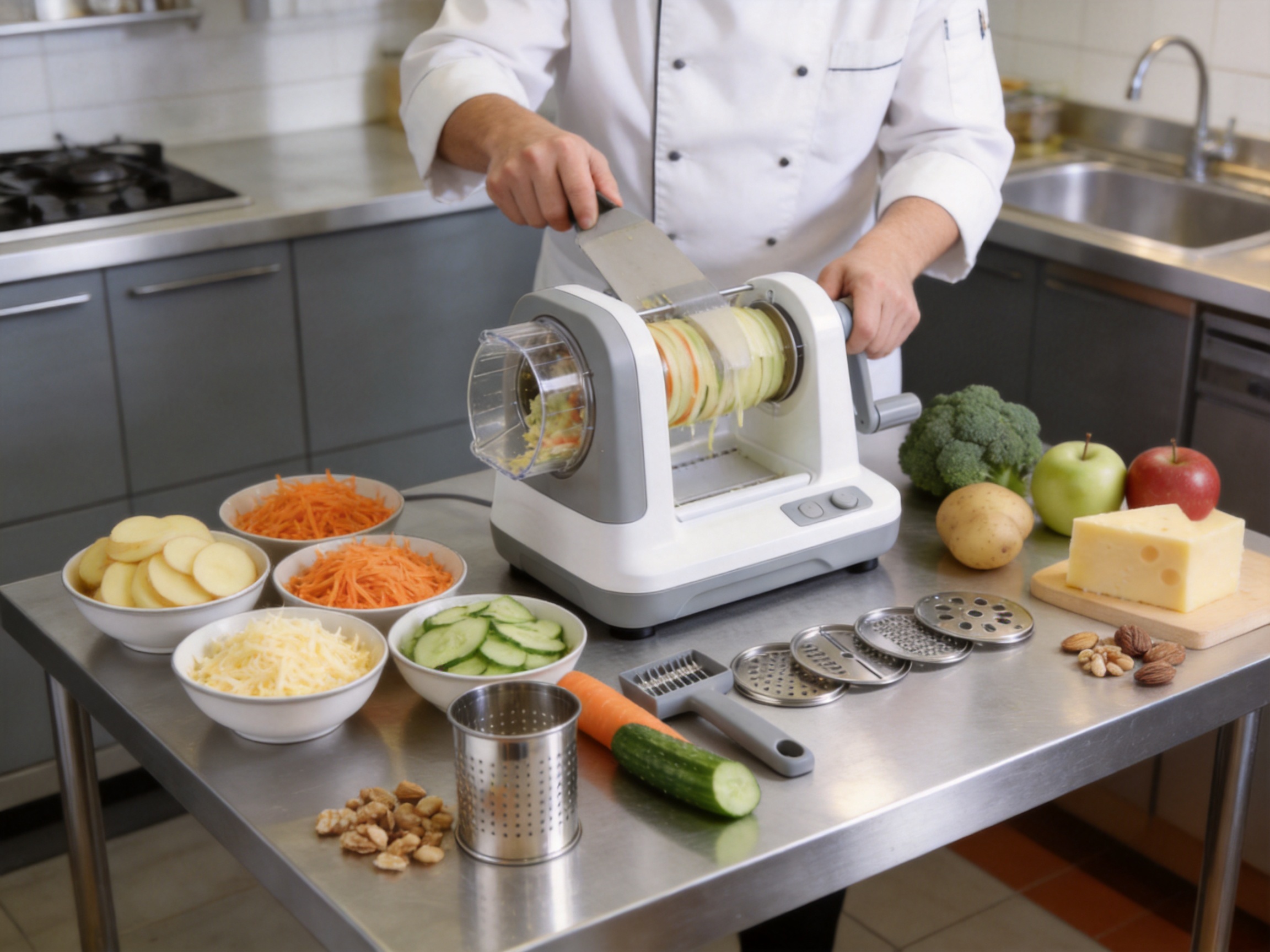
Manufacturing Strength Behind the Product
A product’s final performance depends heavily on the manufacturer’s process discipline. CIXI GSTAR ELECTRIC APPLIANCE CO., LTD. has developed and manufactured a wide range of small electric kitchen appliances, including blenders, slicers, choppers, food processors, smokeless grills, hot pots, air fryers, and air ovens. The company also manufactures hospitality-related products such as ice buckets, beverage dispensers, pitchers, slicers, and graters. This broad experience supports the design and production of appliances that must combine food safety, mechanical performance, attractive appearance, and stable mass production.
The company’s history includes product development for retail and TV-shopping markets, where items must be innovative, easy to demonstrate, and reliable enough for large-volume sales. This background is especially relevant to the electric drum slicer because the product must perform well in front of customers and remain simple enough for everyday home use.
Manufacturing capability is not only measured by factory size. It also includes engineering experience, quality control, production organization, supply chain coordination, and the ability to support international customer requirements. With an established production base, experienced workers, engineers in research and development, and dedicated quality control personnel, the company is structured to support both standard product supply and customized customer projects.
Research and Development Capability
Kitchen appliance development requires the integration of user behavior, material selection, motor performance, blade geometry, safety requirements, and product appearance. The company’s R&D team supports the design and improvement of products according to market feedback and customer requirements. For a drum slicer, R&D work may involve optimizing the feed chute angle, improving food flow, selecting suitable drum cutting forms, reducing vibration, enhancing stability, and improving part assembly.
A strong R&D process helps distinguish the product from basic copycat alternatives. Instead of relying only on an existing shape, engineering teams can refine how the appliance feels, sounds, processes food, and withstands repeated use. The result is a product that is more competitive in demanding retail and wholesale markets.
Material and Component Selection
The material structure of the electric drum slicer supports both practical use and compliance expectations. ABS provides a strong and moldable external structure. SS430 stainless steel supports cutting performance and corrosion resistance. PP is suitable for food-contact parts that require chemical stability and durability. PCTG provides toughness and transparency for selected components. Careful material selection helps the product meet expectations for hygiene, strength, and appearance.
Competitive products sometimes reduce cost by using fragile plastics, weak cutting surfaces, or poorly finished components. Such decisions can cause cracking, staining, deformation, unpleasant odor, or poor long-term performance. A manufacturer with export experience and certification awareness must control material sourcing and confirm that parts meet customer and regulatory standards.
Injection Molding and Plastic Part Quality
Plastic parts are central to the appliance’s performance. The housing, chute, pusher, outlet area, and accessory supports must fit accurately and resist repeated handling. Advanced injection molding management helps maintain consistent dimensions, smooth surfaces, and reliable assembly. Good tooling reduces flash, gaps, deformation, and visual defects.
For the electric drum slicer, part precision affects more than appearance. If the drum chamber is not aligned correctly, the blade may rotate unevenly or food may jam. If the feed chute is poorly shaped, ingredients may not reach the cutting surface efficiently. If the pusher does not fit properly, users may feel the appliance is unstable or inconvenient. Therefore, molding accuracy is directly connected to user satisfaction.
Metal Cutting Part Control
The drum blade is the heart of the appliance. Its sharpness, hole pattern, surface finish, and structural stability affect slicing and shredding performance. Proper metal processing helps ensure that the blade cuts cleanly rather than tearing or crushing ingredients. Stainless steel selection and finishing also affect corrosion resistance and hygiene.
Quality inspection of metal parts is important because small defects may affect performance or safety. Burr control, edge consistency, drum roundness, and secure assembly all contribute to reliable operation. A well-manufactured drum blade can make the appliance feel more powerful because sharp, properly formed cutting surfaces reduce resistance against the motor.
Motor and Electrical Assembly
The 120W motor must be selected and assembled to match the product’s intended load. A good motor system should start smoothly, run with acceptable noise levels, and maintain stable performance during normal use. Electrical assembly must consider wiring safety, insulation, switch reliability, and compliance with target market standards.
For international customers, certifications such as CE, GS, CB, ETL, and RoHS are important indicators that the product has been designed with electrical safety and regulatory compliance in mind. These certifications support market access and give distributors greater confidence when planning wholesale orders.
Quality Control Process
Quality control is essential for mass-produced appliances. A well-managed QC system can include incoming material inspection, in-process inspection, assembly checks, functional testing, appearance inspection, packaging inspection, and random finished-product sampling. For an electric drum slicer, functional tests may confirm motor operation, switch response, drum rotation, part locking, noise level, and general cutting performance.
Quality control also supports consistency across large orders. When a buyer orders thousands of units, the first carton and the last carton should meet the same expectations. This requires discipline in production records, operator training, inspection standards, and corrective action processes. A manufacturer with dedicated QC personnel can better support these requirements.
Compliance and Certification Value
The product is listed with CE, GS, CB, ETL, RoHS, LFGB, and FDA certifications. These certifications and compliance references are important in global appliance distribution because they address safety, material, and regulatory expectations across different markets. While specific requirements depend on the destination country and customer channel, a broad certification foundation helps reduce barriers for importers and retailers.
CE is important for products sold in the European Economic Area. GS is a respected German safety mark. CB supports international recognition of electrical product testing. ETL is relevant for North American market confidence. RoHS addresses restrictions on hazardous substances. LFGB and FDA relevance supports food-contact material expectations for Europe and the United States. Together, these certifications strengthen the product’s credibility and competitiveness.
For buyers, certification readiness can save time and cost. Retailers often require documents before approving a product. Importers may need test reports for customs or internal compliance. E-commerce platforms may ask for proof of safety or food-contact suitability. A supplier that can provide certification support gives customers a smoother purchasing experience.
Applications in Everyday Cooking
The multifunctional electric drum slicer is useful in many food preparation scenarios. For breakfast, it can grate cheese for omelets or shred vegetables for a quick wrap. For lunch, it can prepare carrots, cucumbers, and cabbage for salads or sandwiches. For dinner, it can slice potatoes for baked dishes, shred vegetables for stir-fries, and grate cheese for pasta. For desserts, it can help process nuts or chocolate-style toppings if suitable for the chosen drum and ingredient condition.
In home cooking, the appliance encourages users to include more fresh ingredients because preparation becomes easier. Many people avoid vegetables not because they dislike them, but because washing, peeling, slicing, and shredding take time. By simplifying one of the most repetitive steps, the drum slicer supports healthier meal habits.
In small commercial kitchens, the appliance can support prep work where a large industrial machine is unnecessary. Cafes, salad bars, small restaurants, hotel breakfast counters, and catering teams may use it for moderate-volume preparation. It is especially useful where operators need flexible output rather than one very high-volume cutting function.
Design Features That Support User Experience
Simple Feeding System
The feed chute is designed to guide ingredients toward the rotating drum. A good feeding system must balance safety, ingredient size, and smooth processing. If the chute is too small, users must cut ingredients into very small pieces before processing. If it is too large, safety and control may be reduced. The electric drum slicer uses a practical chute concept that supports everyday kitchen ingredients while encouraging users to prepare food in manageable pieces.
Direct Output
One major convenience of a drum slicer is direct output. Processed food can fall directly into a bowl, plate, or cooking container. This reduces transfer steps and makes the workflow more efficient. Users can grate cheese directly over pasta, shred carrots into a salad bowl, or slice vegetables into a prep container.
Interchangeable Function Potential
Many multifunctional drum slicers support different drums for different textures. Depending on the package configuration requested by buyers, drums may be designed for fine shredding, coarse shredding, slicing, or grating. This flexibility allows the appliance to address multiple recipe needs. For private-label projects, accessory configuration can also be adjusted to match target price points and market preferences.
Convenient Cleaning
Cleaning is a critical factor in whether consumers continue using a kitchen appliance. If a product is difficult to disassemble or wash, it may be used only once and then stored away. A drum slicer’s relatively straightforward structure helps make cleaning more manageable. Food-contact parts can typically be removed for washing according to the manual, while the motor base should be wiped and kept away from water immersion.
Packaging and Logistics Advantages
For wholesalers and importers, packaging efficiency matters. The product is packed 6 pieces per carton, with carton measurement of 54.6 x 23.6 x 51.2 cm. The carton net weight is 10.8 kg and gross weight is 12.0 kg. Container loading quantities are 2320 pieces for a 20-foot container, 4800 pieces for a 40-foot container, and 5616 pieces for a 40HQ container.
These figures help buyers calculate freight cost, warehouse space, retail allocation, and promotional volume. A clear packaging specification supports professional sourcing decisions and reduces uncertainty during order planning. The MOQ of 2000 pieces is suitable for wholesale and private-label customers who need meaningful production volume while maintaining commercial flexibility.
Packaging design can also influence consumer experience. A product intended for retail shelves or e-commerce should be protected against transportation stress, visually clear, and easy to understand. For TV-shopping or online sales, packaging may need to emphasize key functions, accessories, and safety information. A manufacturer experienced in export appliances can support such packaging needs according to customer requirements.
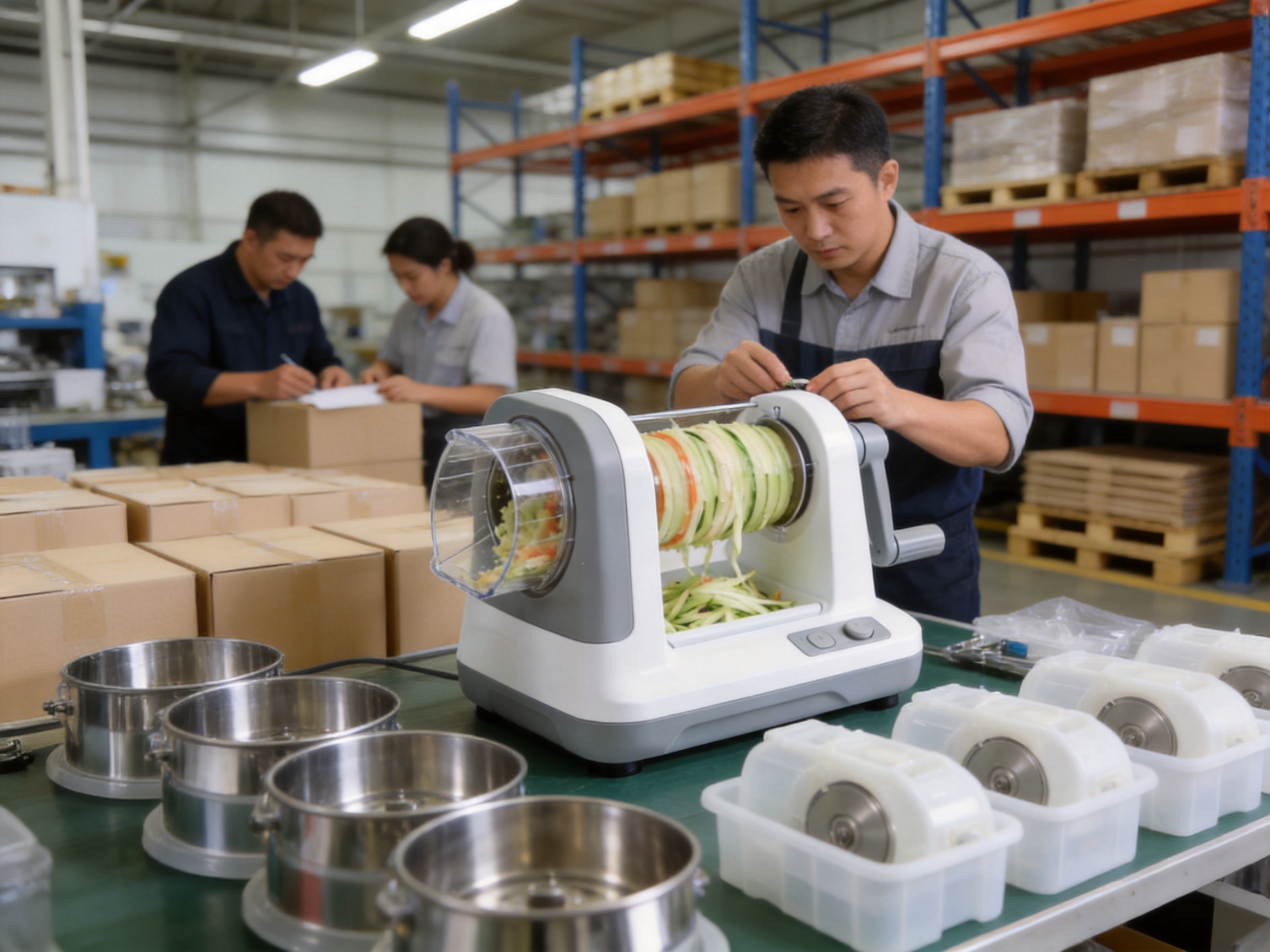
OEM and ODM Potential
The electric drum slicer is suitable for OEM and ODM cooperation because it can be adapted for different market channels. Buyers may request private-label branding, different color schemes, customized packaging, manual languages, plug types, accessory combinations, or certification documents. With manufacturing experience in small electric appliances, the supplier can support customization while maintaining production efficiency.
For retailers, differentiation is important. Two products may look similar at first glance, but color, packaging, accessory selection, user manual quality, and demonstration content can determine market success. OEM/ODM flexibility allows buyers to build a product that fits their customer group, whether that group values affordability, premium appearance, compact storage, healthy eating, or fast meal preparation.
ODM capability is especially valuable for buyers who want more than a standard product. Engineering cooperation can improve details such as chute design, surface finish, attachment arrangement, stability, switch design, or user guidance. This creates a stronger product identity and helps buyers compete against generic alternatives.
Why Manufacturing Experience Matters
Small kitchen appliances are deceptively complex. A consumer may see only a compact device, but behind it are decisions about motor performance, materials, blade geometry, electrical safety, user ergonomics, thermal behavior, noise, packaging, and compliance. A manufacturer with broad appliance experience understands how these details interact.
CIXI GSTAR ELECTRIC APPLIANCE CO., LTD. has a development history connected with innovative home products and international retail channels. The company has supplied products to well-known supermarket and retail markets, and its experience with high-volume items supports an understanding of cost control, quality stability, and customer expectations. Its transition into electric products builds on earlier success with kitchen preparation tools such as spiralizers and drum graters.
The company’s production area, experienced workforce, R&D engineers, and QC team create a foundation for reliable output. This is important for importers because a good sample is not enough; the manufacturer must also reproduce the same quality in mass production. Strong manufacturing systems help ensure that the delivered order matches the approved sample.
Product Value for Different Buyer Groups
For Household Consumers
Household users benefit from faster preparation, reduced hand fatigue, consistent results, and easier use. The appliance supports fresh cooking and makes vegetables, cheese, nuts, and fruits more convenient to prepare. It is suitable for families that cook regularly and want to reduce repetitive kitchen labor.
For Retailers
Retailers benefit from a product with clear demonstration value and broad consumer appeal. The appliance can be promoted as a time-saving kitchen helper, a healthy-eating tool, a meal-prep accessory, or a giftable household appliance. Its compact format and multifunctional use make it suitable for seasonal promotions, kitchenware sections, and e-commerce campaigns.
For Importers and Distributors
Importers need products that combine competitive pricing, certification readiness, stable quality, and reliable packaging data. The electric drum slicer offers defined specifications, established production capacity, and international compliance support. Container loading data and MOQ information help distributors plan purchasing and logistics efficiently.
For Hospitality and Light Commercial Users
Hotels, cafes, small restaurants, and catering teams can use the appliance for moderate-volume preparation. It is not a heavy industrial cutter, but it is useful for flexible everyday tasks where convenience and speed are required. It can help standardize ingredient preparation and reduce manual work in compact food-service environments.
Responsible Use and Maintenance
To achieve the best performance, users should cut ingredients into sizes that fit the feed chute, avoid overloading the motor, and choose the correct drum for the desired result. Hard ingredients should be processed according to the manual’s recommendations. The pusher should always be used instead of fingers or utensils. The appliance should be placed on a stable surface before operation.
After use, the appliance should be switched off and unplugged before disassembly. Food-contact parts should be cleaned promptly to prevent residue from drying on the cutting surfaces. The motor base should not be immersed in water. Blades should be handled carefully during cleaning because they are sharp. Proper maintenance supports hygiene, cutting performance, and product life.
For commercial or frequent use, operators should inspect parts regularly for wear, cracks, dullness, or loose fitting. Replacement parts and accessory availability may be arranged according to distributor and supplier agreements. Clear user instructions and after-sales support help improve customer satisfaction and reduce misuse.
Competitive Selling Points
The multifunctional electric drum slicer offers several strong selling points. It is powered by a 120W motor, suitable for everyday kitchen slicing and shredding. It uses practical materials including ABS, SS430 stainless steel, PP, and PCTG. It supports multiple food preparation tasks. It provides faster and easier operation than manual graters. It is more convenient for small tasks than many full-size food processors. It offers certification support for major markets. It is supported by a manufacturer with broad experience in small electric kitchen appliances.
These advantages make the product suitable for wholesale programs, private-label development, retail promotion, and household use. In competitive markets, buyers need products that are not only affordable but also credible. The combination of function, certification, production experience, and clear logistics data strengthens the appliance’s market potential.
Q&A Section
What is a multifunctional electric drum slicer used for?
It is used to slice, shred, and grate foods such as vegetables, fruits, nuts, and cheese. It helps prepare ingredients for salads, pasta, pizza, soups, casseroles, desserts, sandwiches, and many everyday recipes.
How is it different from a manual grater?
A manual grater requires repeated hand movement and pressure, while an electric drum slicer uses a motor-driven drum blade to process food faster and with less effort. It also helps improve consistency and reduces direct contact with open blades during normal use.
Is it the same as a full-size food processor?
No. A full-size food processor is usually larger and may include a processing bowl and multiple internal blades. The drum slicer is more focused on direct slicing, shredding, and grating. It is convenient for quick tasks and direct output into a bowl or plate.
What materials are used in the product?
The product uses ABS, SS430 stainless steel, PP, and PCTG. These materials are selected for strength, food-contact suitability, durability, appearance, and practical kitchen performance.
What is the rated power?
The rated power is 120W, which is suitable for routine household slicing and shredding tasks when the appliance is used according to instructions.
What certifications are available?
The product is listed with CE, GS, CB, ETL, RoHS, LFGB, and FDA certifications or compliance support. These help distributors and retailers address electrical safety, material safety, and food-contact requirements in different markets.
Who can benefit from this product?
Household users, elderly users, meal-prep enthusiasts, retailers, importers, distributors, cafes, hotels, and small food-service operators can benefit from the appliance’s speed, convenience, and versatility.
Can the product be customized for private-label orders?
Yes. OEM and ODM cooperation may include logo branding, packaging design, color adjustments, accessory configuration, plug types, manual languages, and market-specific documentation, depending on project requirements and order quantity.
What is the minimum order quantity?
The MOQ is 2000 pieces, making it suitable for wholesale, distribution, and private-label purchasing programs.
How should users clean the appliance?
Users should unplug the appliance before cleaning, remove washable food-contact parts according to the manual, clean blades carefully, and wipe the motor base without immersing it in water. Prompt cleaning helps maintain hygiene and performance.
Conclusion
The multifunctional electric drum slicer is a valuable kitchen appliance for modern food preparation. It combines speed, convenience, consistency, and versatility in a compact electric format. Compared with manual graters, it reduces effort and improves efficiency. Compared with full-size food processors, it offers simpler direct-output operation for everyday slicing and shredding tasks. Compared with low-quality competitors, it benefits from practical material selection, certification support, and manufacturing experience.
For consumers, the appliance makes fresh cooking easier. For retailers, it provides strong demonstration value and broad market appeal. For distributors and importers, it offers clear specifications, packaging data, compliance advantages, and OEM/ODM potential. Backed by CIXI GSTAR ELECTRIC APPLIANCE CO., LTD.’s experience in small electric kitchen appliances, the GSE002 electric drum grater is positioned as a competitive product for global kitchen appliance markets.
As demand grows for convenient, healthy, and time-saving kitchen tools, multifunctional appliances like the electric drum slicer will continue to play an important role. A well-designed drum slicer does more than cut vegetables or grate cheese; it helps users cook more often, prepare food with confidence, and enjoy a smoother kitchen workflow.
References
1. International Electrotechnical Commission. Household and Similar Electrical Appliances Safety Standards.
2. European Committee for Electrotechnical Standardization. General Requirements for Small Household Electrical Appliances.
3. U.S. Food and Drug Administration. Food-Contact Material Safety Guidance.
4. German LFGB Food and Feed Code. Food-Contact Compliance Principles.
5. RoHS Directive Reference Materials. Restriction of Hazardous Substances in Electrical and Electronic Equipment.
6. Kitchen Appliance Engineering Handbook. Design Principles for Motorized Food Preparation Equipment.
7. Retail Product Development Guide. Best Practices for Demonstrable Home and Kitchen Appliances.