
 English
 中文简体
中文简体 Español
 English
 中文简体
中文简体 Español
Fresh juice has become an important part of modern home, hospitality, and wellness routines. Consumers increasingly want beverages that are convenient, natural, and easy to prepare, while retailers and distributors are searching for compact appliances that offer strong everyday value without taking up excessive storage space. The GSE018 rechargeable citrus juicer is designed for this market. It combines a portable format, automatic juice and peel separation, direct drinking convenience, and a 250 milliliter capacity in a compact appliance suitable for homes, offices, travel, cafés, restaurants, and hotel service areas.
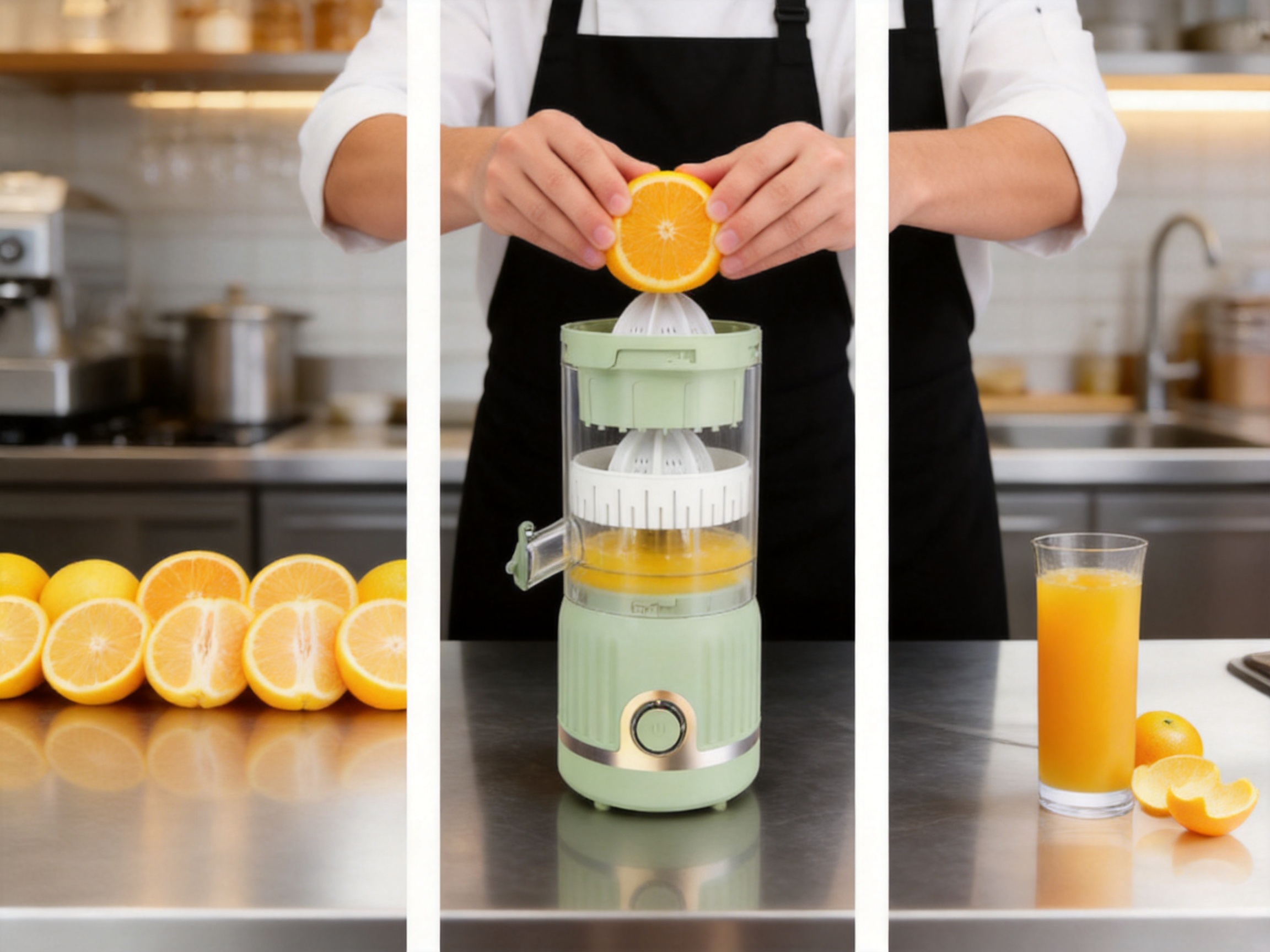
Unlike a traditional manual citrus squeezer, the GSE018 is designed to reduce the amount of hand labor required during juice extraction. The user cuts the fruit in half, places it into the appliance, and allows the juicing mechanism to complete the extraction process. The juice and peel are automatically separated, helping users enjoy fresh citrus juice without repeatedly pressing, twisting, or manually removing pulp and peel residue.
The product is positioned within a broader small electric kitchen appliance portfolio that includes blenders, slicers, choppers, food processors, air fryers, air ovens, hot pots, smokeless grills, and related food-service products. This product range gives the manufacturer experience across several categories of compact food preparation equipment. For buyers, that experience can support product development, private-label cooperation, wholesale purchasing, and coordinated sourcing across multiple appliance categories.
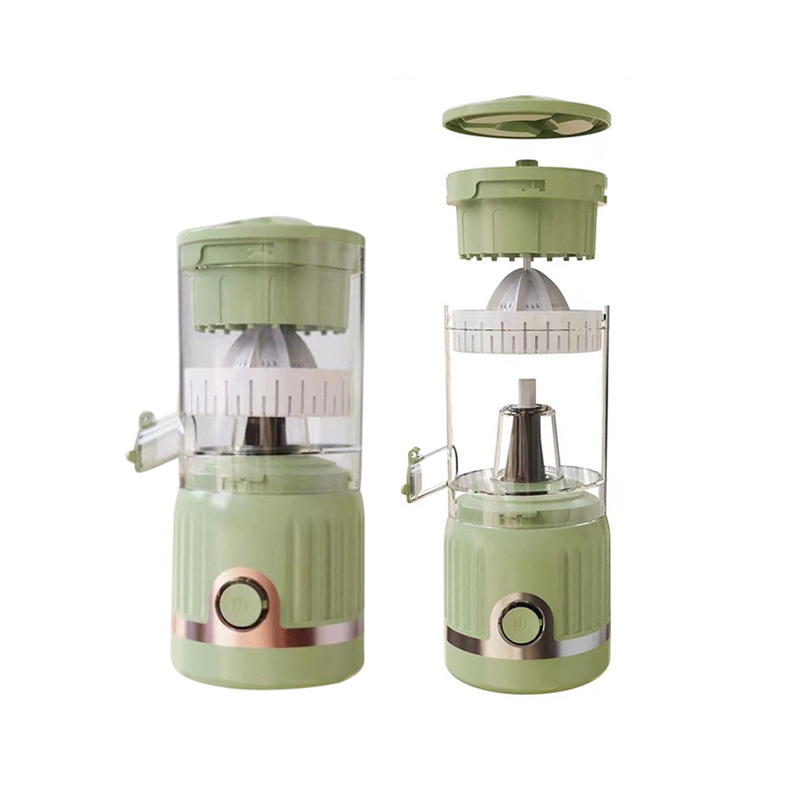
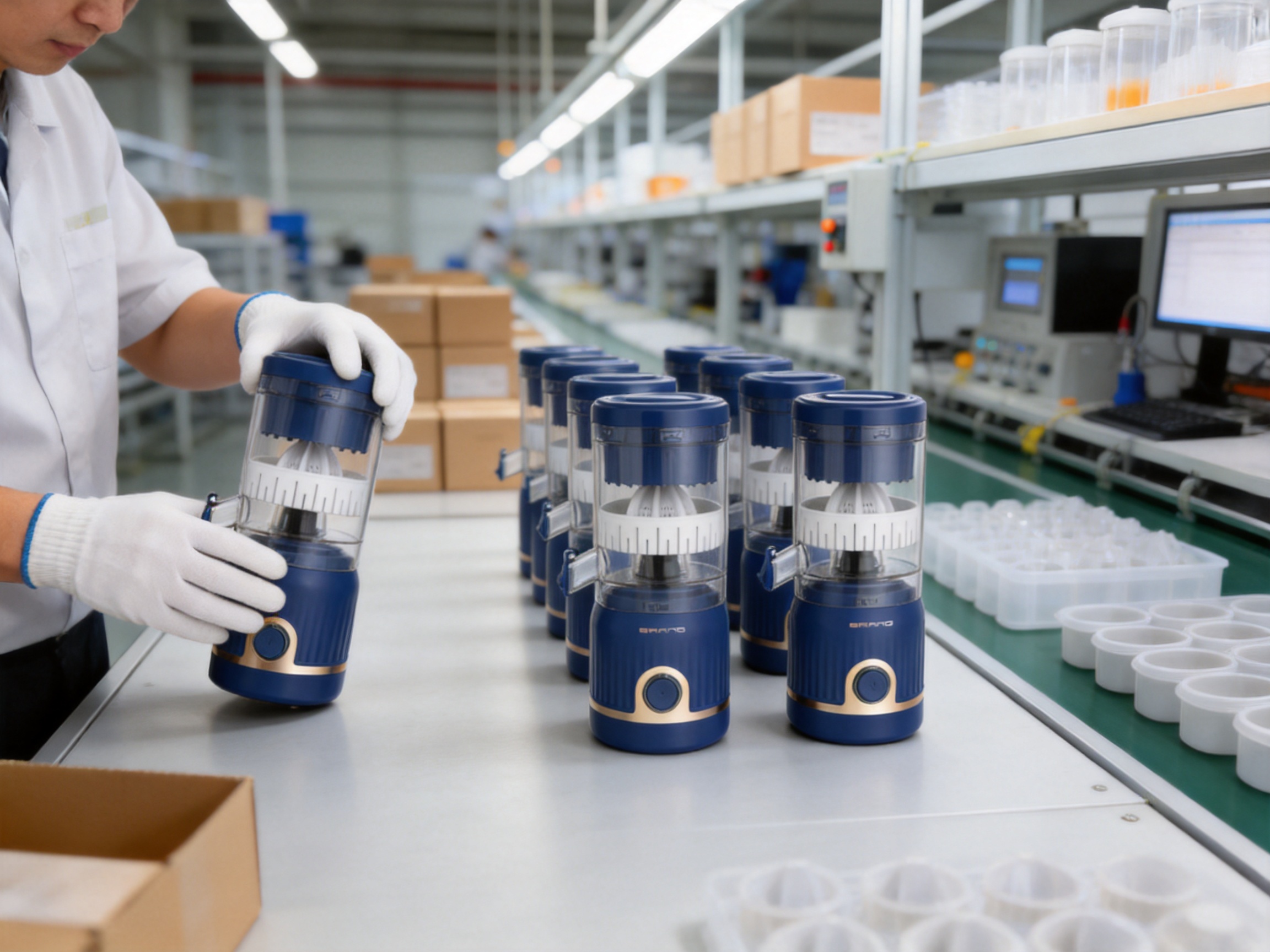
GSE018 Rechargeable fruit juice portable blenders 7 in 1 citrus juicer
What Makes the GSE018 Citrus Juicer Different?
The central function of the GSE018 is simple: it is designed to cut and extract juice from citrus fruit halves while separating the peel automatically. This straightforward operating concept gives the appliance a practical advantage over many manual juicers and basic hand-held citrus tools. Users do not need to hold the fruit against a fixed reamer throughout the complete extraction process, and they do not need to remove the peel from the juice by hand after squeezing.
The appliance is also designed for direct consumption. The product information states that no additional filtering is required and that users can drink the juice directly in one sip. This feature is particularly useful for consumers who want to prepare a small quantity of juice quickly without transferring it to a separate glass or using an additional strainer.
With a 250 milliliter capacity, the product is intended for personal servings and small-batch preparation rather than large-volume commercial juicing. This size can be suitable for a morning serving, a fresh beverage during office hours, a child-sized portion, or a small hospitality service. Its compact capacity also helps keep the appliance portable and easy to place in a kitchen cabinet, pantry, hotel room service area, or café preparation station.
The rechargeable design further supports mobility. A rechargeable appliance can be used in locations where access to a fixed power outlet is limited or inconvenient, provided that the battery has been charged in advance. This makes the product suitable for kitchens, offices, dormitories, travel situations, outdoor use, and temporary food-service environments. Buyers should confirm the specific battery capacity, charging interface, charging time, and operating cycles with the manufacturer before finalizing a purchase order, because these technical details are not included in the supplied product information.
Key Product Specifications
The GSE018 is identified by Item No. GSE018 and Product Name CITRUS JUICER. Its rated power is 45 watts, and its stated capacity is 250 milliliters. The product materials are listed as PP, PA, ABS, AS, POM, copper, and PC. These materials are used across different product components and may support a balance of structural strength, light weight, electrical insulation, wear resistance, and visual appeal when properly engineered and assembled.
| Specification | Product Information |
|---|---|
| Item number | GSE018 |
| Product name | Citrus Juicer |
| Rated power | 45 watts |
| Capacity | 250 milliliters |
| Material listing | PP, PA, ABS, AS, POM, copper, and PC |
| Carton quantity | 12 pieces per carton |
| Carton size | 57.3 x 32.9 x 42.3 centimeters |
| Net weight | 14.4 kilograms |
| Gross weight | 16.8 kilograms |
| Container loading reference | 4,200 pieces for a 20-foot container |
| High-cube container loading reference | 10,080 pieces for a 40-foot high-cube container |
| Minimum order quantity | 4,200 pieces |
| Listed certifications | CE, GS, CB, ETL, RoHS, LFGB, and FDA |
The carton information indicates that the product is prepared for organized wholesale distribution. Twelve pieces are packed per carton, while the stated carton dimensions and weights can assist importers, warehouse planners, freight forwarders, and retail buyers when estimating storage and transport requirements. The listed container quantities provide a reference for large-volume purchasing, although actual loading results may vary depending on packaging configuration, palletization, shipping method, and container arrangement.
Fresh Juice Without Complicated Preparation
One of the product’s primary selling points is the reduction of preparation steps. Traditional citrus juicing can involve several separate actions: cutting the fruit, pressing or twisting it against a reamer, holding the fruit in place, removing seeds or peel, filtering the juice, and transferring the beverage into a separate container. Each action is manageable individually, but the combined process can be inconvenient for users who want a quick serving.
The GSE018 addresses this sequence by combining extraction and separation in one appliance. The user cuts the fruit in half, places it into the juicing area, and starts the appliance. According to the supplied product information, the peel is automatically separated, and the juice does not require additional filtering before drinking. Fewer manual steps can make the appliance more attractive to busy households, office workers, older users, and consumers who value simple controls.
The direct-drinking concept also reduces the number of accessories required. A manual juicer often requires a separate cup, strainer, spoon, or cleaning container. By integrating the collection capacity into the appliance, the GSE018 can help simplify the morning routine and reduce countertop clutter. The 250 milliliter size is suitable for a single serving or a small amount shared among several people.
For commercial buyers, this simplicity can improve the usability of the product in settings where staff need to prepare fresh beverages quickly. Hotels may use compact citrus juicers in breakfast areas or guest service operations. Cafés and small restaurants may use them for individual servings or specialty beverage preparation. Offices may provide them as part of a wellness-oriented kitchen area. The product is not intended to replace high-volume commercial juicing equipment, but its small format can complement larger food-service machinery when portability and serving flexibility are more important than maximum throughput.
Automatic Peel Separation and Cleaner Operation
Automatic peel separation is a significant functional advantage. When citrus fruit is squeezed manually, peel fragments, excess pulp, and residue can enter the juice or remain around the reaming surface. The user then needs to remove the residue and clean the juicer manually. The GSE018 is designed to separate the peel during extraction, helping produce a cleaner process and reducing direct contact with waste material.
The product advantages specifically state that the peel is clean and free of residue. This feature can have practical value in both domestic and commercial settings. At home, it may make cleanup less unpleasant and reduce the time required to prepare another serving. In a hospitality environment, a cleaner peel separation process can help staff maintain a more orderly preparation area.
Reduced residue can also support a more consistent user experience. If juice and peel remain mixed together, the flavor and texture can vary from one serving to another. The stated design objective of the GSE018 is to retain dietary fiber while avoiding an unwanted residue taste. The result is intended to be a fresh citrus beverage with a natural character rather than a heavily filtered juice.
As with any food-contact appliance, correct cleaning and maintenance remain important. Users should follow the final instruction manual regarding removable components, washing methods, drying, and restrictions on immersing electrical parts. Buyers should also request food-contact material documentation and test reports applicable to their target markets before selling the product.
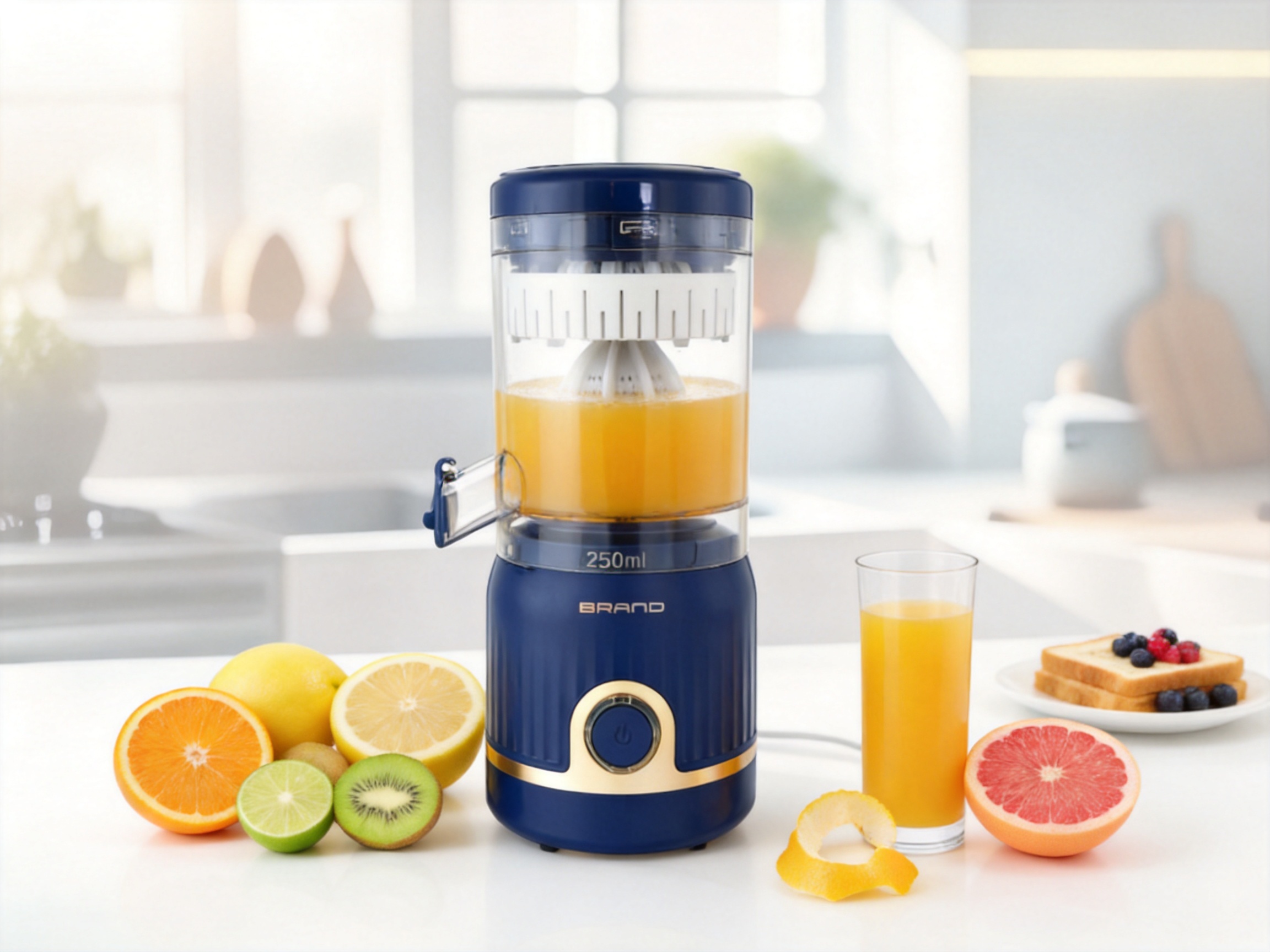
Retaining Dietary Fiber While Avoiding Unwanted Residue
Many consumers associate fresh juice with a natural taste and a less processed drinking experience. Excessive filtering may produce a very clear liquid, but it can also remove some of the pulp and fiber that users expect from freshly prepared citrus. The GSE018 is described as retaining dietary fiber while avoiding a residue taste. This positioning gives the appliance a useful point of differentiation from juicers that focus only on maximum clarification.
The product is therefore suitable for customers who want a balance between convenience and a natural beverage profile. The juice can be consumed directly, without requiring a separate filtering step. This can be especially appealing to health-conscious consumers, although the appliance should not be marketed with unverified medical or nutritional claims. The appropriate message is that the product is designed to preserve some natural fiber and provide fresh juice conveniently.
The flavor experience can depend on the type and condition of the fruit, including ripeness, variety, temperature, and natural acidity. The appliance itself is designed to make extraction easier and cleaner, but it cannot control the characteristics of the fruit being used. Retailers can explain this clearly in product descriptions to establish realistic customer expectations.
Portable Design for Modern Lifestyles
Portability is another important product advantage. Large juicers can deliver high output, but they often require a permanent countertop position, a power cord, and a nearby sink. A compact rechargeable citrus juicer can be moved from one location to another and stored after use. This flexibility is useful in smaller apartments, shared kitchens, offices, guest rooms, student accommodation, and temporary food-service environments.
The portable format also supports a wider range of sales channels. The product can be offered through kitchenware retailers, online marketplaces, household appliance distributors, wellness stores, gift programs, hotel supply companies, and promotional product channels. Its compact size and clear use case make it suitable for demonstration videos and lifestyle-oriented marketing campaigns.
For travel-oriented customers, the product may be appealing because it can support fresh juice preparation away from a conventional kitchen. However, the exact travel suitability depends on battery capacity, charging requirements, transportation regulations, and the availability of a suitable charging source. Importers should obtain complete battery and logistics documentation before promoting the appliance for air travel or international shipment.
Portability does not mean that performance must be sacrificed. The 45-watt power rating is designed for the stated citrus juicing function, while the compact capacity prevents users from expecting the product to process large commercial quantities. A clear product positioning strategy is important: the GSE018 is a convenient personal citrus juicer rather than a heavy-duty industrial extraction machine.
Comparison with Traditional Competitor Products
The competitive advantages of the GSE018 are most apparent when it is compared with common alternatives. Manual reamers are inexpensive and simple, but they require continuous hand pressure and usually leave the user responsible for separating seeds, pulp, and peel. Electric countertop citrus presses can reduce manual effort, but some models are corded, larger, and less convenient to move. High-capacity commercial juicers can process more fruit, but they are generally more expensive and require more space and maintenance.
| Product Type | Typical Strength | Common Limitation | GSE018 Positioning Advantage |
|---|---|---|---|
| Manual hand reamer | Low purchase cost and simple operation | Requires repeated hand pressure and manual cleanup | Rechargeable operation and automatic peel separation reduce manual work |
| Basic electric citrus press | Powered extraction | May require a fixed outlet and separate serving container | Portable format and integrated 250 milliliter serving capacity |
| Large countertop juicer | Higher output for family or commercial use | Requires more storage space and may be more difficult to clean | Compact design for personal servings and flexible placement |
| High-capacity commercial extractor | Designed for continuous volume production | Higher cost, larger footprint, and greater operating complexity | Useful as a complementary appliance for individual servings and smaller operations |
| Hand-held battery juicer | Portable and convenient | May offer limited collection capacity or less integrated waste separation | Combines rechargeable mobility with automatic peel separation and direct drinking convenience |
This comparison should be understood as a positioning framework rather than a claim that one appliance is universally better than every competitor. Each juicing technology serves a different use case. The GSE018 is strongest when the buyer values compactness, convenient operation, automatic separation, direct consumption, and small-serving preparation.
Materials and Engineering Considerations
The supplied material list includes PP, PA, ABS, AS, POM, copper, and PC. These materials are commonly selected for different functions in small appliances. Polypropylene may be used in components requiring light weight and resistance to household use. ABS can support durable external housings. Polycarbonate may be used where transparency or impact resistance is desired. Polyamide and acetal materials can be selected for mechanical components that require strength or dimensional stability, while copper is commonly associated with electrical conduction and motor-related components.
The final performance of an appliance depends not only on the material names but also on material grade, component geometry, molding accuracy, assembly quality, sealing design, and quality control. A professional buyer should request detailed component specifications, food-contact declarations, colorant information, and applicable testing documents. This is especially important when the product will be sold in markets with strict requirements for food-contact materials and electrical appliances.
For a rechargeable appliance, engineering quality must also cover the battery system, charging protection, electrical insulation, motor operation, connector reliability, and resistance to repeated use. The listed power rating of 45 watts gives buyers a basic reference, but it does not by itself define extraction speed, battery life, noise level, or service life. These performance indicators should be confirmed through samples, laboratory testing, and production validation.
The product’s compact construction creates opportunities for efficient packaging and storage. At the same time, compact products require careful internal arrangement because motor components, battery components, food-contact parts, and control elements must fit into a limited space. Proper design validation helps reduce risks related to heat, vibration, leakage, assembly variation, and accidental misuse.
Manufacturing Strengths and Product Development Experience
The manufacturer, CIXI GSTAR ELECTRIC APPLIANCE CO., LTD., has developed experience in small electric kitchen appliances and related food-service products. Its portfolio includes blenders, slicers, choppers, food processors, smokeless grills, hot pots, air fryers, air ovens, ice buckets, beverage dispensers, pitchers, slicers, and graters. This range indicates familiarity with multiple appliance structures, food-contact requirements, mechanical systems, heating or motor-driven functions, and the practical needs of household and commercial users.
The company’s development history also includes non-electric innovative products before expanding further into electric appliances. This background is relevant because successful kitchen appliance design requires more than motor selection. It requires understanding how consumers handle food, how components are cleaned, how products are stored, and how the product can be made easier to use. Experience with manual and electric products can support a more complete approach to usability and function integration.
The company reports a dedicated research and development department with engineers and a quality control team. It also reports a wholly owned manufacturing plant, a substantial production area, and more than 200 experienced workers in its latest company information. Earlier company information describes a facility occupying approximately 10,000 square meters with a building area of approximately 18,000 square meters and more than 150 workers, while later information states a production area of approximately 15,000 square meters and more than 200 workers. Because facility figures may change over time or refer to different areas, buyers should request the latest verified factory profile during supplier qualification.
A dedicated research and development capability can support several stages of product creation. These may include concept development, industrial design, mechanical engineering, electrical engineering, prototype evaluation, mold coordination, sample testing, production transfer, and design improvement. For a product such as the GSE018, cross-functional development is especially important because the juicing mechanism, peel separation path, food-contact components, rechargeable power system, and exterior housing must work together.
The company states that it works closely with customers as an engineering partner. This can be valuable for importers and brand owners who need changes to colors, packaging, labels, user instructions, electrical specifications, regional compliance documents, or private-label presentation. Any customization should be confirmed through a written technical agreement, approved samples, and documented production standards.
Quality Control from Design to Shipment
Reliable appliance manufacturing requires quality control at more than one point in the production process. A final visual inspection alone cannot identify every potential issue. A robust quality approach normally begins with approved raw materials and continues through component inspection, assembly checks, functional testing, safety verification, packaging inspection, and pre-shipment approval.
For the GSE018, key inspection points may include the dimensional accuracy of molded components, the fit of food-contact parts, the alignment of the extraction mechanism, the effectiveness of peel separation, the security of the rechargeable battery installation, charging performance, motor operation, switch response, leakage resistance, and package integrity. The exact inspection plan should be agreed upon by the manufacturer and buyer according to the final product specification.
Production validation is particularly important when a product moves from prototype to mass manufacturing. A sample may perform well while production variation affects later units. Tooling condition, molding temperature, component tolerances, assembly sequence, adhesive application, wire routing, and torque control can all influence final performance. Documented work instructions and trained operators help minimize these variations.
The manufacturer’s reported quality control personnel and engineering staff can support this process, but buyers should still conduct their own supplier qualification. Recommended measures include factory audits, sample evaluation, inspection of certification documents, review of test records, and third-party pre-shipment inspection. These measures are useful for protecting both the buyer and the end consumer.
Certification and Market-Readiness Considerations
The product information lists CE, GS, CB, ETL, RoHS, LFGB, and FDA certifications or compliance references. These designations cover different regulatory or market expectations, and their applicability depends on the destination country, product configuration, electrical system, materials, and current regulations. Buyers should not assume that a general certification statement automatically covers every variant or every market.
CE-related documentation may be relevant for products sold in the European Economic Area, while GS can support certain German product safety expectations. CB documentation can assist with international electrical safety recognition, and ETL is commonly associated with North American product safety evaluation. RoHS relates to the restriction of certain hazardous substances in electrical and electronic products. LFGB and FDA references are generally connected with food-contact or material requirements, but the precise scope must be confirmed through current test reports and declarations.
Before placing a large order, the buyer should request copies of valid certificates, test reports, declarations of conformity, food-contact reports, battery documentation, labeling requirements, and applicable user manual information. The documents should identify the correct model, electrical rating, factory or applicant details, and relevant test standards. If the buyer changes the plug, battery, housing material, food-contact components, or electrical design, additional testing may be required.
Compliance is not only a documentation issue. It should be incorporated into product design, component selection, manufacturing control, packaging, labeling, and after-sales support. A manufacturer with experience across different appliance categories can help coordinate these activities, but final responsibility for market placement should be established clearly between the manufacturer, importer, distributor, and brand owner.
Wholesale and Private-Label Opportunities
The stated minimum order quantity is 4,200 pieces, which corresponds to the listed reference quantity for one 20-foot container. This indicates that the product is primarily suited to wholesale, distribution, retail chain, promotional, and private-label programs rather than small test purchases. A buyer planning a launch should consider inventory requirements, regional demand, packaging volume, warehouse space, seasonal sales patterns, and replacement stock.
Because the product has a clear and easily demonstrated function, it may work well in retail environments where visual merchandising is important. Packaging can emphasize the rechargeable format, automatic peel separation, 250 milliliter capacity, direct-drinking convenience, and suitability for fresh citrus beverages. Product demonstrations can show the simple sequence of cutting fruit, loading the appliance, starting extraction, and enjoying the result.
Private-label buyers may request customized branding, colors, packaging artwork, instruction manuals, promotional inserts, carton marks, and product photography. These details should be finalized before production. The buyer should also define whether the product will be sold as a citrus juicer, portable juicer, rechargeable kitchen appliance, wellness accessory, or part of a broader beverage preparation collection.
For distributors serving hospitality customers, the product can be presented as a compact supplementary appliance. It may be useful in breakfast areas, staff kitchens, guest amenities, small café counters, and event beverage stations. Its most appropriate commercial role depends on local demand and the expected number of servings. The appliance’s 250 milliliter capacity makes it suitable for small portions but not a substitute for a high-capacity production line.
Packaging, Logistics, and Inventory Planning
The product is packed 12 pieces per carton. The listed carton size is 57.3 by 32.9 by 42.3 centimeters, with a net weight of 14.4 kilograms and gross weight of 16.8 kilograms. These figures provide an initial basis for freight calculations, pallet planning, warehouse layout, and container utilization.
Importers should confirm whether the carton measurements include all retail packaging, protective materials, and master-carton markings. They should also clarify pallet quantities, pallet dimensions, stacking limits, carton compression strength, and the recommended storage environment. Rechargeable products may require special handling during transportation, and battery-related shipping documents should be obtained before booking freight.
Inventory planning should account for both selling units and service requirements. A distributor may need replacement parts, spare charging accessories, warranty units, and customer support materials. The manufacturer should clarify available spare parts, repair procedures, expected lead times, warranty conditions, and the process for handling defective units.
For international distribution, packaging should protect the product against vibration, impact, moisture, and compression. The retail box should provide clear operating instructions and safety warnings in the languages required by the target market. Since the product is intended for food preparation, packaging should also protect food-contact components from dust and contamination before first use.
Practical Applications in the Home
In a home kitchen, the GSE018 can support everyday citrus preparation with minimal equipment. Users can prepare orange, lemon, lime, grapefruit, and other compatible citrus fruit according to the instructions supplied with the appliance. The product can be useful for breakfast, cooking ingredients, fresh beverage preparation, salad dressings, and occasional entertaining.
The product can also suit households with limited counter space. Since it is portable and rechargeable, it does not need to remain permanently connected to a wall outlet. After use, it can be stored in a cabinet or drawer, provided that all components are cleaned and dried according to the instruction manual.
Its small serving capacity can reduce unnecessary preparation. Instead of operating a large juicer for a single glass, users can prepare a personal portion. This can help make fresh juice a more convenient habit for people who live alone, work from home, or prefer freshly prepared beverages in small quantities.
Applications in Offices, Hotels, and Food Service
In office environments, the product can be included in shared kitchen facilities, wellness programs, employee refreshment areas, or corporate gift packages. The rechargeable design can be convenient where countertop outlets are already occupied by coffee makers, water boilers, or other appliances.
Hotels and guest-service providers may consider the appliance for breakfast service, small beverage stations, or selected room amenities. Before using it in guest-facing areas, operators should evaluate cleaning frequency, staff training, battery charging routines, replacement costs, and the suitability of the appliance for the expected number of daily servings.
Small cafés and restaurants may use the product for limited-volume citrus preparation, garnish-related tasks, tasting events, or specialty beverages. It can serve as a flexible secondary tool when the business needs a fresh individual portion but does not want to start a larger machine. For continuous high-volume service, however, the business should select equipment specifically engineered for that workload.
Bars, catering businesses, and event operators may also value portability. A rechargeable juicer can be moved between preparation areas when the venue layout changes. Its usefulness will depend on charging arrangements, cleaning access, fruit volume, and the operator’s food-safety procedures.
How Buyers Should Evaluate a Sample
A pre-production or production sample should be evaluated in conditions that reflect actual customer use. The buyer should test several types of citrus fruit, different ripeness levels, and repeated operating cycles. Important observations include extraction completeness, ease of loading, peel separation, juice consistency, residue levels, operating sound, vibration, charging behavior, and cleaning time.
The buyer should also examine the product’s physical construction. Check whether the housing feels secure, whether components fit together without excessive looseness, whether the food-contact surfaces are smooth, and whether removable parts can be accessed without difficulty. Inspect the charging port, switch, indicator lights if included, seals, hinges, and waste collection areas.
Testing should include a full battery cycle and repeated charging if time allows. Record how many servings can be prepared from a full charge, how long charging takes, and whether performance changes as the battery becomes depleted. These results should be compared with the manufacturer’s official claims before marketing content is finalized.
Where food-contact safety is important, buyers should request material test reports and verify that the supplied components match the tested configuration. Retail packaging, manuals, labels, and certifications should also be reviewed for accuracy. A sample approval process should be documented with photographs, specifications, and signed confirmation to reduce disputes during mass production.
Recommended Customer Care and Maintenance
Good maintenance can help preserve the performance and appearance of a small kitchen appliance. Users should remove fruit residue soon after operation instead of allowing it to dry on the juicing mechanism. Food-contact components should be cleaned using the method specified by the manufacturer, and electrical or charging components should be kept away from water unless they are specifically designed for washing.
All removable parts should be dried thoroughly before reassembly and storage. Users should avoid exceeding the stated capacity and should not force fruit into the mechanism. Damaged components, unusual noise, abnormal heat, charging problems, or leakage should be addressed through authorized service channels.
For distributors, clear after-sales instructions can reduce avoidable complaints. The user manual should explain fruit preparation, operating steps, charging, cleaning, storage, safety precautions, and troubleshooting. Retail staff and online product pages should avoid promising performance beyond the rated function and confirmed test results.
Company Capabilities for Long-Term Cooperation
The manufacturer’s history shows a progression from sourcing and product development experience to the establishment of its own factory and the expansion of electric appliance manufacturing. The company reports cooperation with customers in multiple international markets and experience supplying retail-oriented products. It also reports successful sales of food processors, air ovens, and air fryers in different regions.
This background may be valuable to buyers seeking more than a single product. A supplier with experience in several categories can help a customer develop a coordinated kitchen appliance range, combine products into seasonal promotions, or source complementary items from one manufacturing partner. Such cooperation may simplify communication, packaging coordination, quality procedures, and shipment planning.
The company’s stated business principles include innovative products, competitive pricing, quick delivery, after-sales service, and close cooperation with customers. These objectives should be translated into measurable commercial terms during negotiation. Buyers should define target pricing, sample lead time, production lead time, quality standards, acceptable defect levels, inspection rights, packaging requirements, warranty responsibilities, and document delivery schedules.
Long-term cooperation is strongest when both sides maintain transparent communication. Product changes should be approved before implementation, and any substitution of materials or components should be documented. Forecast sharing can help the factory plan production capacity, while timely feedback can support design improvements and reduce repeated sample cycles.
Why the Product Can Compete in the Small Appliance Market
The GSE018 has several characteristics that can help it compete in the crowded small kitchen appliance market. Its rechargeable format addresses mobility and outlet limitations. Its automatic peel separation reduces manual handling. Its direct-drinking design minimizes the number of accessories required. Its 250 milliliter size supports personal servings, and its 45-watt rating provides a compact powered solution for citrus extraction.
The product also benefits from a clear demonstration value. Consumers can quickly understand the basic operating sequence, and distributors can explain the benefit without relying on highly technical language. This can support e-commerce listings, retail demonstrations, social media content, and promotional campaigns.
Compared with a simple manual tool, the product offers automation and reduced hand effort. Compared with a large electric juicer, it offers portability and a smaller footprint. Compared with a basic portable juicer, it adds the stated benefit of automatic peel separation and an integrated serving concept. These differences give buyers several possible market positions depending on their target customer.
The product should be marketed honestly and precisely. It is best positioned as a compact rechargeable citrus juicer for personal and small-serving use. Statements about battery life, noise, waterproofing, health effects, extraction percentage, or compatibility with particular fruit types should be made only after they have been verified through technical testing.
Q&A: Frequently Asked Questions
What is the main function of the GSE018?
The GSE018 is a citrus juicer designed to extract juice from fruit halves while automatically separating the peel. It is intended to simplify fresh juice preparation and reduce manual handling.
Is the product rechargeable?
Yes. The product title identifies it as rechargeable and portable. Buyers should confirm the battery specification, charging time, connector type, and operating cycles with the manufacturer for the final production version.
What is the capacity?
The stated capacity is 250 milliliters. This makes the product suitable for individual servings and small quantities rather than high-volume commercial production.
What is the rated power?
The listed power is 45 watts. This rating is a basic electrical specification and should not be interpreted as a direct guarantee of extraction speed or battery endurance.
Does the juice need to be filtered?
The product information states that no additional filtering is required and that the juice can be consumed directly. The final drinking texture may vary according to the fruit and the operating conditions.
Does the appliance separate the peel?
Yes. Automatic peel separation is one of the product’s main stated functions and advantages. Buyers should verify the separation performance using representative fruit during sample approval.
Can the product replace a commercial high-capacity juicer?
No. The 250 milliliter capacity and compact design make it more appropriate for personal servings, small operations, supplementary preparation, and portable use. Businesses requiring continuous high-volume production should select equipment designed for that workload.
What materials are used?
The listed materials include PP, PA, ABS, AS, POM, copper, and PC. The precise material used in each component should be confirmed through the technical specification and food-contact documentation.
What certifications are listed?
The supplied information lists CE, GS, CB, ETL, RoHS, LFGB, and FDA. Buyers should request current certificates and test reports for the exact model and configuration intended for their market.
What is the minimum order quantity?
The stated minimum order quantity is 4,200 pieces. This matches the listed reference quantity for one 20-foot container, although the final shipment arrangement should be confirmed with the manufacturer.
How many units are packed in one carton?
There are 12 pieces per carton. The stated carton size is 57.3 by 32.9 by 42.3 centimeters, with a net weight of 14.4 kilograms and a gross weight of 16.8 kilograms.
Who is the product suitable for?
The product may suit households, offices, hotels, cafés, restaurants, catering businesses, distributors, retailers, and private-label brands seeking a compact citrus juicing appliance. Suitability depends on serving volume and local compliance requirements.
Can the product be customized?
Customization opportunities should be discussed directly with the manufacturer. Potential areas may include branding, colors, packaging, labels, manuals, and market-specific electrical configurations. All changes should be confirmed through approved samples and written specifications.
What should buyers check before placing an order?
Buyers should check sample performance, battery behavior, extraction results, peel separation, food-contact materials, certifications, packaging, warranty terms, spare parts, production lead time, inspection procedures, and shipment documentation.
Conclusion
The GSE018 rechargeable citrus juicer combines several practical features in one compact product: a 45-watt powered system, 250 milliliter serving capacity, portable rechargeable operation, automatic peel separation, direct-drinking convenience, and a design intended to retain natural dietary fiber without an unwanted residue taste. These characteristics give it a clear position between manual citrus tools, corded countertop juicers, and larger commercial extraction systems.
Its strongest competitive value lies in convenience. Users can prepare a fresh serving with fewer manual steps, less direct contact with peel waste, and fewer separate accessories. The compact format makes it suitable for modern households and flexible commercial environments where portability and small-batch preparation matter.
For wholesale buyers, the product is supported by defined carton specifications, container-loading references, a substantial minimum order quantity, and a listed range of international certifications. For brand owners and distributors, the manufacturer’s experience in small electric kitchen appliances, product development, engineering, quality control, and international customer cooperation may provide a foundation for long-term sourcing.
Successful commercialization will depend on disciplined sample approval, accurate compliance documentation, reliable battery and charging performance, clear marketing claims, and appropriate positioning. When presented as a convenient personal and small-serving citrus juicer rather than a high-volume industrial machine, the GSE018 can offer an attractive combination of portability, automation, clean operation, and everyday usability.
References
1. GSE018 Product Specification Sheet, including product function, advantages, technical data, packing information, and listed certifications.
2. CIXI GSTAR ELECTRIC APPLIANCE CO., LTD. Company Profile, including product categories, manufacturing history, research and development resources, quality control information, and factory development.
3. General Principles for the Design and Evaluation of Small Food-Preparation Appliances.
4. General Food-Contact Material Safety Considerations for Household and Commercial Kitchen Equipment.
5. General Guidance for Electrical Appliance Compliance, Battery-Powered Products, Packaging, and International Shipment Preparation.