
 English
 中文简体
中文简体 Español
 English
 中文简体
中文简体 Español
Introduction
Tableware is an essential part of everyday life, yet buyers increasingly expect more than basic function. A modern salad plate must be convenient to use, easy to handle, simple to store, economical to purchase, and suitable for the demands of busy households, hospitality businesses, retailers, and foodservice operators. The GS068 Salad Plate is designed to meet these practical requirements through a straightforward polypropylene construction, efficient packaging, and a supply structure intended for volume purchasing.
Made from PP, the GS068 Salad Plate is a lightweight tableware product for salads, fruit, snacks, side dishes, desserts, and other daily serving needs. Its design is positioned within the daily necessities and tableware categories, making it relevant to supermarkets, importers, distributors, household goods wholesalers, restaurants, hotels, catering suppliers, and promotional product buyers.
The product is manufactured by CIXI GSTAR ELECTRIC APPLIANCE CO., LTD., a Chinese manufacturer with experience in product development, factory production, engineering cooperation, quality control, and international supply. Although the company is widely associated with small kitchen appliances, its product development history also includes non-electric household products and innovative tableware-related items. This background gives the manufacturer a useful understanding of kitchen organization, food preparation, serving requirements, packaging, and practical consumer use.
This article examines the GS068 Salad Plate in detail. It explains the product’s material advantages, commercial value, packaging information, manufacturing strengths, quality-oriented processes, and potential applications. It also compares the product’s practical benefits with common alternatives while identifying the points that buyers should confirm before placing an order.
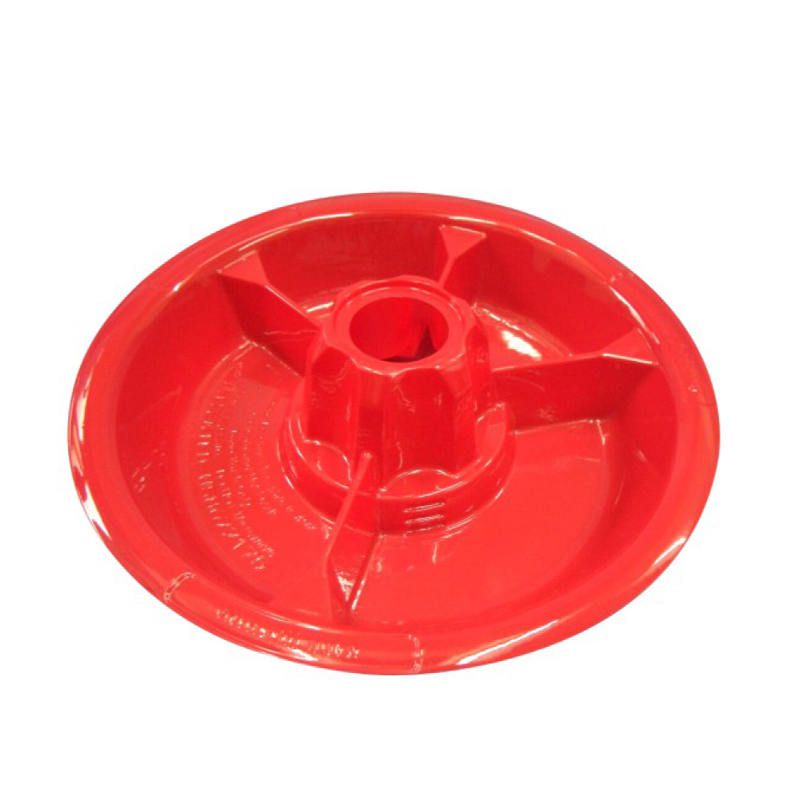
Salad Plate
Product Overview
The GS068 Salad Plate is a PP tableware product intended for everyday serving. The item number is GS068, and the product name is Salad Plate. It is supplied in sets and packed at a quantity of 12 sets per carton. The stated minimum order quantity is 2,000 pieces, while the listed delivery time is 30 days.
Polypropylene, commonly abbreviated as PP, is a widely used thermoplastic material in household products, food-related accessories, storage products, packaging, and tableware. It is valued for its relatively low weight, practical toughness, resistance to moisture, and suitability for mass production. In a plate application, these characteristics support easy handling, efficient transportation, and convenient daily use.
The GS068 is particularly suitable for users who need functional tableware without the weight and fragility associated with ceramic or glass. It can be considered for casual dining, outdoor meals, children’s use, buffet service, shared dining environments, workplace kitchens, dormitories, hospitality rooms, and household meal preparation.
The available product information does not specify the individual plate diameter, depth, color options, temperature range, dishwasher suitability, microwave suitability, or food-contact certification. These details should therefore be confirmed with the manufacturer before final purchase. The stated measurement of 54.5 x 54.5 x 51 cm is presented in the product data and is best understood as a carton or shipping measurement rather than the dimensions of one individual plate. Buyers should request a packaging drawing or sample measurement if exact logistics planning is required.
| Product Attribute | Specification |
| Product Name | Salad Plate |
| Item Number | GS068 |
| Product Category | Tableware and daily necessities |
| Material | PP, polypropylene |
| Packing Quantity | 12 sets per carton |
| Carton Measurement | 54.5 x 54.5 x 51 cm |
| Net Weight | 6 kg per carton |
| Gross Weight | 7 kg per carton |
| 20-Foot Container Loading | 2,192 pieces |
| 40-Foot High Cube Container Loading | 4,340 pieces |
| Minimum Order Quantity | 2,000 pieces |
| Delivery Time | Approximately 30 days |
Material Advantages of Polypropylene
Low Weight and Easy Handling
One of the most important advantages of a PP salad plate is its low weight. A lightweight plate is easier for children, elderly users, catering staff, hotel employees, and retail consumers to handle. It also reduces the physical burden associated with washing, carrying, stacking, and serving multiple plates at one time.
For commercial users, weight affects many daily operations. Restaurant employees can move larger quantities of plates more comfortably. Catering teams can transport serving equipment between locations with less effort. Retailers can place more units on shelves or promotional displays without creating excessive structural load. Consumers can store and use the product without needing specialized cabinets or reinforced shelving.
Lower product weight can also contribute to more efficient logistics. Compared with heavier ceramic or glass alternatives, PP tableware can reduce the weight component of transportation and warehouse handling. The final freight cost depends on carton dimensions, shipping terms, order volume, and destination, but a lightweight material provides a strong starting point for efficient distribution.
Practical Toughness
PP is generally more resistant to impact than brittle materials such as glass and many ceramic products. This characteristic is valuable in environments where plates may be dropped, moved quickly, stacked repeatedly, or used by children. A PP plate may still be damaged by severe misuse, sharp objects, excessive force, or unsuitable temperatures, but its practical toughness can reduce the breakage concerns associated with fragile tableware.
For hotels, restaurants, cafeterias, and event organizers, breakage can represent a continuing operating cost. A plate that is less vulnerable to ordinary impacts can help reduce replacement frequency and interruptions. It can also improve safety by lowering the risk of broken shards in food preparation and dining areas.
For households, the same advantage supports relaxed daily use. Families can use the plate for snacks, salads, fruit, sandwiches, or desserts without treating it as an especially delicate item. This makes the product suitable for informal meals, outdoor dining, picnics, parties, and seasonal gatherings.
Moisture Resistance
Polypropylene does not absorb water in the same way as porous materials. This makes PP suitable for serving foods with moisture, dressings, sauces, fruit juice, or condensation. A smooth, non-porous surface can also make ordinary rinsing and cleaning more convenient, subject to the final surface design and the manufacturer’s care instructions.
Moisture resistance is especially useful for salad service. Salads may contain leafy vegetables, cut fruit, creamy dressings, oil-based sauces, or chilled ingredients. A practical plate should maintain its basic function when exposed to these foods during normal serving.
Efficient Mass Production
PP is well suited to industrial processing, particularly injection molding and other high-volume forming methods. This allows manufacturers to reproduce a consistent shape across large production runs when molds, machines, materials, and quality controls are properly managed. Consistency is important for buyers who need uniform products for retail packaging, restaurant supply, or private-label programs.
Mass production also supports cost control. A simple, functional PP plate can be produced in larger quantities without the firing, glazing, or heavy handling processes required by some ceramic products. This does not mean that all PP tableware is automatically inexpensive; mold cost, design complexity, raw material pricing, packaging, labor, inspection, and shipping all affect the final price. Nevertheless, PP provides a commercially efficient material platform for large-volume tableware supply.
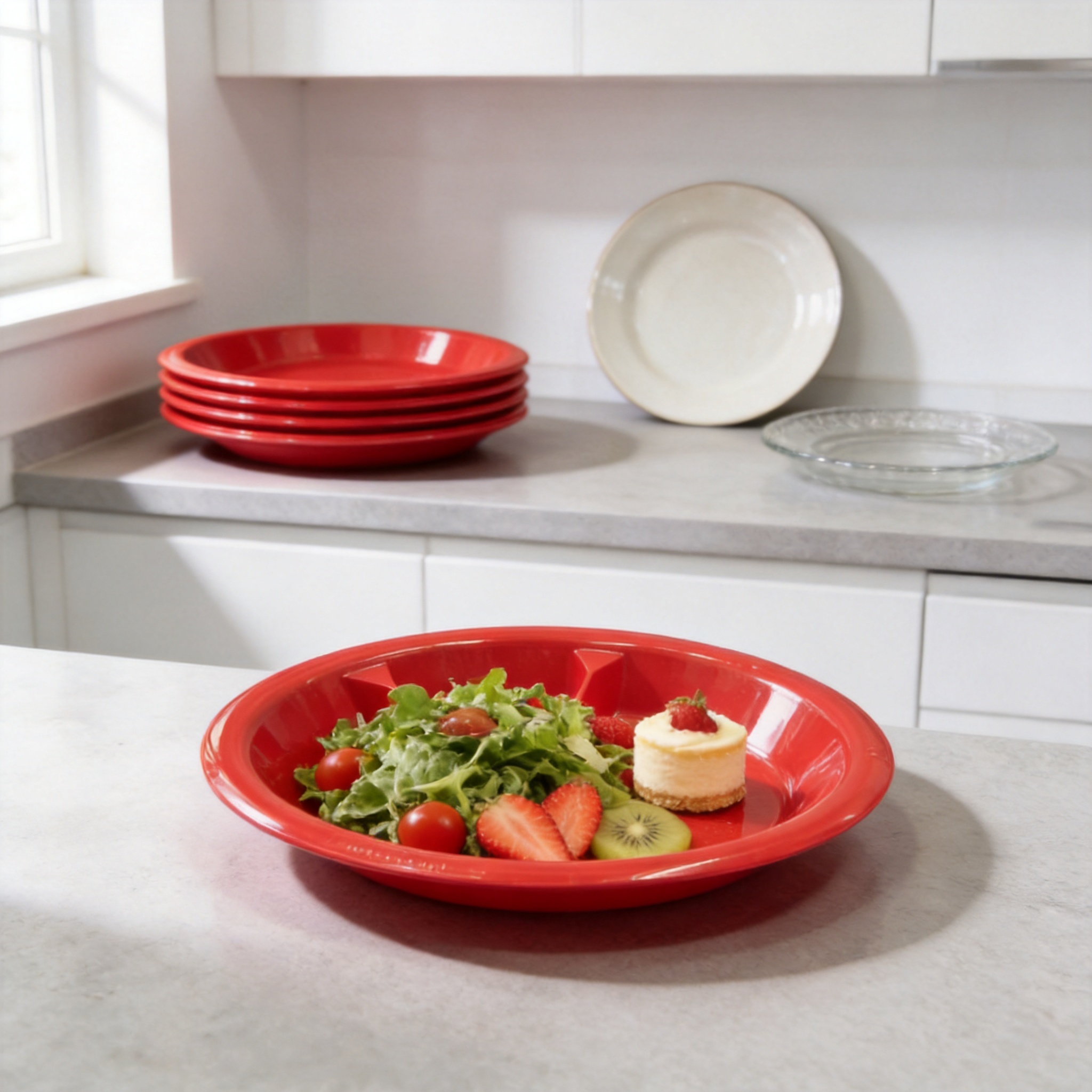
Advantages Compared with Common Tableware Alternatives
Compared with Ceramic Plates
Ceramic plates are valued for their solid feel, traditional appearance, and suitability for many dining environments. However, they are typically heavier and more fragile than PP plates. Ceramic products may also require more careful handling during transport, storage, and washing. For buyers prioritizing portability, impact resistance, and economical replacement, the GS068 PP Salad Plate offers a practical alternative.
PP is especially competitive in environments where casual use is more important than formal presentation. A household with young children, an outdoor event organizer, or a cafeteria operator may prefer a lightweight plate that can tolerate ordinary handling. The product can also complement ceramic tableware by serving as a separate option for informal meals, snacks, and shared events.
It is important to recognize that PP and ceramic serve different aesthetic expectations. Ceramic may be preferred for formal dining, premium restaurants, and table settings where weight and visual refinement are central. PP is more appropriate where convenience, mobility, resilience, and cost-conscious purchasing are the primary concerns.
Compared with Glass Plates
Glass tableware can provide a clear, polished, and premium appearance, but glass is vulnerable to chipping and breakage. It is also heavier than PP and may require more protective packaging. The GS068 can be a useful alternative for casual food service, outdoor use, children’s tableware programs, and high-turnover environments.
The lower breakage risk associated with PP can make inventory management simpler. Retailers may experience fewer damaged units during handling, while foodservice operators can reduce the need to separate fragile serving items from general-use products. Again, the exact durability of any plate depends on its shape, wall thickness, processing quality, and use conditions, so buyers should conduct sample testing before making broad claims.
Compared with Melamine Tableware
Melamine plates are often selected for their hard surface and attractive appearance. They can be appropriate for many dining applications, but buyers must pay close attention to product instructions, food-contact requirements, and temperature limitations. PP offers a different balance of flexibility, lightweight handling, and impact tolerance.
The choice between PP and melamine should be based on the intended application. If a buyer needs a simple, lightweight plate for everyday use, PP may be the more convenient option. If the buyer requires a more rigid, decorative appearance, melamine may be considered. In either case, food-contact documentation and usage instructions should be reviewed before commercial distribution.
Compared with Disposable Tableware
Disposable plates can be convenient for one-time events, but repeated replacement may create higher long-term purchasing costs and greater waste. A reusable PP plate offers a more durable daily-use approach when washing facilities are available. It can be used for repeated meals, family gatherings, workplace dining, or foodservice operations.
The reusable nature of a PP product should be evaluated together with local recycling systems, product labeling, consumer behavior, washing practices, and end-of-life management. A reusable product is most valuable when users actually reuse it appropriately and when the material is handled responsibly after its service life.
Applications for Homes and Commercial Users
Household Dining
The GS068 Salad Plate can serve a broad range of household needs. It can be used for green salads, fruit portions, breakfast items, sandwiches, cakes, pastries, side dishes, and snacks. Its simple function allows it to fit into everyday routines without requiring special preparation.
Households may also use the plate as an additional serving item during gatherings. When standard tableware is insufficient for guests, lightweight PP plates can provide a convenient supplement. They are easier to carry from storage areas to dining spaces and can be stacked for compact organization.
Outdoor Meals and Events
Outdoor dining creates special requirements. Tableware may need to be carried over a distance, placed on temporary tables, used by many people, and packed away quickly after the event. A PP plate is suitable for these conditions because it combines light weight with practical toughness.
Potential users include picnic organizers, campsites, community events, school activities, birthday parties, sports clubs, food festivals, and seasonal markets. For these applications, buyers should also consider whether the product’s dimensions, color options, and packaging format are suitable for event branding and consumer expectations.
Restaurants and Cafeterias
Restaurants and cafeterias may use PP plates for salads, appetizers, desserts, children’s menus, staff meals, buffet lines, or outdoor service. The product can also be useful in casual dining concepts that emphasize speed and convenience rather than formal table presentation.
Before commercial use, operators should assess the plate’s compatibility with their washing equipment, storage racks, food temperatures, cleaning chemicals, and service procedures. These tests can confirm whether the product maintains its appearance and function under the buyer’s actual operating conditions.
Hotels and Hospitality Businesses
Hotels may consider PP tableware for breakfast areas, poolside service, children’s facilities, outdoor dining, guest activities, and housekeeping support areas. The product’s lightweight form can help employees move multiple units efficiently, while its practical toughness can be helpful in busy hospitality environments.
Hotels often require consistent appearance across large quantities. This makes production uniformity, color consistency, packaging accuracy, and replacement availability important purchasing factors. A manufacturer with engineering, production, and quality control resources can provide stronger support for these requirements than a supplier that only trades finished goods.
Retail and Wholesale Distribution
The GS068 is also relevant to importers, distributors, supermarket suppliers, and household goods wholesalers. The minimum order quantity of 2,000 pieces is suited to buyers who need a commercial shipment rather than a small trial purchase. The listed carton packing of 12 sets per carton provides a structure for inventory planning and wholesale distribution.
Retail buyers may position the product in tableware aisles, kitchen accessory sections, seasonal outdoor displays, picnic collections, dormitory product ranges, or value-oriented household departments. Packaging design, barcode requirements, color assortment, labeling language, and retail testing should be discussed before production.
Packaging and Logistics Efficiency
Commercial tableware purchasing is not determined by unit price alone. Carton size, gross weight, loading quantity, warehouse handling, product protection, and delivery schedule all influence the total cost of ownership. The GS068 product data provides several logistics figures that help buyers begin planning.
Each carton contains 12 sets, with a net weight of 6 kilograms and a gross weight of 7 kilograms. The stated carton measurement is 54.5 x 54.5 x 51 centimeters. The difference between net and gross weight indicates that the carton, internal protection, labels, and other packing materials account for approximately 1 kilogram per carton, although the final packing composition should be confirmed.
The listed loading capacity is 2,192 pieces for a 1 x 20-foot container and 4,340 pieces for a 1 x 40-foot high-cube container. These figures provide a useful initial reference for shipping calculations. Actual loading quantities may vary depending on pallet use, container loading rules, packaging revisions, port requirements, and the buyer’s preferred arrangement.
| Logistics Item | Available Information | Buyer Consideration |
| Carton Packing | 12 sets per carton | Useful for wholesale inventory and warehouse planning |
| Carton Measurement | 54.5 x 54.5 x 51 cm | Confirm whether measurement applies to the final export carton |
| Net Carton Weight | 6 kg | Supports product-weight calculations |
| Gross Carton Weight | 7 kg | Use for freight and handling estimates |
| 20-Foot Container | 2,192 pieces | Confirm loading method and packing configuration |
| 40-Foot High-Cube Container | 4,340 pieces | Confirm final quantity after packaging and loading review |
| Minimum Order Quantity | 2,000 pieces | Suitable for commercial buyers and distribution programs |
| Delivery Time | 30 days | Confirm whether this refers to production after order approval |
Efficient logistics can provide an advantage over heavier or more fragile tableware. A lightweight PP product may require less protective material than glass, and its commercial packing can be organized for high-volume shipment. However, protection remains important. Plates should be prevented from excessive movement, compression, abrasion, or contamination during transportation. Buyers should request carton photographs, packing samples, and loading details when placing a substantial order.

Manufacturing Strengths of the Supplier
Experience in Product Development
The supplier’s history began with non-electric innovative household products before expanding into electric kitchen appliances. This development path is relevant to the GS068 Salad Plate because it demonstrates experience in designing practical products for kitchens, homes, retailers, and international markets.
Product development is more than selecting a material and creating a shape. It includes identifying consumer needs, assessing manufacturing feasibility, creating samples, reviewing mold structures, improving usability, organizing packaging, and preparing the product for repeat production. A manufacturer that has worked across different household product categories can bring broader practical knowledge to these stages.
Factory-Based Production
The company operates its own manufacturing facility in Cixi, Ningbo, China. The provided company information describes a production area of approximately 15,000 square meters, more than 200 experienced workers, 10 engineers in the research and development department, and 10 personnel in quality control. Earlier company information also refers to a factory occupying approximately 10,000 square meters with a building area of 18,000 square meters. Because the supplied figures describe different stages or reporting periods, buyers should confirm the latest official factory profile during qualification.
Factory-based production can offer several advantages over purely trading-based supply. It allows closer coordination between design, engineering, production, inspection, packaging, and shipment. It can also make it easier to discuss mold changes, color adjustments, packaging improvements, and private-label requirements with the actual production team.
For the GS068 Salad Plate, factory control may support more consistent shaping, stacking, surface finish, color management, and carton packing. The quality of these results depends on the specific production line and inspection procedures assigned to the order, so buyers should still approve pre-production samples and define acceptance standards.
Research and Development Capability
The company states that it has an R&D department with engineers dedicated to product development. This capability is important for buyers who do not want a generic product with no technical support. Engineering resources can help evaluate design details, production constraints, material behavior, mold requirements, packaging structures, and product improvements.
A strong development process can be especially valuable if a buyer wants to adjust the GS068 for a specific market. Possible discussions may include color selection, surface appearance, packaging style, set configuration, labeling, brand presentation, and coordinated kitchen product collections. Any modification would need to be reviewed for tooling, cost, minimum order quantity, and lead time.
Quality Control Organization
The supplier’s stated quality control team includes 10 QC personnel. A dedicated QC function can help manage incoming material checks, production inspections, assembly or forming checks, appearance evaluation, packing verification, and final shipment review.
For a PP salad plate, quality control may reasonably focus on several areas. These include plate shape, edge smoothness, surface cleanliness, color consistency, deformation, flash, warpage, cracks, contamination, stacking behavior, quantity accuracy, carton condition, and label correctness. The final inspection plan should be agreed with the buyer because different markets may have different requirements.
Quality control is most effective when it is integrated throughout production rather than performed only at the end. Incoming material review can prevent unsuitable resin or colorant from entering production. In-process checks can identify mold or machine issues early. Final inspections can confirm that finished cartons match the approved sample and purchase order.
Recommended Manufacturing Process for a PP Salad Plate
Design and Engineering Review
Manufacturing begins with a clear product design. The design team reviews the plate’s shape, rim, stacking profile, wall structure, surface details, and intended use. A good design should balance appearance, rigidity, material consumption, production speed, ease of demolding, and packing efficiency.
The rim is particularly important. It should provide a comfortable handling edge and help maintain the plate’s shape during use. The underside should support stable placement on a table. The stacking profile should allow multiple plates to be stored without excessive sticking or difficult separation.
Mold Development
After design approval, a mold is prepared for production. Mold quality affects repeatability, surface appearance, dimensional stability, and cycle efficiency. Engineering teams evaluate cooling, material flow, gate position, venting, ejection, and maintenance access.
For a plate, balanced material flow is important because uneven filling can lead to inconsistent thickness, warpage, sink marks, or surface defects. Proper cooling can help the product retain its intended shape after removal from the mold. Ejection components must be arranged to reduce stress and avoid visible marks in sensitive areas.
Material Preparation
PP resin must be selected and prepared according to the required product specification. If color is used, the color masterbatch or compound should be controlled for consistency. Material handling should minimize contamination and maintain traceability where required by the buyer.
Buyers should request information about the PP grade, food-contact suitability, recycled content if applicable, additives, colorants, and compliance documentation. These factors can vary according to the destination market and the product’s intended food-contact use.
Injection Molding or Forming
A PP plate is commonly produced through an industrial forming process such as injection molding. During molding, the material is heated, formed in a mold, cooled, and removed. Machine settings such as temperature, pressure, injection speed, holding pressure, cooling time, and cycle time influence the result.
Stable process parameters help reduce variation between production batches. Operators and engineers monitor the appearance and dimensions of early samples, then make adjustments if required. Continuous attention is needed because environmental conditions, material batches, machine behavior, and mold wear can affect the finished product.
Trimming and Appearance Inspection
After forming, any necessary gate remnants or small excess material may be removed. The plate is then checked for visual defects and functional concerns. A suitable inspection process should identify sharp edges, deformation, incomplete filling, cracks, discoloration, contamination, and other conditions that could affect usability or appearance.
Stacking and Packing
Finished plates are counted, arranged, and packed according to the approved quantity. Since the GS068 is listed as 12 sets per carton, packing personnel should verify that every carton contains the correct number of products and that the products are protected from rubbing or impact.
Carton markings should match the purchase order and shipping documents. Depending on the buyer’s requirements, labels may include product name, item number, quantity, material, country of origin, handling symbols, barcode information, and customer-specific details.
Quality Assurance for International Buyers
International buyers should treat quality assurance as a cooperative process. A clear technical specification helps the supplier understand what must be controlled, while sample approval gives both parties a visual and physical reference.
The buyer should consider requesting a pre-production sample, a production sample, or both. A pre-production sample confirms the proposed design and finish. A production sample confirms that the actual manufacturing process reproduces the approved result. For larger orders, a third-party inspection may also be considered according to the buyer’s internal policy.
Testing can include visual inspection, dimensional measurement, weight verification, stacking assessment, drop or impact evaluation, cleaning trials, odor checks, color review, packaging inspection, and food-contact documentation review. The exact test plan should reflect the destination market and the intended application.
| Quality Area | Suggested Review |
| Appearance | Check color, gloss, surface cleanliness, scratches, flash, and visible marks |
| Shape | Check plate flatness, rim form, deformation, and stacking stability |
| Edges | Confirm that edges are smooth and comfortable to handle |
| Material | Confirm PP specification and required food-contact documentation |
| Function | Evaluate serving suitability, stability, and resistance to normal handling |
| Cleaning | Conduct buyer-specific washing and detergent tests where relevant |
| Packaging | Verify count, carton strength, labels, and protection against transport damage |
| Documentation | Review inspection records, test reports, and shipment documents as required |
Buyers should not assume that a general PP designation automatically confirms every desired use. Microwave use, dishwasher use, hot-food service, freezer use, and food-contact compliance depend on the specific formulation, design, and applicable regulations. These claims should be supported by the manufacturer’s documentation and testing for the actual product.
Customization and Private-Label Potential
Many wholesalers and retailers require products that fit a specific assortment or brand identity. The GS068 may provide a starting point for discussions about color, packaging, set configuration, and labeling. The feasibility of each option depends on order quantity, mold requirements, material availability, print method, artwork approval, and production scheduling.
Color customization can help the plate fit a retailer’s seasonal collection or a hospitality operator’s visual identity. Neutral colors may support broad household distribution, while brighter colors may be suitable for children’s products, outdoor dining, or promotional programs. Color consistency should be checked against an approved master sample or color standard.
Packaging customization can improve shelf presentation and product communication. Buyers may request retail boxes, printed sleeves, polybags, barcode labels, multilingual instructions, or carton marks. Packaging should clearly communicate the product name, quantity, material, care instructions, and any applicable warnings.
Private-label projects require careful planning because packaging and branding changes can create additional lead time and minimum order requirements. A written approval process is recommended for artwork, color, sample, carton markings, and final inspection criteria.
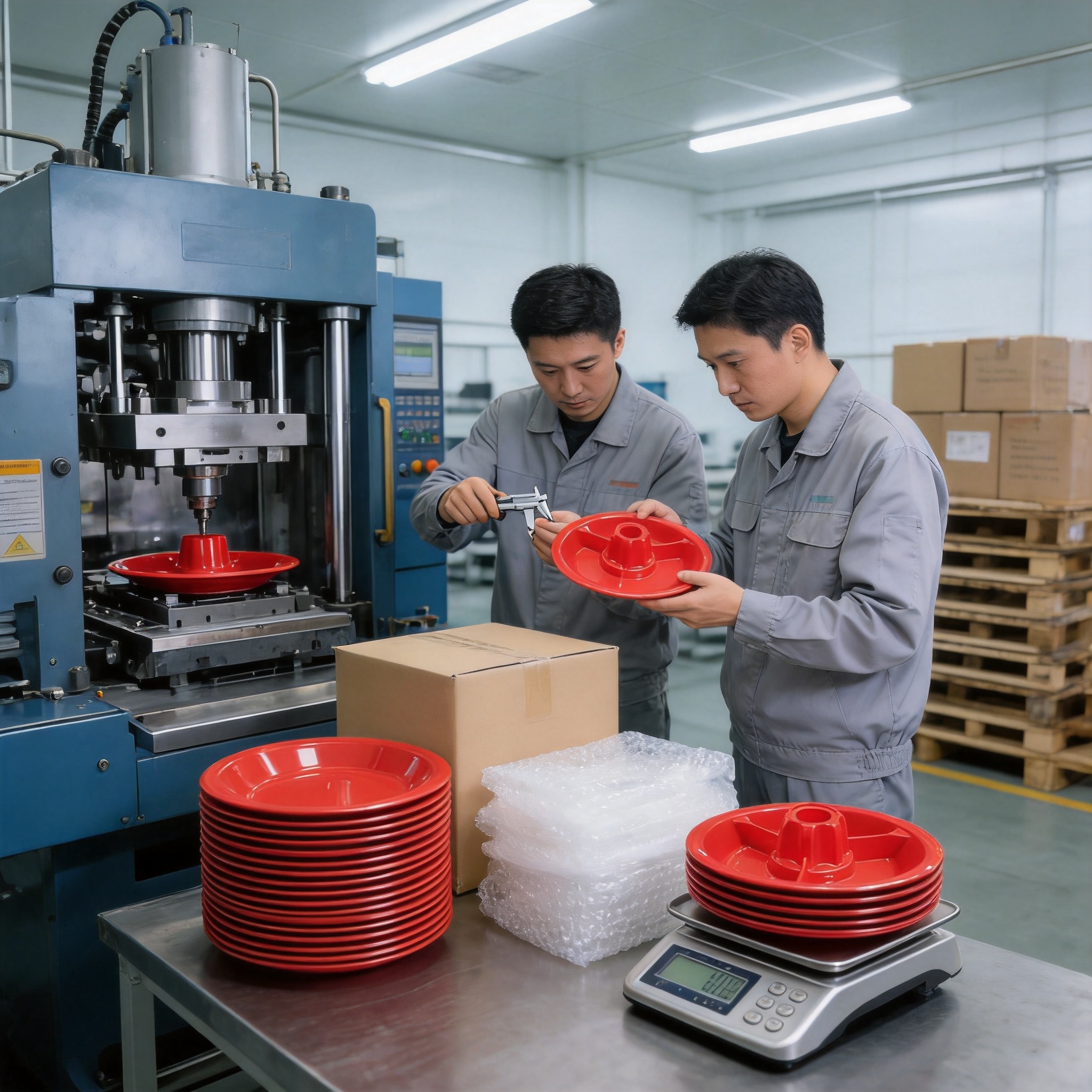
Commercial Value for Different Buyer Groups
For Importers
Importers can benefit from a product that has a clear use case, broad consumer appeal, and relatively simple construction. The salad plate can be included in a larger tableware program or combined with other kitchen and household products. Its practical positioning may suit value-focused, convenience-oriented, and outdoor-use categories.
The manufacturer’s experience with international customers and supermarket-oriented product development may also help importers coordinate packaging, documentation, quality control, and shipment planning. Importers should still conduct their own supplier qualification and regulatory review for the destination market.
For Supermarket Suppliers
Supermarket suppliers often require reliable replenishment, uniform packaging, attractive presentation, and predictable delivery. The GS068’s carton packing and stated container quantities can support initial inventory calculations. A 30-day delivery time may be suitable for planned purchasing, provided that artwork, samples, materials, and production schedules are approved in advance.
Supermarket programs may also require strict carton labeling, barcode placement, packaging tests, product liability documentation, and social or environmental compliance reviews. These requirements should be addressed before the order is released to production.
For Foodservice Distributors
Foodservice distributors can position the plate as a reusable option for casual restaurants, cafés, catering companies, schools, canteens, and event venues. The lightweight design can support efficient handling, while the PP construction may be appropriate for environments where breakage is a concern.
Distributors should identify the plate’s operating limits and communicate them accurately to customers. If the product has not been verified for microwave, dishwasher, or high-temperature use, those functions should not be promoted without supporting evidence.
For Hospitality and Promotional Programs
Hotels, resorts, campsites, and event organizers may use PP tableware as part of a practical service package. The product can also be considered for promotional programs involving outdoor activities, family events, food brands, kitchen retailers, or community organizations.
For promotional use, buyers may value the ability to add printed packaging or coordinate colors with an event theme. The product’s practical daily-use function may also provide more lasting value than a purely decorative promotional item.
Responsible Product Positioning
A responsible product description should communicate both benefits and limitations. The GS068 Salad Plate can be presented as lightweight, practical, reusable, and suitable for many everyday serving applications. Claims about heat resistance, food-contact safety, dishwasher use, microwave use, or environmental performance should be made only when supported by product-specific evidence.
PP tableware can support repeated use, but responsible use depends on proper cleaning, storage, and handling. Users should follow the supplier’s care instructions. Plates should be inspected periodically and removed from service if they become cracked, heavily scratched, deformed, or otherwise unsuitable for food service.
Environmental considerations should include the entire product life cycle. This includes material selection, manufacturing efficiency, packaging, transportation, repeated use, cleaning, recycling availability, and disposal. Buyers may ask the supplier about material composition, packaging reduction, recycled content, and end-of-life guidance if these issues are important in their market.
Why the GS068 Is a Competitive Choice
The GS068 Salad Plate has several characteristics that can make it competitive in the practical tableware segment. Its PP material supports low-weight handling and efficient production. Its intended everyday use gives it broad market relevance. Its product format is simple enough for household and commercial applications, while its volume packaging is suitable for wholesale distribution.
Compared with fragile alternatives, the plate can offer a more relaxed handling experience. Compared with disposable products, it can support repeated use. Compared with heavier tableware, it can simplify movement, storage, and transport. These advantages are particularly relevant when buyers prioritize function, value, and operational efficiency.
The supplier adds further value through factory production, product development experience, engineering resources, quality control personnel, and international customer experience. The company’s history includes innovative household products, kitchen appliances, and products supplied to large retail and commercial customers. This background may help buyers seeking a partner capable of supporting more than a one-time commodity transaction.
The strongest competitive position is achieved when the product, supplier, packaging, quality standards, and market strategy are aligned. Buyers should therefore evaluate the GS068 not only by unit price, but also by sample quality, delivery performance, documentation, communication, customization capability, carton efficiency, and after-sales support.
Buyer Checklist Before Ordering
Before placing an order, buyers should request a product sample and confirm the individual plate dimensions. The supplied data identifies the carton measurement but does not provide the plate diameter or depth. These dimensions are essential for shelf planning, storage, serving portions, and customer communication.
Buyers should also confirm whether the product is supplied as a single plate or as a set, because the data lists 12 sets per carton while the container quantities are expressed in pieces. The exact definition of one set should be documented on the quotation, packaging, and purchase order.
Material details should be clarified, including the PP grade, food-contact suitability, colorant information, and any applicable compliance documents. Buyers should ask whether the product is suitable for hot food, cold food, refrigeration, microwave use, or dishwasher cleaning. These functions should not be assumed without confirmation.
Packaging requirements should be agreed in writing. This includes inner packing, carton quantity, carton dimensions, gross weight, labels, barcode information, pallet requirements, and carton drop-test expectations. The buyer should also confirm whether the stated container loading quantities apply to loose loading or palletized loading.
Finally, the production schedule should be clarified. The listed delivery time is 30 days, but the start point may depend on deposit receipt, artwork approval, sample approval, material confirmation, or mold completion. Establishing these conditions early can reduce misunderstandings and support reliable planning.
Q&A
What is the GS068 Salad Plate made from?
The GS068 Salad Plate is made from PP, or polypropylene. PP is a lightweight thermoplastic commonly used in household products, food-related accessories, packaging, and tableware.
What foods can be served on the plate?
The plate is intended for everyday serving applications such as salads, fruit, snacks, desserts, sandwiches, pastries, and side dishes. Buyers should confirm any temperature or food-contact limitations before using it for specialized applications.
Is the plate suitable for children?
Its lightweight PP construction may be suitable for children’s everyday use, schools, family events, and casual dining. However, buyers should review the specific product safety documentation and confirm that the design and material meet the requirements of the intended market.
How many products are packed in one carton?
The supplied product information states 12 sets per carton. Because the container quantities are listed in pieces, buyers should confirm exactly how many individual plates are included in one set.
What is the carton size?
The stated measurement is 54.5 x 54.5 x 51 centimeters. Buyers should confirm that this is the final export carton measurement and determine whether it applies to a complete carton containing 12 sets.
What are the carton weights?
The listed net weight is 6 kilograms per carton, and the listed gross weight is 7 kilograms per carton. Gross weight includes the products and packaging materials.
What is the minimum order quantity?
The stated minimum order quantity is 2,000 pieces. The final order unit should be clarified if the product is sold by piece, set, carton, or a combination of these units.
How long is the delivery time?
The listed delivery time is 30 days. Buyers should confirm whether this period begins after order confirmation, deposit payment, artwork approval, sample approval, or another agreed milestone.
Can the product be customized?
Customization may be possible for areas such as color, packaging, labeling, set configuration, and private-label presentation. Feasibility depends on order volume, tooling, material availability, artwork, and production scheduling.
Can the plate be used in a microwave or dishwasher?
The available product information does not confirm microwave or dishwasher suitability. Buyers should request product-specific testing and written instructions before making these claims or using the plate in such conditions.
What quality checks should buyers request?
Buyers may request checks for appearance, shape, flatness, edge smoothness, stacking performance, material documentation, quantity, carton condition, labels, and transportation protection. Additional tests can be arranged according to market requirements and intended use.
What makes this product different from ceramic or glass plates?
The PP construction is generally lighter and less brittle than ceramic or glass. This can make the plate easier to handle, transport, and use in casual or high-turnover environments. Ceramic and glass may still be preferred where a heavier, more formal, or premium appearance is required.
Who can purchase the GS068 Salad Plate?
Potential buyers include importers, wholesalers, supermarkets, retail chains, foodservice distributors, restaurants, hotels, catering companies, event organizers, and household goods suppliers.
Conclusion
The GS068 Salad Plate is a practical PP tableware product designed for everyday serving and volume distribution. Its lightweight material, moisture resistance, practical toughness, and efficient production potential make it suitable for homes, outdoor events, foodservice operations, hospitality businesses, retailers, and wholesalers.
The product’s commercial advantages are strengthened by organized carton packing, stated container loading quantities, a 2,000-piece minimum order quantity, and an estimated 30-day delivery time. These details provide a useful foundation for import planning, although final packaging, loading, and production conditions should be confirmed for each order.
The supplier’s factory background, R&D resources, quality control team, engineering experience, and history of developing household products offer additional support for buyers seeking a manufacturing partner. Its experience in kitchen products and international supply can be valuable for customers requiring consistent production, customized packaging, product improvement, and coordinated quality management.
For the best purchasing result, buyers should approve samples, confirm plate dimensions, clarify the meaning of the set quantity, review food-contact and usage documentation, define inspection standards, and agree on packaging and delivery conditions. With these steps in place, the GS068 Salad Plate can serve as a flexible and cost-conscious addition to modern tableware programs.
References
1. Product specification supplied for GS068 Salad Plate, including material, packing, carton measurement, weights, container loading information, minimum order quantity, and delivery time.
2. Company profile and manufacturing history supplied for CIXI GSTAR ELECTRIC APPLIANCE CO., LTD.
3. General technical information concerning polypropylene material characteristics and common household tableware applications.
4. General principles of injection molding, product development, packaging control, and quality inspection for plastic household goods.
5. General international purchasing practices for food-related household products, including sample approval, documentation review, packaging verification, and shipment inspection.