
 English
 中文简体
中文简体 Español
 English
 中文简体
中文简体 Español
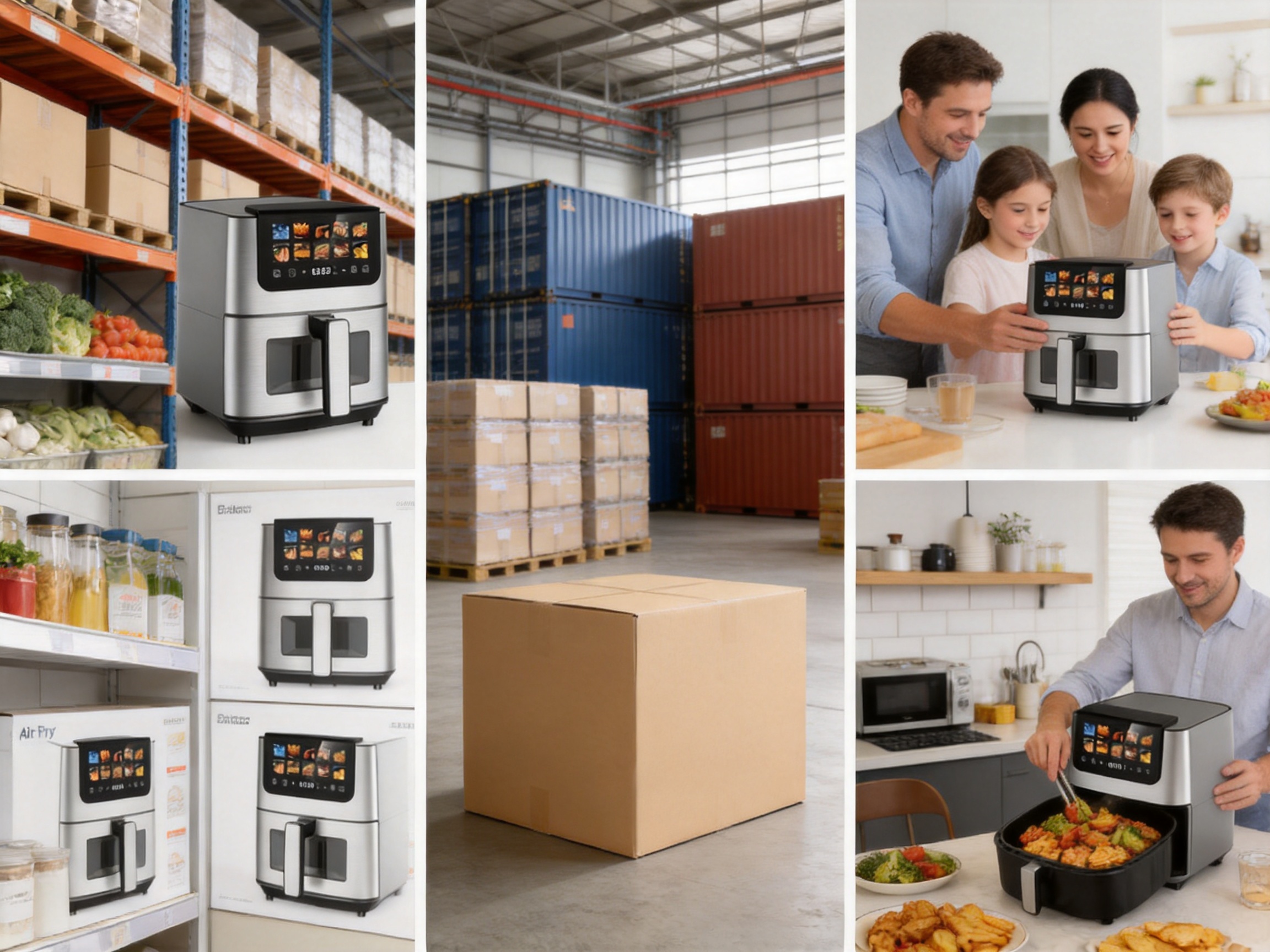
Air frying has developed from a specialist cooking method into a practical everyday solution for households, hospitality businesses, and food-service environments. Consumers increasingly want meals that are quick to prepare, less dependent on large quantities of oil, and simple to control. At the same time, importers, retailers, and private-label brands are looking for appliances that combine attractive design, dependable performance, efficient production, and broad market appeal.
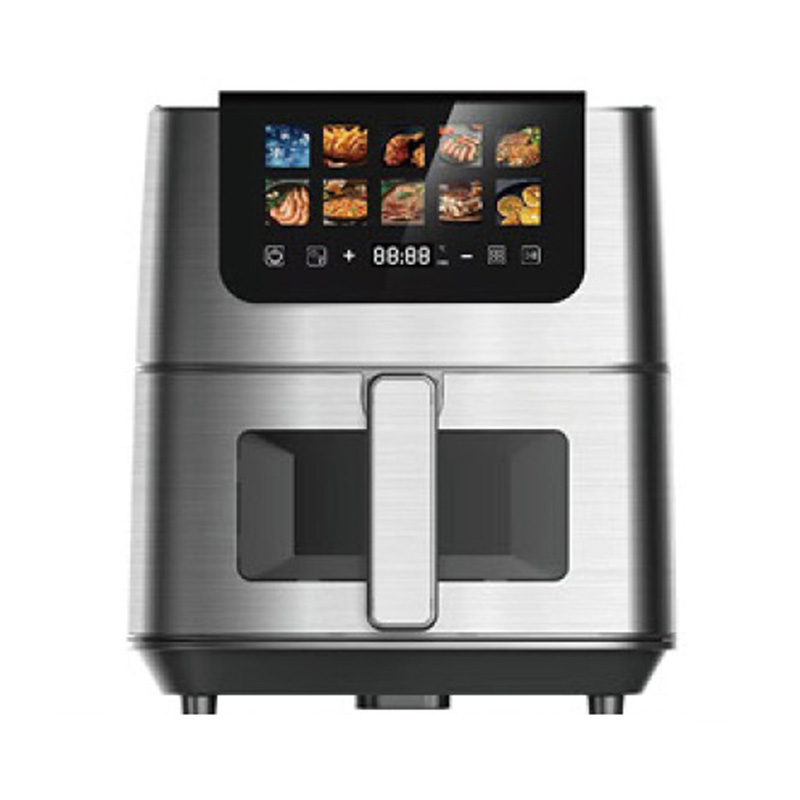
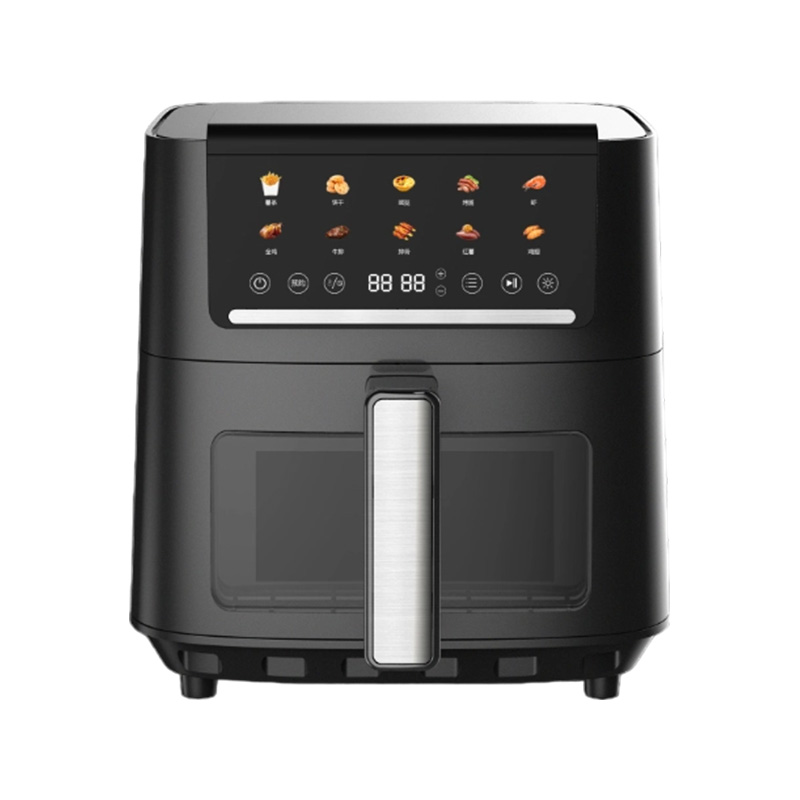
The GSE034 air fryer is designed to answer these requirements through a combination of large cooking capacity, LCD touch control, a streamlined exterior, and a concealed comfortable handle. It belongs to the small electric kitchen appliance category and is suitable for distributors, wholesalers, retail chains, online sellers, and commercial partners seeking a contemporary air-frying product with practical specifications.
With a 6.5-liter single-pot cooking chamber, an operating temperature range of 80–200°C, and a rated power configuration of 1700+400W, this model is positioned for families and users who want to prepare generous portions without repeatedly loading a small basket. Its touch-sensitive LCD interface gives users direct access to cooking settings, while the handle design helps maintain a clean appearance and comfortable operation.
Beyond the product itself, the manufacturing capability behind the appliance is an important part of its value. Cixi Gstar Electric Appliance Co., Ltd. develops and manufactures small kitchen appliances, including air fryers, air ovens, blenders, slicers, choppers, food processors, smokeless grills, and hot pots. The company also produces selected products for bars, restaurants, and hotels. Its facilities, engineering team, quality-control personnel, production experience, and export background provide a foundation for long-term OEM, wholesale, and distribution cooperation.
1. Product Overview
The GSE034 is a large-capacity air fryer intended for convenient countertop cooking. It uses a single-pot structure with a 6.5-liter capacity, allowing users to prepare larger quantities of food in one cycle than many compact personal air fryers. The product measures approximately 37 centimeters in length, 30 centimeters in width, and 30 centimeters in height, creating a substantial but manageable footprint for a modern kitchen worktop.
The appliance combines several materials selected for different functional requirements. The listed construction includes PP, PA, aluminum, ABS, PC, and SS430 stainless steel. Polymer components can support insulation, structural molding, user comfort, and exterior finishing, while aluminum can assist with heat-related components. Stainless steel is commonly used in areas where strength, durability, and resistance to kitchen conditions are important.
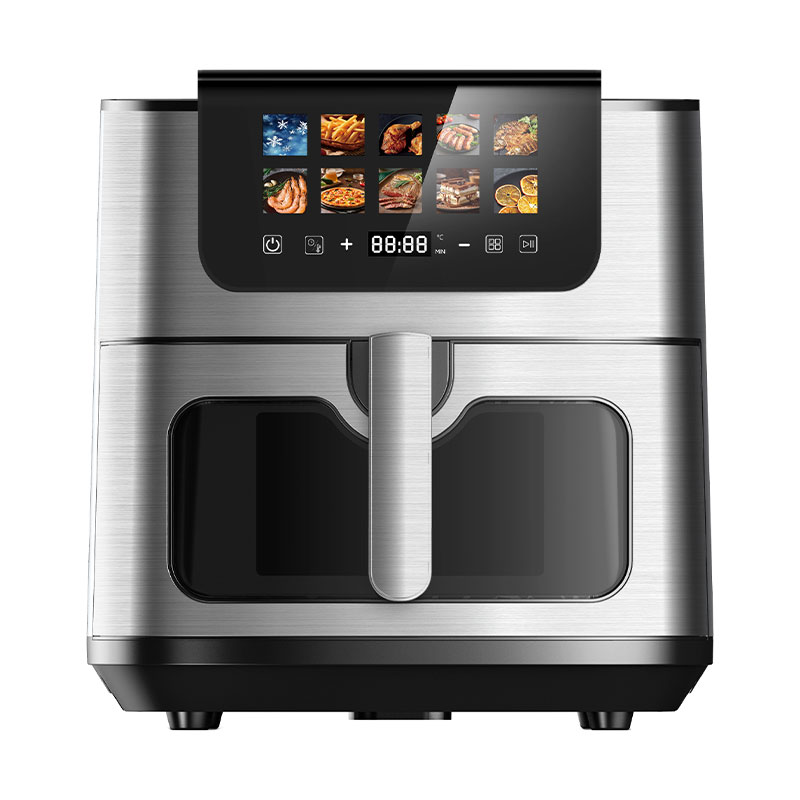
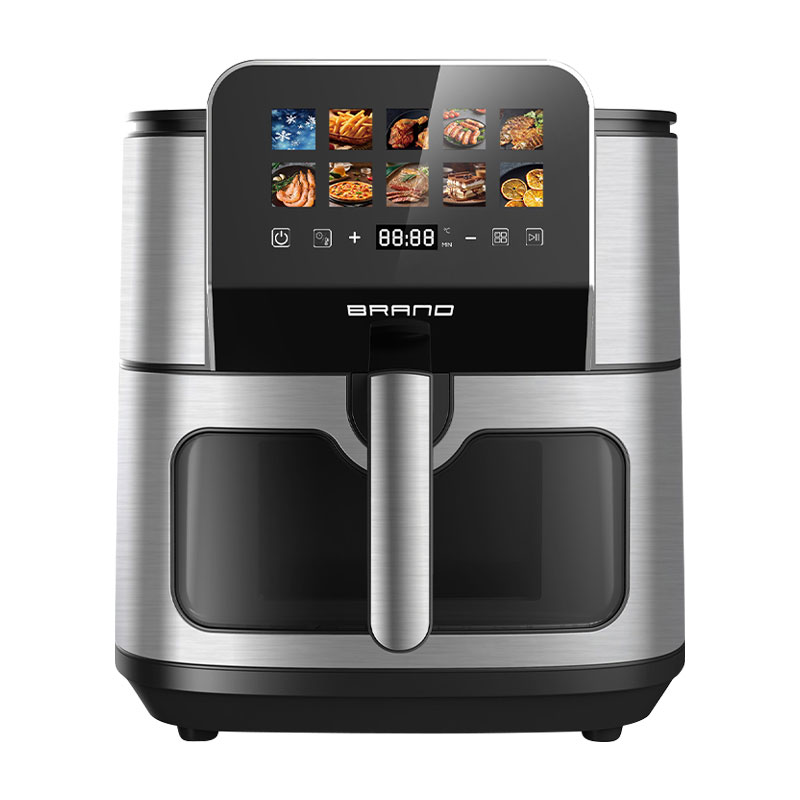
Its top-mounted LCD touch-control layout is one of the most visible product features. Rather than relying only on mechanical knobs, the interface is intended to let users adjust cooking time, temperature, and other operating functions through touch-sensitive controls. This approach supports a cleaner product appearance and can be more intuitive for consumers who are already familiar with touch interfaces on ovens, microwave ovens, induction cookers, and other household appliances.
The product title also highlights an invisible comfortable handle. This description indicates a handle integrated into the overall structure in a way that reduces visual bulk when viewed from the outside. The design can help create a more streamlined appearance while still providing a practical gripping area for opening, closing, or removing the cooking pot. A comfortable handle is particularly useful because the basket and drawer may become hot during operation.
Air fryers typically circulate heated air around food to create a browned and crisp exterior with less added oil than conventional deep frying. The final result depends on the food, preparation method, quantity, temperature, time, and arrangement inside the cooking chamber. The GSE034 is therefore best understood as a versatile hot-air cooking appliance rather than a direct replacement for every traditional cooking method.
2. Main Specifications at a Glance
| Specification | GSE034 Details |
|---|---|
| Product category | Air fryer |
| Item number | GSE034 |
| Control system | LCD touch control |
| Cooking structure | 6.5-liter single pot |
| Material composition | PP, PA, aluminum, ABS, PC, and SS430 |
| Power | 1700+400W |
| Frequency | 50/60Hz |
| Temperature range | 80–200°C |
| Product dimensions | 37 × 30 × 30cm |
| Gift box dimensions | 40 × 33 × 34.2cm |
| Carton dimensions | 41.5 × 34.5 × 36cm |
| Gross/net weight | 7.5/6.5kg |
| Container loading reference | 1,348 pieces per 40-foot high-cube container |
| Listed certifications | CE, CB, GS, RoHS, and LFGB |
The power specification is listed as 1700+400W. Buyers should confirm the exact electrical architecture, heating-element arrangement, and rated input configuration with the manufacturer before finalizing a purchase order. Electrical specifications can vary according to destination market, plug type, voltage, control programming, and certification requirements.
The 50/60Hz frequency specification is suitable for discussions involving multiple international markets, but voltage must also be confirmed for each target country. Importers should request the applicable nameplate, laboratory documents, user manual, plug configuration, and compliance file during product approval.
3. Large Capacity for Everyday Household Use
Capacity is one of the most important factors influencing air-fryer purchasing decisions. A small air fryer may be suitable for an individual or a couple, but users preparing food for several people may need multiple cooking cycles. Repeated cycles increase preparation time and require more supervision. The 6.5-liter capacity of the GSE034 is intended to reduce this limitation.
A large single-pot chamber can be useful for preparing chicken wings, potato products, vegetables, fish, sausages, pastries, and other foods in family-sized quantities. It can also support meal preparation when users want to cook a main dish and side ingredients in a practical sequence. For retailers, the large capacity creates a clear marketing message that is easy for consumers to understand: the appliance is designed for more than individual snacks.
The single-pot configuration also provides a straightforward user experience. Some multi-basket models require users to manage two separate cooking zones, synchronize cooking programs, or divide ingredients between drawers. A single cooking vessel may be easier for customers who prefer simple loading and one set of controls. It can also make the exterior visually more balanced and reduce the complexity of product education at the point of sale.
Capacity should not be interpreted as a guarantee that every food can be placed in one thick layer or cooked at the same time. Air circulation remains important. Overfilling may reduce browning and extend cooking time. Retailers and distributors can add value by providing recipe guidance, loading recommendations, and cleaning instructions with the product.
4. LCD Touch Control and User Convenience
The LCD touch-control interface is designed to make the air fryer easier to operate. Users can typically select a cooking temperature and time through the touch panel, then monitor the selected settings on the display. A digital interface can make settings more visible than markings on a mechanical dial, especially when the appliance is used in a well-lit kitchen.
Touch control also contributes to a contemporary product identity. Consumers often associate digital displays with precision, convenience, and modern household technology. For retail brands, this can help position the product above basic entry-level air fryers that use only analog controls. The visual difference is important in online product listings, showroom displays, catalogues, and promotional photography.
A touch panel can also support a more flexible user interface. Depending on the final program configuration, the manufacturer may provide preset cooking functions, temperature adjustment, time adjustment, start and pause functions, or other operating indicators. The exact functions should be confirmed in the final user manual and control software version rather than assumed from the product title alone.
Digital controls are most effective when they are supported by clear icons, readable text, responsive touch sensitivity, and logical button placement. Product development should therefore include testing under different lighting conditions, with dry and slightly damp fingers, and with repeated use over the expected service life. These checks help reduce user frustration and support a more positive ownership experience.
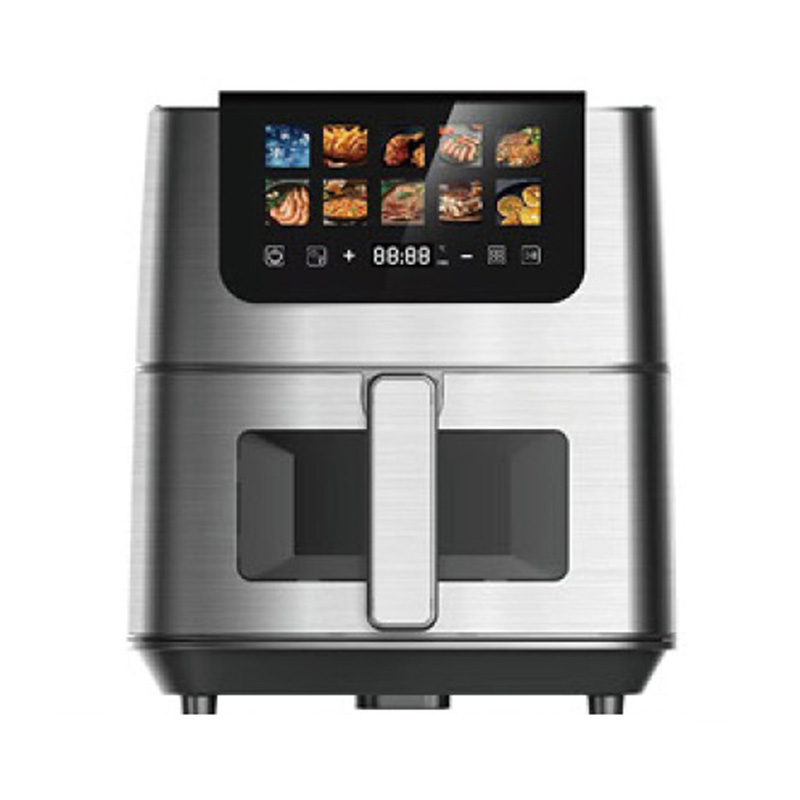
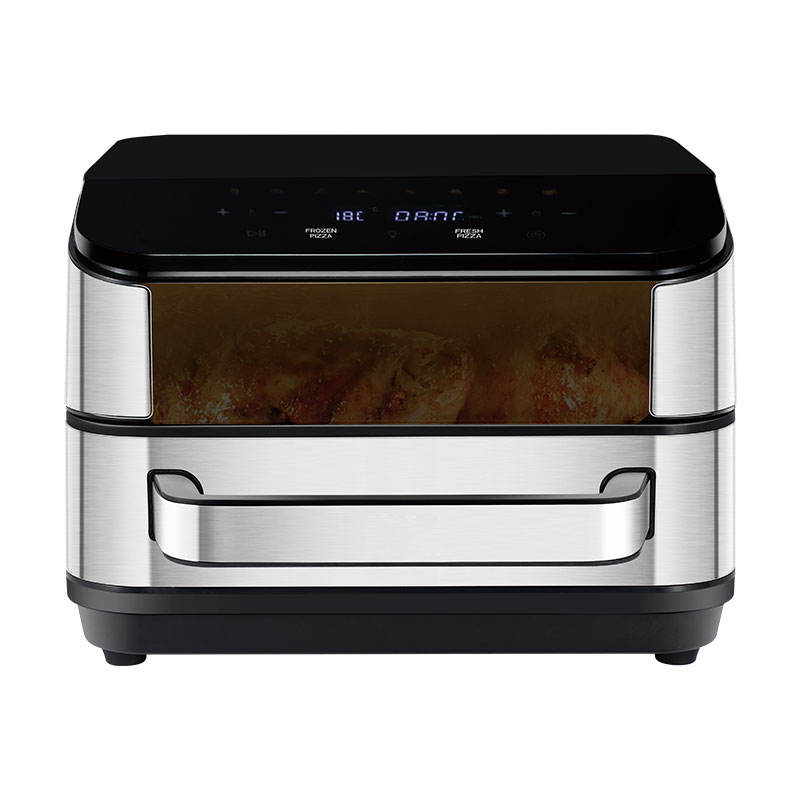
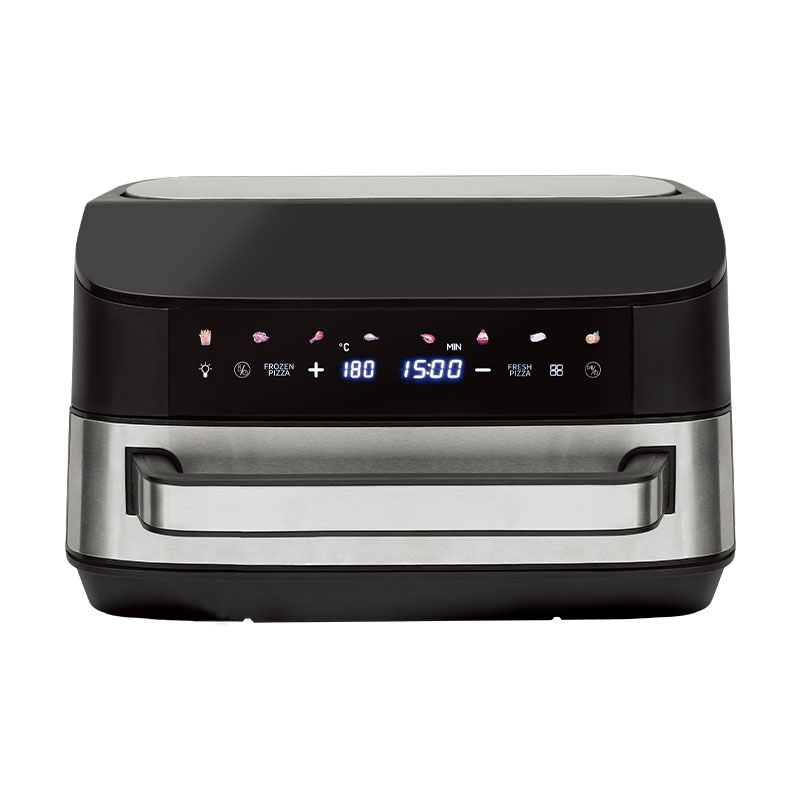
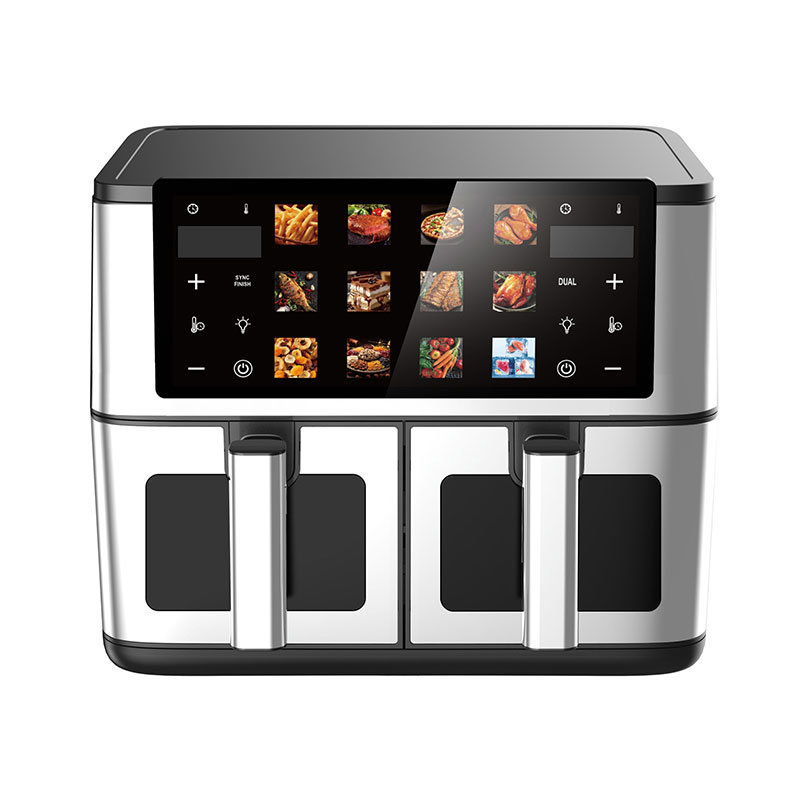
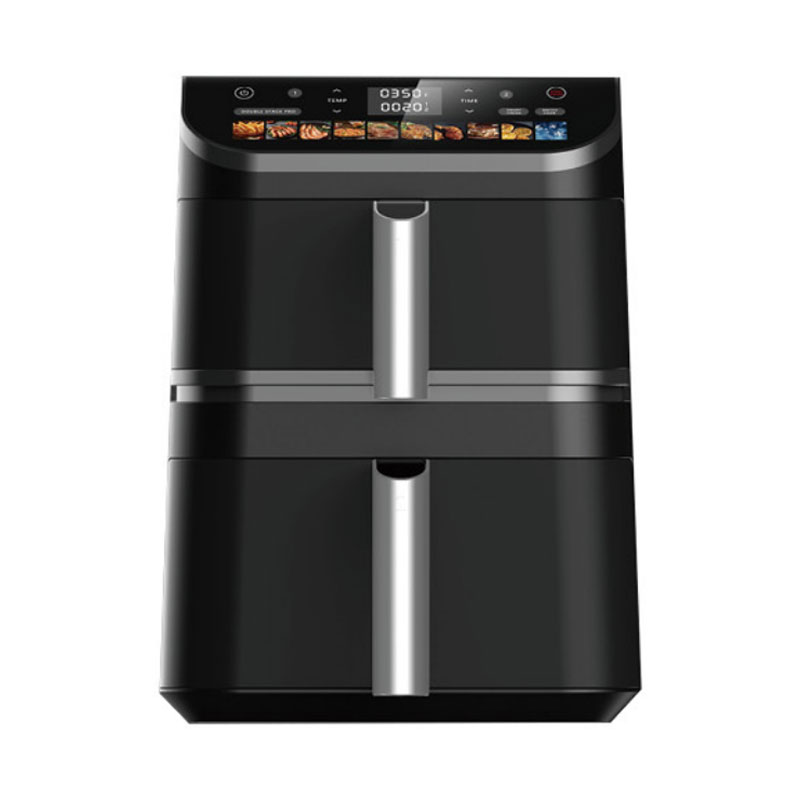
Top LCD touch control large capacity invisible comfortable handle air fryer
5. Temperature Flexibility from 80 to 200°C
The GSE034 provides a listed temperature range of 80–200°C. This range covers lower-temperature heating and warming applications as well as the higher temperatures commonly used for browning, crisping, roasting, and air frying. The flexibility enables users to adjust the cooking process according to the food type and desired texture.
Lower-temperature settings may be useful for gentle heating, warming prepared foods, or gradually cooking certain ingredients. Higher settings can support the surface browning associated with air-fried foods. Users should follow the food manufacturer’s instructions or tested recipes because cooking time and temperature depend on portion size, starting temperature, moisture content, and food density.
Temperature control is also valuable from a product-positioning perspective. A wider usable range gives retailers more opportunities to describe the appliance as a multipurpose countertop cooker rather than a single-function snack machine. This may broaden its appeal to consumers who want to reheat leftovers, roast vegetables, prepare frozen food, and experiment with home recipes.
For consistent performance, the heating system, fan, thermostat or temperature sensor, and control software must work together. Manufacturing quality is important because temperature inconsistency can lead to uneven cooking. A reliable production process should include inspection of heating elements, wiring, temperature sensors, control boards, fan operation, insulation, and final product performance.
6. Streamlined Exterior and Comfortable Handle Design
Kitchen appliances occupy visible space, so exterior design influences purchase decisions as much as technical specifications. The invisible or integrated handle concept used in the product description is intended to reduce the visual prominence of the handle. This can help the air fryer appear more compact, smooth, and coordinated with modern kitchen interiors.
A streamlined handle may provide practical benefits beyond appearance. It can reduce protruding parts that might catch on clothing or interfere with nearby objects. It may also make the product easier to photograph, package, and display. The handle must nevertheless remain easy to locate and grip, particularly when the cooking drawer is warm or contains a heavy portion of food.
Ergonomic design requires attention to grip size, surface texture, opening force, hand clearance, heat protection, and the balance of the removable pot. These factors are important for both younger and older users. A handle that is visually concealed but difficult to hold would not provide a meaningful advantage, so engineering validation and consumer-use testing should form part of the development process.
The combination of a top LCD interface, large single-pot capacity, and integrated handle gives the GSE034 a distinct visual and functional identity. Compared with basic air fryers using exposed knobs and conventional protruding handles, this model is designed to offer a more modern presentation while retaining the core practicality expected from a countertop cooking appliance.
7. Advantages Compared with Basic Competitor Models
7.1 Larger usable household capacity
Many entry-level air fryers are designed around compact baskets that suit one or two portions. The 6.5-liter chamber of the GSE034 is positioned for larger households and users who want fewer cooking cycles. This can be a meaningful advantage for families, shared homes, and consumers who prepare food in batches.
7.2 More contemporary controls
Mechanical dials remain functional, but LCD touch control can provide a more polished appearance and clearer digital setting information. This feature may help the product compete in retail categories where consumers compare not only cooking performance but also interface design and perceived technology level.
7.3 Broader cooking flexibility
The listed 80–200°C range gives users flexibility across warming, reheating, roasting, and crisping tasks. A product with a clear digital interface and adjustable settings can be easier to position as a multipurpose appliance, especially when supported by a well-designed recipe guide.
7.4 Integrated handle appearance
The invisible comfortable handle gives the exterior a cleaner profile than many traditional designs. It can help the appliance look less bulky on the countertop and may improve the product’s appeal in lifestyle-oriented retail photography.
7.5 International market potential
The 50/60Hz frequency specification and listed CE, CB, GS, RoHS, and LFGB certifications indicate that the product has been developed with international sales in mind. Certification acceptance depends on the destination market, product version, testing scope, and current regulations. Buyers should complete their own compliance review, but the listed documentation categories can support an organized import approval process.
7.6 Suitable balance between consumer and business needs
The GSE034 is primarily a household appliance, yet its capacity and straightforward operating concept can also interest small hospitality businesses, staff kitchens, holiday-rental operators, and office catering environments. It is not a substitute for a high-volume commercial fryer, but it may provide a practical supplementary cooking solution where countertop convenience matters.
8. Manufacturing Materials and Component Considerations
The product uses a combination of PP, PA, aluminum, ABS, PC, and SS430. Each material can serve a different role in the overall appliance. Polypropylene is commonly used for molded components that require a balance of light weight, chemical resistance, and cost efficiency. Polyamide can be used where greater mechanical strength or heat resistance is required, depending on the specific grade and component.
ABS is widely used in appliance housings because it can support attractive surfaces, structural rigidity, and efficient injection molding. Polycarbonate may be selected for components requiring transparency, impact resistance, or dimensional stability. Aluminum is commonly associated with heat-related parts because of its thermal conductivity and relatively low weight. SS430 stainless steel can be used in selected structural or cooking-related areas where corrosion resistance and cleanability are important.
Material selection alone does not determine product quality. The grade, supplier consistency, molding accuracy, surface finish, assembly method, and application environment all matter. A capable manufacturer should maintain approved material specifications and incoming inspection procedures. It should also control changes carefully so that a substitute material does not affect safety, heat resistance, appearance, or durability.
Food-contact components require particular attention. Materials used near food should comply with the relevant requirements of the destination market. The listed LFGB certification reference may be relevant to food-contact evaluation, but buyers should request the complete test reports and verify that they apply to the exact product configuration, materials, and intended market.
9. Engineering and Product Development Capability
Cixi Gstar Electric Appliance Co., Ltd. has experience in designing and developing small kitchen appliances. The company’s product range includes blenders, slicers, choppers, food processors, smokeless grills, hot pots, air fryers, and air ovens. This product breadth is valuable because many appliance technologies share common engineering requirements, including motor systems, heating systems, electronic controls, injection-molded housings, food-contact components, and packaging development.
The company information identifies an R&D department with ten engineers and a QC department with ten quality-control personnel. These teams can support activities such as product improvement, sample development, design verification, process inspection, defect analysis, and customer-specific modifications. For an importer, access to engineering and quality personnel can shorten communication cycles when specifications, packaging, artwork, or compliance documents need to be reviewed.
Product development for an air fryer requires coordination between industrial design and thermal engineering. The exterior must be attractive, but the internal airflow path must also support effective circulation. The heating element, fan, cooking chamber, drawer, basket, insulation, and control system need to be considered as one integrated assembly. Changes to one part can affect temperature, noise, power consumption, assembly time, or user safety.
Engineering validation may include thermal testing, electrical safety checks, endurance cycling, drop testing of selected components, handle-load testing, drawer insertion and removal testing, touch-panel testing, and packaging transportation tests. The exact test plan depends on the market and customer requirements. A structured validation process helps identify weaknesses before mass production and reduces the risk of field complaints.
10. Production Facilities and Manufacturing Scale
The company states that it moved into its own new factory in 2018. The facility is described as occupying approximately 10,000 square meters, with a building area of approximately 18,000 square meters. The company also reports a wholly owned plant with a production area of approximately 15,000 square meters and more than 200 experienced workers. These figures should be confirmed during supplier qualification because facility descriptions can change as production expands or is reorganized.
A dedicated factory can provide advantages in production coordination, quality supervision, engineering communication, and scheduling. When key processes are managed within an integrated manufacturing environment, the company may be able to respond more quickly to sample revisions, packaging changes, production inspections, and corrective actions.
Manufacturing scale is particularly relevant to wholesale and private-label projects. Large orders require stable purchasing of components, predictable assembly capacity, organized warehouse management, and reliable shipment planning. The reference loading quantity of 1,348 pieces per 40-foot high-cube container provides buyers with an initial logistics planning figure. Actual loading may vary according to packaging configuration, pallet use, carton orientation, and shipping requirements.
The listed minimum order quantity is also shown as 1,348 pieces per 40-foot high-cube container. This indicates a container-oriented order reference rather than a small trial quantity. Buyers should confirm whether mixed models, mixed colors, customized packaging, or partial-container orders are possible under current commercial terms.
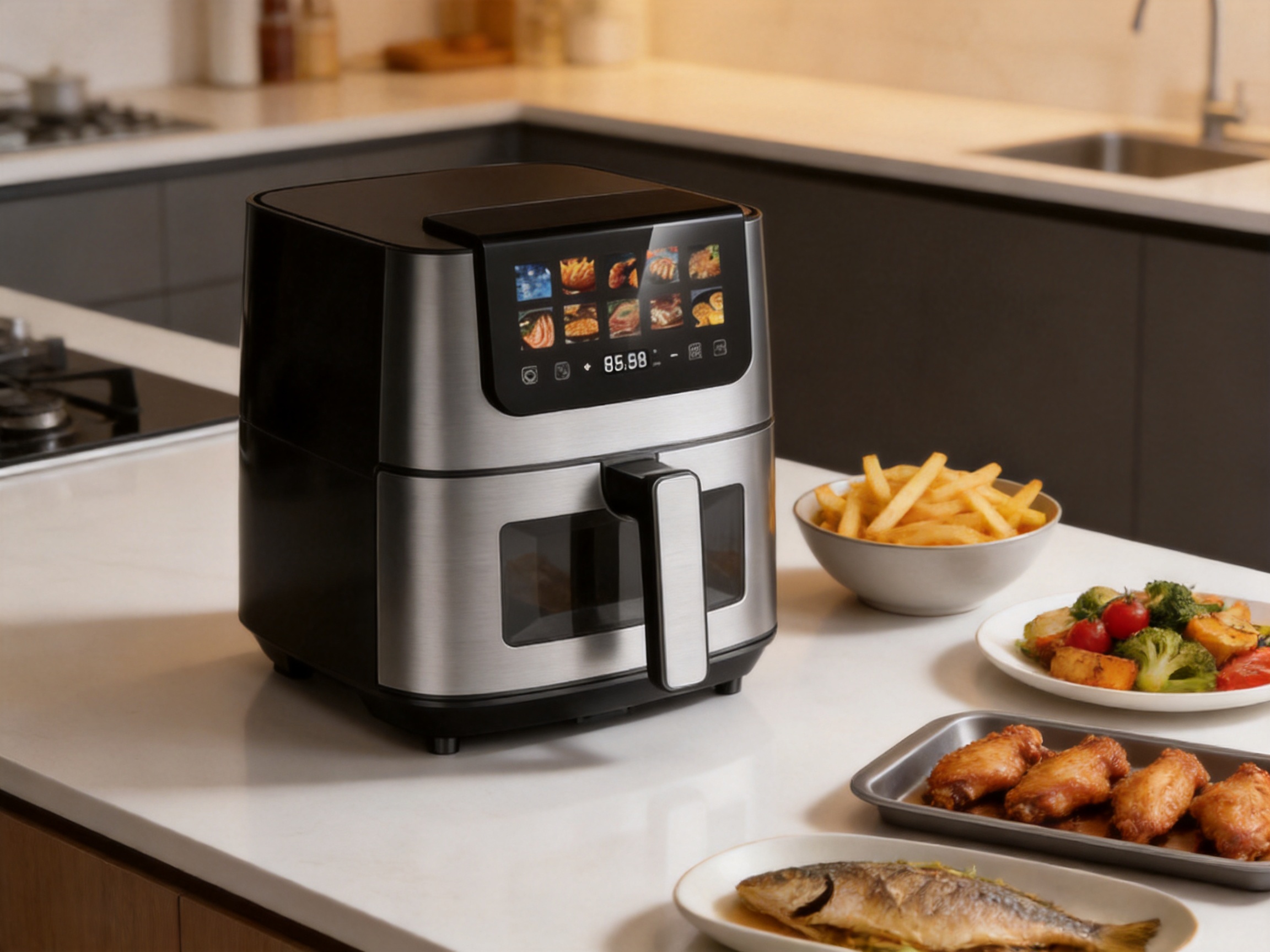
11. Quality-Control Processes for Air Fryer Production
Quality control should begin before assembly. Incoming materials and components can be inspected for dimensions, appearance, color, electrical ratings, material identity, and supplier documentation. Components such as heating elements, fans, motors, control boards, power cords, switches, sensors, and fasteners should be controlled against approved specifications.
During production, quality personnel can monitor injection-molded parts, metal components, wiring, terminal connections, insulation, assembly torque, and alignment. The purpose of in-process inspection is to detect problems before they are hidden inside the completed appliance. For example, loose wiring or an incorrectly positioned sensor may be more difficult and expensive to correct after final assembly.
Finished-product inspection can include appearance checks, power-on testing, touch-panel operation, heating operation, fan operation, timer performance, temperature control, drawer movement, handle strength, and abnormal-noise checks. A sample-based performance test can be supplemented by routine safety checks on every unit, depending on the manufacturer’s quality plan and customer requirements.
Reliability testing is also important. Repeated opening and closing of the drawer can reveal weaknesses in rails, latches, handles, or alignment. Extended heating cycles can expose problems with thermal insulation, wiring, control boards, and temperature sensors. Repeated touch operations can identify display or control responsiveness issues. These tests help support consistent performance across production batches.
Corrective-action procedures should be available when a defect is detected. A strong process records the problem, identifies its root cause, defines the responsible department, establishes a corrective measure, and verifies that the issue has been resolved. This approach is more effective than simply removing defective units from one shipment without addressing the underlying process.
12. Certification and Compliance Planning
The product information lists CE, CB, GS, RoHS, and LFGB certifications. These references can support initial market evaluation, but certification is not automatically transferable between every country or product variation. Compliance may depend on voltage, plug, frequency, power rating, materials, labeling, packaging, instructions, and the specific test report.
CE marking is associated with applicable European Union requirements, while CB documentation can support international electrical-safety evaluation through participating certification bodies. GS is commonly associated with tested safety and quality requirements for the German market. RoHS addresses restrictions on certain hazardous substances in electrical and electronic equipment. LFGB is associated with food-contact material requirements in Germany and related evaluation contexts.
Importers should request current certificates, test reports, declarations, critical-component lists, factory information, and product photographs. They should also verify the certification holder, model number, rated input, applicable standards, report dates, and whether the documents cover the exact version being purchased. Where a private-label name is used, the relationship between the original model and the branded version should be documented.
Compliance planning should begin before tooling, artwork, or mass production. Changes to the heating system, control board, power cord, food-contact parts, or enclosure can affect testing. Early coordination reduces the possibility of costly changes after production has started.
13. Packaging, Logistics, and Export Preparation
The product is listed with a gift box size of 40 × 33 × 34.2cm and a carton size of 41.5 × 34.5 × 36cm. These dimensions provide a basis for freight calculations, warehouse planning, shelf presentation, and container loading. Packaging design should protect the display, housing, drawer, handle, and other vulnerable components during handling and transportation.
Packaging materials should be selected to limit movement inside the carton. Internal supports can help prevent the cooking drawer from striking the housing, while protective films or bags may reduce surface scratches. The package should also include clear handling marks where required, especially if the product must remain upright or protected from moisture.
Retail packaging can serve both protective and promotional functions. The front panel may emphasize the 6.5-liter capacity, LCD touch control, temperature range, and modern handle design. Side panels can present cooking applications, electrical information, dimensions, and certification references. The final artwork must be reviewed for accuracy and compliance with the destination market’s labeling rules.
With a listed gross weight of 7.5kg and net weight of 6.5kg, the product is substantial enough to require thoughtful handling. Warehouse operators and retailers should consider carton stacking limits, pallet patterns, lifting procedures, and last-mile delivery requirements. A well-designed carton can reduce damage rates and improve the customer’s first impression.
For container planning, the stated reference quantity is 1,348 pieces per 40-foot high-cube container. The actual quantity should be confirmed after final packaging approval. If the buyer requests different accessories, manuals, colors, or packaging inserts, the carton dimensions or loading efficiency may change.
14. Private-Label and Wholesale Opportunities
The GSE034 can be considered by companies seeking a modern air fryer for wholesale distribution or private-label development. The product has several features that can be communicated clearly in catalogues and online listings: large capacity, digital touch control, adjustable temperature, streamlined handle design, and a single-pot format.
Private-label buyers may wish to discuss logo placement, product color, control-panel artwork, packaging design, user manuals, recipe cards, and regional electrical configurations. Any customization should be evaluated for tooling cost, minimum order quantity, lead time, certification impact, and production feasibility.
Retailers may also segment the product for different customer groups. For family households, the emphasis can be on capacity and meal preparation. For technology-oriented buyers, the LCD interface and modern exterior can be highlighted. For consumers seeking countertop convenience, the integrated handle and straightforward single-pot structure may be central selling points.
Distributors should avoid presenting the appliance as a professional deep fryer or claiming results that depend entirely on recipe conditions. Accurate communication builds trust. Marketing materials should explain that air frying uses circulating heated air and generally requires less added oil than deep frying, while also advising users to follow food-specific preparation guidance.
15. Application Scenarios
15.1 Family kitchens
The large capacity is suited to households preparing meals for several people. Users can cook larger batches of side dishes, frozen foods, vegetables, or protein products without relying on a small cooking chamber. The digital interface can also make daily operation easier for family members with different levels of cooking experience.
15.2 Apartment and condominium living
Air fryers are attractive in homes where users want a compact alternative to some larger cooking equipment. The GSE034 remains a countertop appliance, but its single-pot design can support a broad range of tasks without requiring a full-size oven for every meal.
15.3 Office kitchens and staff rooms
An air fryer can provide an additional food-heating option in an office environment. The appliance should be operated according to workplace safety policies, with sufficient ventilation and adequate clearance around the housing. A cleaning schedule is also important when several people share the product.
15.4 Holiday rentals and serviced accommodation
Property managers may select air fryers as guest amenities because they are relatively simple to operate and useful for quick meals. In these settings, clear instructions, durable packaging, and easy-to-clean components can influence purchasing decisions.
15.5 Small hospitality operations
Small cafés, bars, and food-service venues may use an air fryer for limited-volume side dishes or supplementary preparation. It should not be represented as a replacement for high-capacity commercial cooking equipment unless the specific product has been tested and approved for that purpose.
16. Cleaning, Maintenance, and Ownership Experience
Cleaning is a major factor in customer satisfaction. Food residue, grease, and crumbs should be removed according to the user manual. The cooking pot and basket should be handled carefully to preserve coatings or surfaces. Users should avoid abrasive tools or cleaning products unless the manufacturer specifically permits them.
The exterior LCD panel should be cleaned with a suitable soft cloth rather than exposed directly to water. The appliance should be unplugged and allowed to cool before cleaning. Ventilation openings must remain unobstructed because restricted airflow can affect performance and increase heat accumulation.
A well-designed product can reduce maintenance effort through removable cooking components, accessible surfaces, smooth exterior geometry, and limited areas where food particles can collect. These details may appear minor, but they influence whether consumers continue using the air fryer regularly after the initial purchase.
Manufacturers and distributors can support ownership experience by providing clear instructions for preheating, food loading, shaking or turning where appropriate, temperature adjustment, cleaning, storage, and troubleshooting. Recipe guidance can also help users understand how to use the full capacity without overcrowding the cooking chamber.
17. Why Manufacturer Experience Matters
Gstar’s company history reflects a progression from sourcing and product development into manufacturing its own small appliances. The company information states that it was founded in 2009 and initially focused on non-electric innovative products, including spiralizer drum graters, iced pitchers, and iced bowls. The company later expanded into electric products and developed a broader range of kitchen appliances.
This background can be relevant because successful appliance development requires more than factory assembly. It involves market understanding, product selection, industrial design, supplier management, engineering, quality assurance, packaging, and after-sales support. Experience across both non-electric and electric categories can provide a wider perspective on usability, materials, and consumer expectations.
The company reports that its products have been sold to international customers and that its electric products have received favorable reception in multiple countries. It also identifies experience with supermarket and retail customers. Such experience may help the manufacturer understand the importance of packaging consistency, delivery schedules, product documentation, inspection standards, and commercial communication.
The company’s stated production philosophy emphasizes innovative products, competitive pricing, quick delivery, after-sales service, and close cooperation with customers as engineering partners. For buyers, the practical value of this philosophy depends on how well it is demonstrated through samples, documentation, production records, communication speed, and shipment performance. Supplier evaluation should therefore combine company claims with independent verification and quality audits.
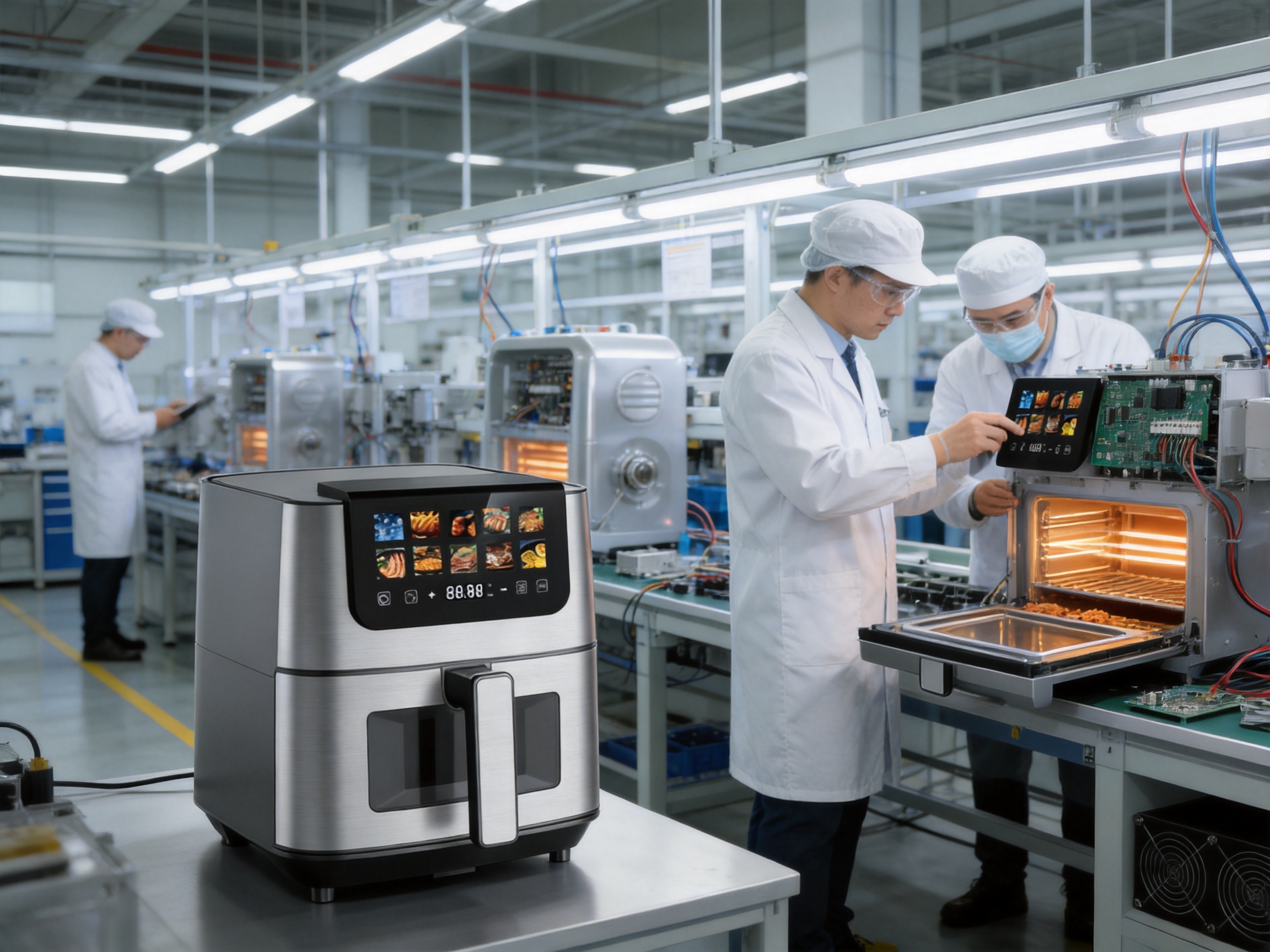
18. Buyer Evaluation Checklist
Before placing an order, buyers should confirm the exact model number, rated voltage, frequency, power, plug, color, control functions, temperature range, timer range, cooking-pot configuration, and included accessories. They should also confirm whether the sample matches the version intended for mass production.
Documentation should include a specification sheet, user manual, packaging artwork, certification documents, test reports, declaration documents where applicable, and a list of critical components. Buyers should verify that all documents identify the same model and electrical version.
Quality expectations should be documented in an approved sample or written specification. This may cover housing color, surface finish, display brightness, touch response, drawer fit, handle comfort, noise level, heating performance, carton appearance, and acceptable defect limits.
Commercial terms should clarify minimum order quantity, sample charges, tooling, payment conditions, production lead time, inspection arrangements, spare parts, warranty support, shipping terms, and procedures for handling defective goods. If the order is for a retail chain, additional requirements may apply to social compliance, factory audits, barcode labels, palletization, and delivery appointments.
19. Q&A
What is the capacity of the GSE034 air fryer?
The product has a 6.5-liter single-pot cooking capacity. This format is intended for larger household portions and users who want to reduce the number of cooking cycles compared with smaller personal air fryers.
What type of control does it use?
It uses an LCD touch-control interface. The control panel is designed to allow users to adjust cooking settings such as temperature and time through touch-sensitive controls. The exact preset programs and display functions should be confirmed in the final user manual.
What temperature range is available?
The listed temperature range is 80–200°C. This range supports lower-temperature warming and reheating as well as higher-temperature air frying, roasting, and browning applications.
What does the invisible comfortable handle mean?
It refers to a handle integrated into the appliance’s overall design so that it is less visually prominent than a conventional protruding handle. The intended benefits are a cleaner exterior appearance and a comfortable grip during operation.
Is this air fryer suitable for large families?
The 6.5-liter capacity is designed to be more suitable for family use than many compact air fryers. Actual portion size depends on the food and how it must be arranged for effective hot-air circulation.
Can the product be used in commercial kitchens?
It may be useful as a supplementary countertop appliance in small hospitality or food-service environments, but it should not automatically be treated as heavy-duty commercial equipment. Buyers should confirm the intended operating duty cycle and applicable commercial requirements with the manufacturer.
What materials are used?
The listed materials are PP, PA, aluminum, ABS, PC, and SS430 stainless steel. The specific application of each material should be confirmed through the product’s technical file and component drawings.
What certifications are listed?
The product information lists CE, CB, GS, RoHS, and LFGB. Buyers should obtain current documents and verify that they cover the precise model, electrical version, materials, and destination market.
What are the product dimensions?
The listed product dimensions are approximately 37 × 30 × 30cm. The gift box is approximately 40 × 33 × 34.2cm, and the export carton is approximately 41.5 × 34.5 × 36cm.
How much does the product weigh?
The listed gross and net weights are 7.5kg and 6.5kg respectively. Final shipping weight may vary if packaging, accessories, manuals, or regional electrical components are changed.
How many units fit in a 40-foot high-cube container?
The supplied information gives a reference quantity of 1,348 pieces per 40-foot high-cube container. The final quantity should be reconfirmed after packaging and loading arrangements are approved.
Can the product be customized for private-label sales?
Private-label options should be discussed directly with the manufacturer. Possible areas may include packaging, logo application, color, manuals, recipe materials, and regional electrical configurations. Customization can affect minimum order quantity, lead time, cost, and certification.
What should users consider when cooking?
Users should avoid overfilling the cooking chamber, follow food-specific temperature and time guidance, keep ventilation openings clear, and clean the cooking components after use. Food results depend on ingredients, portion size, moisture, starting temperature, and arrangement.
20. Conclusion
The GSE034 air fryer combines several features that respond to current expectations in the small kitchen appliance market. Its 6.5-liter single-pot capacity is intended for family-sized cooking, while its LCD touch control provides a modern and accessible operating interface. The 80–200°C temperature range supports multiple cooking applications, and the integrated comfortable handle contributes to a cleaner exterior and easier handling.
Compared with basic air fryers, the model is designed to stand out through its combination of capacity, digital controls, streamlined styling, and international-market-oriented specifications. Its material composition, packaging dimensions, listed certifications, and container-loading reference provide useful starting points for wholesale and distribution planning.
The manufacturer’s broader experience in small kitchen appliances, dedicated production facilities, engineering resources, quality-control personnel, and history of international product development further support the product’s commercial potential. For importers and private-label buyers, however, successful cooperation should be based on verified samples, current compliance documentation, written quality standards, confirmed production capacity, and clear logistics arrangements.
As consumers continue to seek convenient countertop cooking solutions, a large-capacity LCD touch air fryer can occupy an attractive position between compact personal appliances and larger kitchen equipment. With appropriate product education, reliable manufacturing controls, and accurate market positioning, the GSE034 can serve as a practical option for household retail, wholesale distribution, and selected hospitality applications.
References
1. Product specification sheet for item GSE034, including capacity, materials, power, dimensions, temperature range, packaging, and certification references.
2. General principles of hot-air frying, countertop appliance operation, food preparation, and temperature management.
3. International guidance concerning electrical appliance safety, electromagnetic compatibility, restricted substances, and food-contact materials.
4. Manufacturer-provided company profile covering product development, factory facilities, engineering resources, quality control, and export experience.
5. Standard practices for appliance packaging, container loading, incoming inspection, in-process quality control, finished-product testing, and supplier qualification.