
 English
 中文简体
中文简体 Español
 English
 中文简体
中文简体 Español
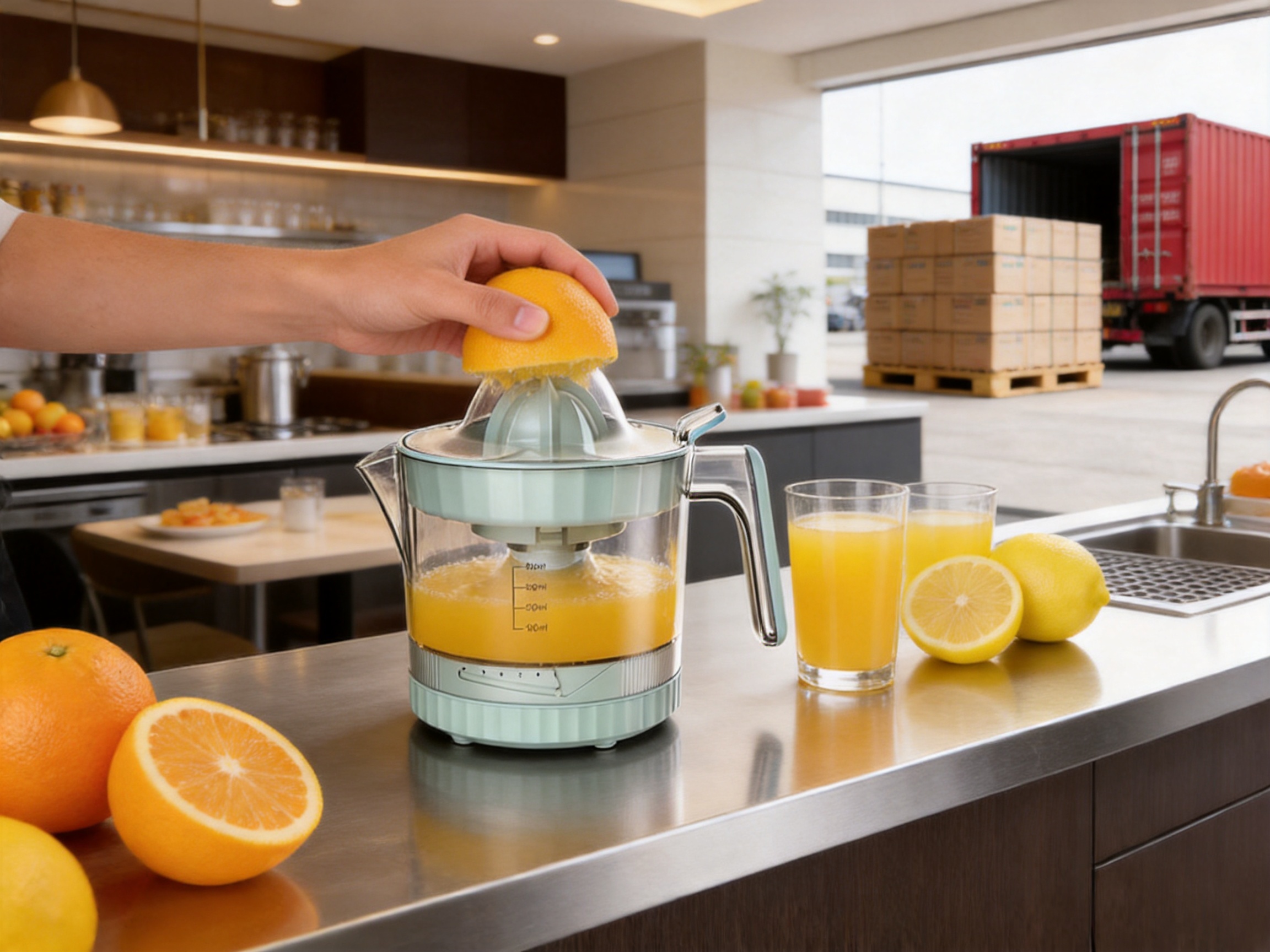
Fresh citrus juice remains one of the simplest ways to add flavor, acidity, and natural refreshment to everyday meals and beverages. However, manually squeezing oranges, lemons, limes, and grapefruits can be slow, inconsistent, and tiring, particularly when juice is required for breakfast service, family cooking, cafés, restaurants, or hospitality operations. The Citrus Juicer GSE017/GSE018 series provides a practical electric solution for these everyday tasks by combining compact construction, straightforward operation, food-contact materials, and two differentiated power and capacity configurations.
The GSE017 and GSE018 models are designed for users who want the convenience of electric extraction without the complexity, high cost, or large footprint associated with commercial juicing equipment. They are suitable for home kitchens, small food-service businesses, hotel breakfast areas, beverage counters, office pantries, and retail programs requiring dependable small kitchen appliances. Their core purpose is clear: to make citrus preparation faster and easier while keeping the product accessible, simple to maintain, and suitable for regular use.
This article examines the product design, operating benefits, specifications, material choices, manufacturing capabilities, quality systems, export readiness, and purchasing considerations associated with the GSE017/GSE018 citrus juicer series. It also explains how an experienced small-appliance manufacturer can support product development, customization, quality control, and large-volume supply.
Product Overview and Intended Applications
The GSE017/GSE018 range consists of electric citrus juicers developed for extracting juice from common citrus fruits. The two versions offer different power ratings and capacities, allowing importers, distributors, retailers, and professional users to select a configuration that better matches their intended market.
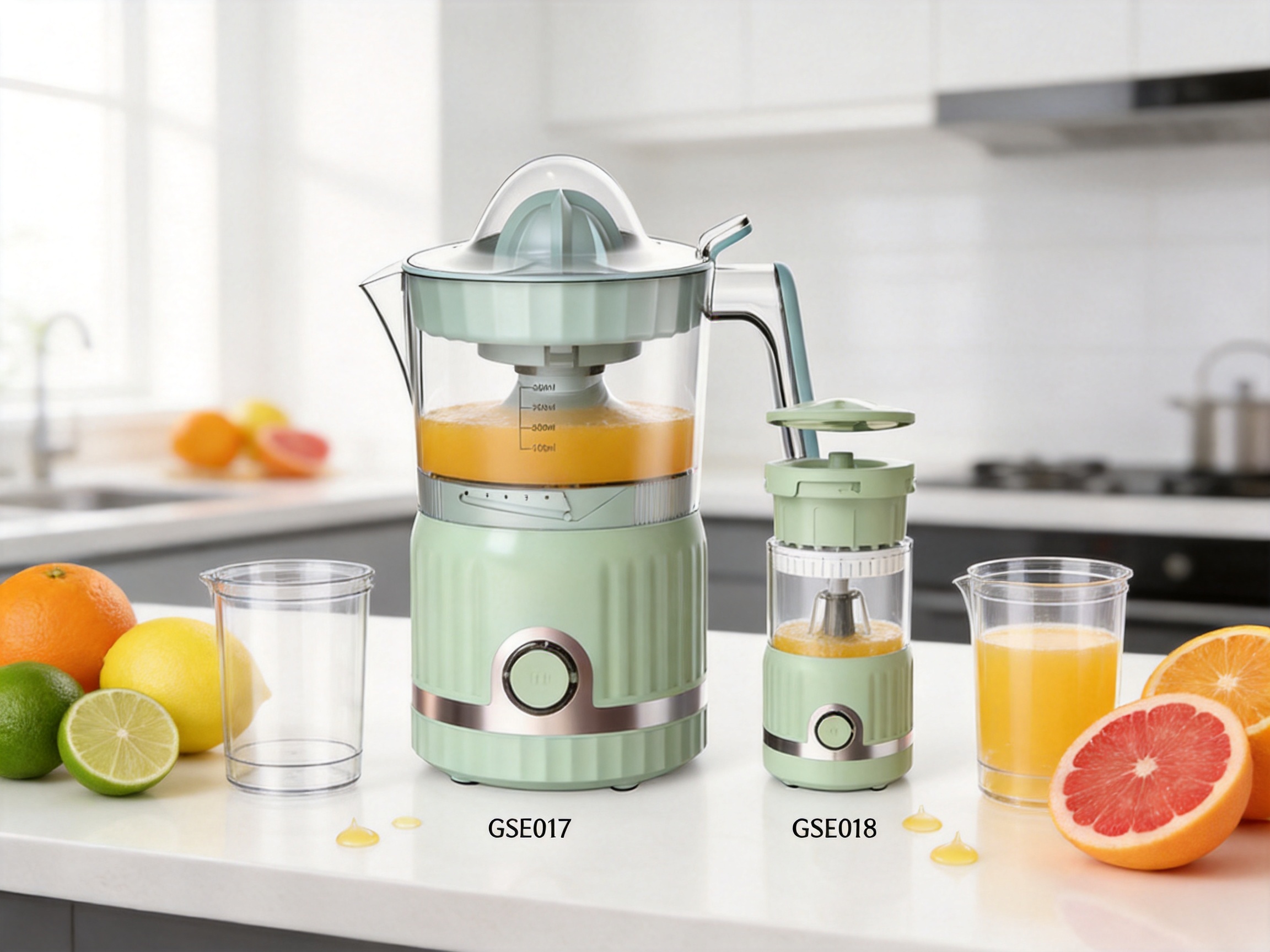
The GSE017 is specified with a 30-watt motor and a 500 ml capacity. Its larger collection volume makes it a practical choice for households and users who prefer to prepare a greater quantity of juice before emptying the container. It may also be well suited to breakfast counters, shared kitchens, and small-scale beverage preparation where multiple servings are made in succession.
The GSE018 is specified with a 45-watt motor and a 250 ml capacity. Its higher power rating supports a more performance-oriented configuration in a smaller format. The compact capacity can be advantageous for individual servings, smaller kitchens, apartment living, gift programs, and retail channels where a reduced footprint is important.
Both versions are based on the same essential product category: an electric citrus juicer intended to simplify pressing and extraction. Instead of requiring the user to apply repeated hand pressure, the motorized mechanism assists the reaming process. This can improve convenience and reduce effort during routine preparation.
The series can serve several important usage environments:
• Residential kitchens that need fresh juice for breakfast, cooking, dressings, desserts, and mixed drinks.
• Cafés and beverage counters that prepare small quantities of citrus juice or use citrus ingredients in drinks.
• Hotel breakfast rooms and guest-service areas where simple, compact appliances are preferred.
• Restaurants that require fresh lemon, lime, orange, or grapefruit juice as an ingredient.
• Office kitchens and shared facilities where an easy-to-operate appliance is more convenient than manual squeezing.
• Retail and promotional programs seeking an affordable small electrical kitchen appliance with broad consumer appeal.
Key Advantages of the Citrus Juicer Series
Electric Assistance for Faster Preparation
The most important benefit of the GSE017/GSE018 series is powered extraction. Manual citrus squeezing can require considerable force and repeated movement, especially when many fruits must be processed. An electric juicer helps transfer this work to the motor and reamer, making the process more convenient for a wider range of users.
Electric assistance is particularly valuable in situations where citrus is used frequently. A home user preparing several glasses of orange juice, a restaurant making fresh lemonade, or a hotel preparing ingredients for breakfast can benefit from a more repeatable and less labor-intensive process. The appliance is designed to make a common kitchen task more efficient without introducing unnecessary controls or complicated programming.
Two Configurations for Different Market Requirements
Offering both GSE017 and GSE018 versions gives purchasers greater flexibility. Some distributors may prefer a 500 ml configuration because it provides a larger collection volume and a family-oriented positioning. Other buyers may focus on compact appliances and select the 250 ml model with its 45-watt power specification.
This two-model approach can help a buyer create a broader product assortment while maintaining a focused citrus-juicer category. Retailers may position the GSE017 as a higher-capacity everyday model and the GSE018 as a compact or individual-use model. Importers can also select one model according to target-market preferences, packaging requirements, price points, and anticipated order volume.
Compact Small-Appliance Format
Citrus juicers are often used in kitchens where countertop space is limited. The compact format of this product category makes it easier to store the appliance when it is not in operation. Compared with larger multifunctional juicers or commercial extraction systems, a dedicated citrus juicer generally requires fewer components, less storage space, and less user training.
A compact appliance may also reduce shipping and retail-display challenges. The carton dimensions listed for the two models support organized master-carton planning, while the relatively lightweight construction can help distributors manage warehouse handling and outbound logistics.
Materials Selected for Practical Use
The GSE017 is listed with PP+AS materials, while the GSE018 specification lists PP, PA, ABS, AS, POM, copper, ABS, and PC components. These material combinations indicate the use of several engineering plastics and electrical or mechanical materials selected for different product functions.
Polypropylene, commonly identified as PP, is widely used in household appliances because it is lightweight, moldable, and suitable for many structural and container applications. AS, or acrylonitrile styrene, can provide a clear or attractive appearance for selected visible parts. ABS is commonly used for rigid housings and structural components. PA, or polyamide, can be useful in parts requiring mechanical strength and wear resistance. POM, or polyoxymethylene, is often applied to precision mechanical components because of its dimensional stability and low-friction characteristics.
The exact material allocation depends on the component and production design. In a properly engineered appliance, material selection supports the balance between durability, appearance, electrical safety, manufacturability, and cost. The use of different materials across the two models also allows the manufacturer to optimize each configuration according to its motor, structure, operating mechanism, and target positioning.
Food-Contact and Compliance Considerations
The product information lists CE, GS, CB, RoHS, LFGB, and FDA certifications or compliance references. These certifications and standards are important for buyers distributing electrical kitchen appliances in different international markets. They indicate that product development and testing can address electrical safety, restricted substances, and food-contact expectations.
Buyers should confirm the precise certificate scope, applicable model numbers, destination-market requirements, plug configuration, voltage, frequency, labeling, and test documentation before placing a commercial order. Certification requirements can vary according to the sales territory and final product configuration. A qualified manufacturing partner can help coordinate these details during product approval and pre-production preparation.
Product Specification Comparison
The following table summarizes the principal commercial and technical information supplied for the two models. The original product data identifies the GSE017 as a 500 ml version with a 24-piece carton quantity and the GSE018 as a 250 ml version with a 12-piece carton quantity.
| Specification | GSE017 | GSE018 |
|---|---|---|
| Product name | Citrus Juicer | Citrus Juicer |
| Power | 30 W | 45 W |
| Listed materials | PP + AS | PP + PA + ABS + AS + POM + copper + ABS + PC |
| Capacity | 500 ml | 250 ml |
| Pieces per carton | 24 pieces/carton | 12 pieces/carton |
| Carton size | 69.5 × 42.5 × 56.7 cm | 43.5 × 29.5 × 57 cm |
| Net weight | 14.2 kg | 12.4 kg |
| Gross weight | 20.0 kg | 13.0 kg |
| Estimated 20-foot container quantity | 3,624 pieces | 4,200 pieces |
| Estimated 40-foot high-cube quantity | 7,548 pieces | 10,080 pieces |
| Minimum order quantity | 2,000 pieces | 4,200 pieces |
| Certification references | CE, GS, CB, RoHS, LFGB, FDA | CE, GS, CB, RoHS, LFGB, FDA |
Container-loading figures are planning references and should be reconfirmed according to final packaging, palletization, loading method, and shipping conditions. Similarly, buyers should verify carton markings and packing details before production begins, particularly when private-label packaging or multilingual labeling is required.
How the Models Compare with Competing Products
The citrus-juicer market includes manual presses, basic electric reamers, multifunctional centrifugal juicers, and larger commercial extraction systems. The GSE017/GSE018 series is positioned most naturally between manual tools and complex high-capacity equipment. Its competitive strength comes from providing motorized convenience while retaining the simplicity associated with a dedicated citrus appliance.
Advantages over Manual Citrus Presses
Manual presses are inexpensive and require no electrical connection, but they depend entirely on the user’s hand strength and technique. They may also become uncomfortable during repeated use. The GSE017/GSE018 series reduces this physical effort and can make extraction more consistent from one fruit to the next.
A powered solution can be especially beneficial for users with limited hand strength or for operations that prepare citrus ingredients regularly. The appliance also presents a more modern retail proposition than a basic hand tool, which can make it attractive for small-appliance departments, online marketplaces, and promotional campaigns.
Advantages over Oversized Juicing Equipment
Large juicing systems may offer greater throughput, but they generally require more counter space, higher investment, more extensive cleaning, and greater operator familiarity. They can be unnecessary for households and small businesses that need only moderate quantities of citrus juice.
The compact GSE017/GSE018 approach allows buyers to serve customers who value convenience but do not need an industrial or restaurant-scale machine. This can broaden the addressable market and reduce barriers to purchase. The smaller format may also simplify product placement in kitchens, guest rooms, beverage stations, and compact apartments.
Advantages over Generic Low-Cost Electric Models
In a competitive market, price alone does not determine product value. A reliable supplier should support the appliance with structured engineering, controlled material selection, factory quality inspection, appropriate certifications, and responsive after-sales communication. These factors can distinguish a professionally developed product from an unverified generic item.
The manufacturer behind this series has experience in both non-electric innovative products and electric small kitchen appliances. Its engineering, quality-control, production, and export background provides a foundation for more consistent product development than a trading-only supply arrangement. For importers, this may reduce communication gaps and improve coordination from prototype review through mass production.
Manufacturing and Engineering Strengths
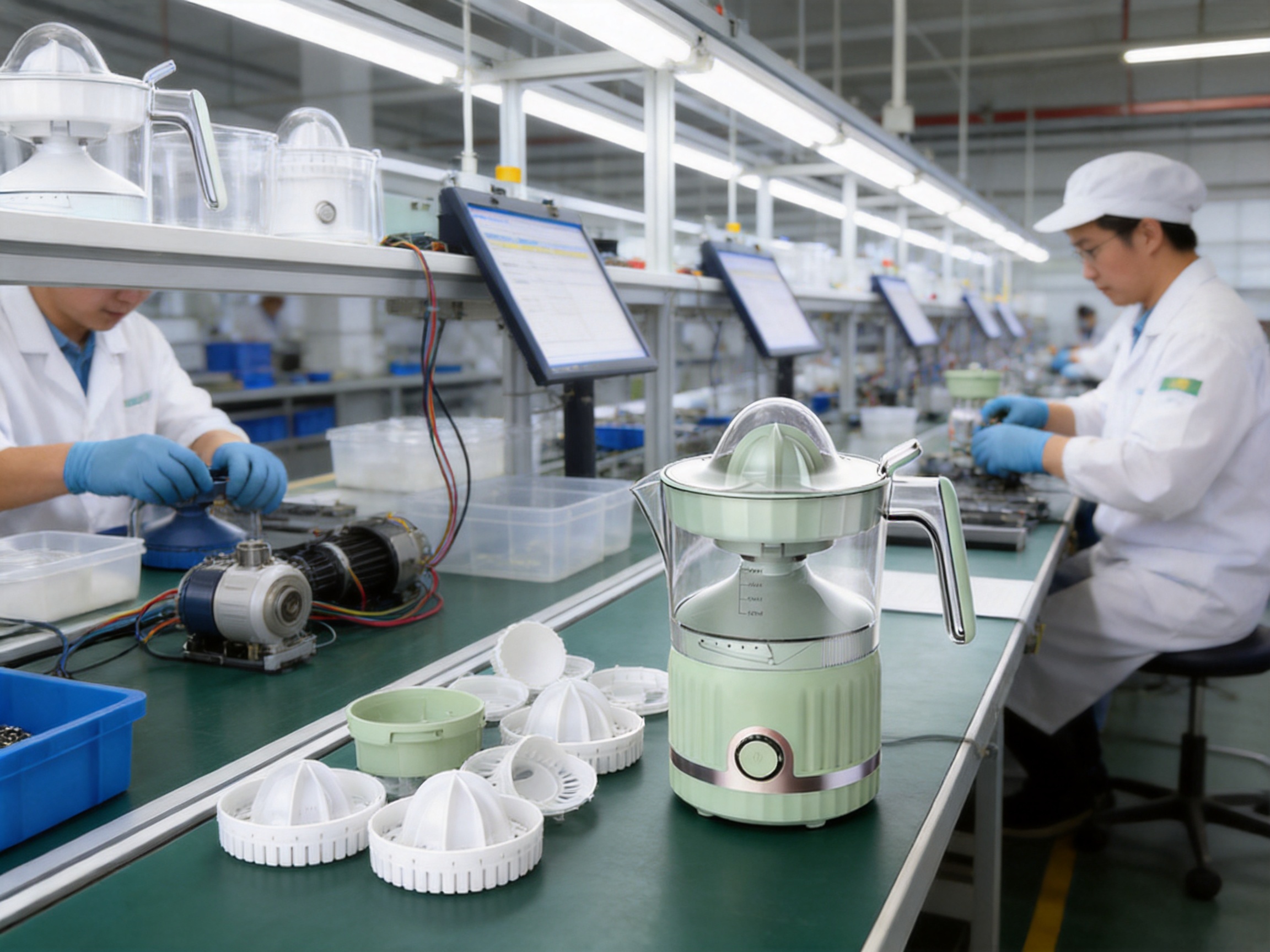
The company responsible for the product has developed from an export and product-sourcing background into a manufacturer with dedicated product development and production capabilities. This history is relevant because successful small-appliance manufacturing involves much more than assembling a motor and plastic housing. It requires product definition, mechanical design, tooling coordination, electrical engineering, material control, production planning, testing, packaging, and customer support.
The company reports a factory with approximately 15,000 square meters of production area, more than 200 experienced workers, engineering resources, and a dedicated quality-control team. Earlier company information also describes a 10,000-square-meter site with an 18,000-square-meter building area and approximately 150 workers at that stage of development. The difference reflects company growth and differing historical descriptions. Buyers should confirm current factory figures during supplier qualification, but both descriptions indicate a substantial manufacturing base rather than a purely commercial office.
Dedicated Research and Development
The reported R&D department includes approximately 10 engineers. This resource can support the development of new small kitchen appliances, refinement of existing products, technical problem-solving, and adaptation for customer requirements. For an electric citrus juicer, engineering attention may cover motor performance, reamer geometry, juice flow, splash control, component fit, noise behavior, electrical insulation, heat management, and cleaning convenience.
R&D capability also matters when a buyer needs changes to packaging, color, labeling, plug type, cord configuration, operating instructions, or regional compliance. A manufacturer with internal engineering knowledge can assess whether a requested change affects tooling, safety, production timing, or certification.
Quality-Control Organization
The company reports a QC department with approximately 10 personnel. Quality control should begin with incoming materials and continue through assembly, testing, final inspection, and shipment release. In a citrus juicer, relevant inspection points may include plastic appearance, dimensional accuracy, component matching, motor operation, switch response, electrical safety, noise, leakage prevention, container fit, and packaging integrity.
A structured QC process helps reduce risks such as incorrect components, cosmetic defects, unstable assembly, incomplete accessories, or inconsistent electrical performance. Buyers can strengthen this process by agreeing on approved samples, acceptable quality limits, inspection standards, testing records, and corrective-action procedures before mass production.
Experience across Multiple Product Categories
The manufacturer produces a broad range of small kitchen appliances and hospitality-related products, including blenders, slicers, choppers, food processors, smokeless grills, hot pots, air fryers, air ovens, ice buckets, beverage dispensers, pitchers, slicers, and graters. This range is valuable because it indicates familiarity with varied materials, motors, heating systems, cutting mechanisms, food-contact components, and consumer-use requirements.
Experience across several categories can support shared expertise in injection molding, electrical assembly, packaging design, product testing, and international compliance. It can also help an importer develop a coordinated product portfolio rather than sourcing each appliance from an unrelated supplier.
Manufacturing Process for a Small Electric Citrus Juicer
Product Planning and Specification Review
Production begins with a clear product specification. The manufacturer and customer should confirm the model number, power rating, capacity, materials, dimensions, electrical input, plug, color, branding, packaging, certification requirements, order quantity, and delivery schedule. This stage prevents misunderstandings that could otherwise affect tooling, production cost, or market approval.
For the GSE017/GSE018 series, model differentiation should be maintained carefully. The 30-watt, 500 ml GSE017 and the 45-watt, 250 ml GSE018 should be identified correctly in drawings, bills of materials, carton labels, manuals, and inspection documents. Clear model control is particularly important when both versions are manufactured in the same facility.
Engineering and Tooling Preparation
Once specifications are approved, engineering teams prepare product drawings, component lists, assembly instructions, testing procedures, and tooling requirements. Injection-molded parts must be designed with appropriate wall thickness, draft angles, ribs, bosses, snap-fits, and surface finishes. These details influence appearance, strength, assembly efficiency, and production consistency.
The collection container, housing, reamer, cover, support components, and other plastic parts must fit together accurately. A reliable fit helps prevent wobbling, unnecessary noise, liquid leakage, and difficult cleaning. Mechanical components such as shafts, couplings, gears, or POM parts must also be aligned correctly to support efficient motion and reduce premature wear.
Incoming Material Inspection
Before assembly, incoming materials and components should be checked against approved specifications. Plastic parts can be inspected for color, dimensions, warpage, surface defects, and material identification. Motors and electrical components can be reviewed for ratings, appearance, wiring, and performance. Packaging materials should be checked for print quality, dimensions, strength, and correct model information.
Material traceability is useful for identifying the source of any production issue. It can help the factory isolate affected batches and implement corrective action without unnecessarily interrupting unrelated production.
Plastic Component Production
Many visible parts of a citrus juicer are produced through injection molding. The process involves heating plastic resin, injecting it into a prepared mold, cooling the formed part, and removing it for inspection. Stable molding conditions are important for achieving consistent dimensions and clean surfaces.
Process controls may include resin drying where necessary, barrel-temperature monitoring, injection-pressure management, cooling-time control, mold maintenance, and regular first-piece approval. Properly managed molding helps ensure that containers, covers, housings, and supports fit correctly during final assembly.
Motor and Electrical Assembly
The electric drive system is assembled with attention to wiring, insulation, terminals, motor seating, switch operation, and strain relief. Electrical assembly must be controlled carefully because safety and reliability depend on correct routing and secure connections. Operators should follow standardized work instructions, while line inspectors verify critical points.
Electrical tests may include power-on operation, insulation checks, dielectric-strength testing where applicable, grounding or leakage-current checks according to the product design, and functional verification. The precise test program should reflect the destination-market standards and approved certification documents.
Mechanical Assembly and Functional Testing
After the electrical and plastic components are prepared, the product is assembled into a complete juicer. The reamer, drive connection, collection container, cover, controls, and housing must operate together smoothly. Each finished unit should receive functional testing rather than relying only on visual inspection.
Functional testing can verify that the motor starts correctly, the juicing mechanism rotates as intended, the container remains stable, and the appliance responds properly to its control method. Where appropriate, sample testing with citrus fruit or a controlled test medium can help evaluate extraction behavior, stability, splash resistance, and ease of operation.
Final Inspection and Packing
Final inspection should confirm the correct model, appearance, accessories, user documentation, labels, power information, and carton configuration. Products that pass inspection are packed using approved protective materials to reduce damage during domestic handling, container loading, and international transport.
Carton packing must be coordinated with the model’s quantity and dimensions. The GSE017 is listed at 24 pieces per carton, while the GSE018 is listed at 12 pieces per carton. Correct carton counts and markings are essential for warehouse receiving, inventory control, customs documentation, and retail distribution.
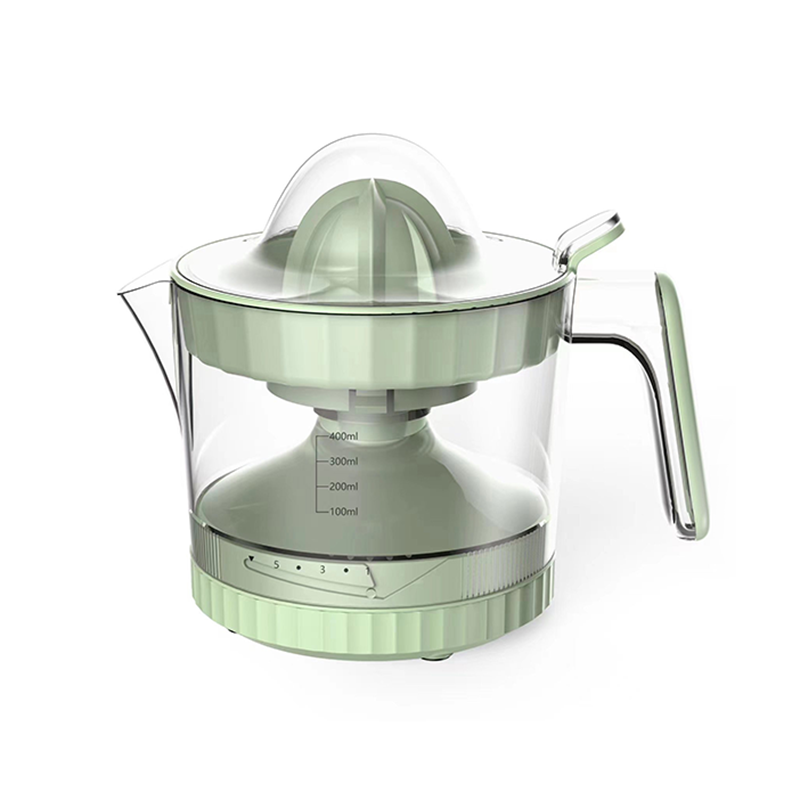
Citrus Juicer GSE017/GSE018
Design Details That Influence User Satisfaction
Capacity and Serving Size
Capacity directly affects the user experience. The 500 ml GSE017 container allows users to collect more juice in a single preparation cycle, reducing the need for frequent emptying. This can be convenient for families and shared kitchens. The 250 ml GSE018 is more suitable when smaller quantities are preferred or when compact storage and a smaller serving format are priorities.
Capacity should not be evaluated in isolation. Buyers should also consider the size of citrus fruits commonly used in the target market, expected serving sizes, packaging position, consumer demographics, and retail price. A model with a smaller container can still be highly competitive when its compactness and higher specified power align with the intended use.
Power Selection
The GSE017 is specified at 30 watts, while the GSE018 is specified at 45 watts. Power is one factor in motor performance, but it should not be interpreted as the only measure of juicing effectiveness. Reamer design, transmission efficiency, fruit condition, operating cycle, electrical input, and thermal management also influence results.
The two power configurations give buyers an opportunity to address different market messages. The GSE017 can be positioned around practical capacity and everyday family use. The GSE018 can be positioned around compact design and a higher power specification. Product communication should remain accurate and should avoid promising performance beyond the verified test results.
Ease of Operation
A dedicated citrus juicer is inherently easier to understand than a multifunctional appliance with numerous settings. Simple operation can reduce the learning curve and make the product approachable for first-time users. It can also reduce the time required for staff training in cafés, hotels, and restaurants.
Clear instructions should explain fruit preparation, safe operation, cleaning, storage, and electrical precautions. Retail packaging and manuals should identify the model accurately and provide guidance appropriate to the destination market.
Cleaning and Maintenance
Fresh juice contains pulp, seeds, and natural sugars that can remain on food-contact surfaces after use. Easy cleaning is therefore a central consideration when evaluating any citrus juicer. Buyers should review which parts can be removed, how easily pulp can be cleared, whether surfaces are accessible, and what cleaning methods are permitted.
Users should follow the supplied instructions and avoid immersing electrical components in water. Food-contact components should be cleaned promptly after use to minimize residue buildup. Importers may also request detailed cleaning diagrams, replacement-part information, and maintenance guidance as part of the technical documentation package.
Commercial and Supply-Chain Benefits
Suitable for Wholesale Programs
The GSE017/GSE018 series is suitable for wholesale purchasing because it is a focused product with broad household and light-commercial applications. Its relatively simple function can make product education easier than for advanced multifunctional appliances. Buyers can introduce it through kitchen-appliance distributors, supermarket programs, online stores, hospitality suppliers, promotional channels, and private-label catalogs.
The listed minimum order quantities are 2,000 pieces for GSE017 and 4,200 pieces for GSE018. These quantities indicate that the products are intended for substantial commercial programs rather than isolated small orders. The buyer should confirm whether the MOQ applies to a single color, model, packaging design, or combined order, since these details can affect production planning.
Container-Loading Potential
The supplied logistics data lists estimated loading quantities of 3,624 GSE017 pieces and 4,200 GSE018 pieces in a 20-foot container, and 7,548 GSE017 pieces and 10,080 GSE018 pieces in a 40-foot high-cube container. These figures can help buyers create preliminary purchasing and freight estimates.
Because actual loading depends on final carton design and shipping procedures, the figures should be validated before a purchase order is finalized. Even so, the data demonstrates that the product can be planned as a containerized wholesale item, with defined carton dimensions, net weights, gross weights, and model-specific packing quantities.
Private-Label and Market Adaptation Potential
Small kitchen appliances are often sold under retailer, distributor, or importer brands. A manufacturing partner with engineering and production experience can assist with logo application, color selection, printed packaging, instruction manuals, carton artwork, and market-specific electrical configurations, subject to tooling, certification, and order requirements.
Customization should be managed through an approved sample process. The buyer should approve the final appearance, logo position, color standard, packaging artwork, language, accessory list, and technical label before mass production. Any change to electrical components or food-contact materials may require additional evaluation, so it should be documented before manufacturing begins.
Quality, Compliance, and Buyer Due Diligence
International buyers should evaluate the complete supply relationship rather than relying on product photographs or a single specification sheet. A thorough review may include factory registration, production capability, quality procedures, certification documents, product samples, packaging samples, testing reports, social-compliance requirements, and export references.
The listed CE, GS, CB, RoHS, LFGB, and FDA references are useful starting points. However, certification names alone do not replace document verification. The buyer should confirm whether certificates cover the exact model, voltage, frequency, materials, accessories, and intended market. Food-contact compliance is especially important because the product handles juice and fruit residue.
Electrical requirements also vary internationally. The buyer should specify rated voltage, frequency, plug type, cord length, language requirements, warning labels, energy information where relevant, and applicable national deviations. These details should be recorded in the purchase contract and product approval documentation.
Recommended Pre-Shipment Checks
A pre-shipment inspection can verify quantity, workmanship, packaging, model separation, labels, and a defined sample of functional units. Typical checks may include:
• Correct model number and power rating.
• Correct capacity and collection container.
• Correct carton quantity and carton markings.
• Motor start-up and operating function.
• Visible appearance and color consistency.
• Secure assembly and absence of sharp or loose components.
• Correct accessories and instruction manuals.
• Packaging protection and carton condition.
• Applicable electrical safety tests according to the approved inspection plan.
Inspection criteria should be agreed before production. A transparent inspection standard protects both buyer and supplier by defining what constitutes an acceptable product.
Company Manufacturing Background and Product Development Experience
The manufacturer, CIXI GSTAR ELECTRIC APPLIANCE CO., LTD., is based in Cixi, Ningbo, China. Its stated address is No. 111 Jing Qi Road, Chongshou Town, Cixi, Ningbo, China. The company develops and manufactures small electric kitchen appliances and related food-service products.
According to the supplied company history, the business was established in 2009 after earlier experience in sales, sourcing, buying-agent services, and international product development. Its early product work included non-electric innovative items such as spiralizer drum graters, iced pitchers, and iced bowls. This background helped establish experience in consumer-product design, international customer requirements, and large-retailer supply.
The company later expanded into electric products and developed categories including food processors, air ovens, air fryers, blenders, slicers, choppers, grills, and hot pots. The company reports that a three-in-one food processor reached sales of approximately 800,000 pieces in Korean and Southeast Asian markets in 2021. It also reports strong sales of air ovens and air fryers in Europe and South America in 2022.
This product history supports the positioning of the citrus juicer as part of a broader small-appliance manufacturing platform. For buyers, this can be useful when developing multiple product lines, coordinating seasonal programs, or seeking a supplier capable of handling both established models and new product projects.
The company also states that its products have been supplied to internationally recognized retail and commercial customers. Such experience can indicate familiarity with purchase orders, production schedules, inspection procedures, packaging standards, shipping documents, and customer service expectations. Buyers should still conduct their own qualification process, but a demonstrated export background can reduce some of the challenges associated with international sourcing.
Applications in Different Business Channels
Retail and E-Commerce
For retail and e-commerce, the citrus juicer can be presented as a compact solution for fresh juice, breakfast preparation, cocktails, baking, and everyday cooking. Product pages should emphasize the model’s capacity, power, intended use, cleaning guidance, materials, certification information, and package contents.
Online buyers often compare appliances quickly. Clear images, accurate dimensions, concise operating instructions, and an honest explanation of capacity can improve purchase confidence. Retailers may choose to list both models so customers can compare the larger-capacity GSE017 with the compact GSE018.
Hotels and Hospitality
Hotels can use citrus juicers in breakfast areas, bar stations, room-service preparation, and staff kitchens. The compact format may be useful where counter space and cleaning time are limited. Hospitality buyers should assess expected usage frequency, staff training, spare-unit requirements, warranty support, and the availability of replacement components.
Restaurants and Beverage Businesses
Restaurants and beverage operators may use citrus juice for sauces, marinades, dressings, desserts, lemonade, cocktails, and garnish preparation. The product is most appropriate for moderate-volume applications rather than continuous industrial extraction. Buyers should match the model to actual demand and conduct operational trials before committing to large deployment.
Promotional and Corporate Programs
A citrus juicer can also work well in seasonal promotions, employee gifts, kitchenware bundles, and corporate merchandise programs. Its everyday usefulness and recognizable function make it easy to communicate to consumers. Custom colors, logos, packaging, or bundled recipe materials may increase promotional value when supported by the required order quantity and production schedule.
Responsible Product Positioning
Effective marketing should communicate practical benefits without making unsupported claims. The product should be described as an electric citrus juicer with model-specific power and capacity. Buyers should avoid guaranteeing a particular juice yield unless that result has been confirmed through controlled testing, because yield varies according to fruit type, size, ripeness, temperature, and user technique.
Similarly, statements about dishwasher suitability, continuous operating time, waterproofing, noise level, or specific extraction rates should be based on official instructions or verified test data. Accurate product communication protects consumers and reduces the risk of complaints, returns, or regulatory issues.
The strongest commercial message is often straightforward: the GSE017/GSE018 series offers a convenient electric method for common citrus-juicing tasks, with two size and power options, a compact small-appliance format, international certification references, and the support of an experienced manufacturer.
Purchasing Recommendations for Importers
Importers should begin by selecting the model that best matches their sales channel. The GSE017’s 500 ml capacity may appeal to family-use and higher-collection-volume programs. The GSE018’s 250 ml capacity and 45-watt specification may suit compact-appliance programs and individual-use positioning.
Next, the buyer should request a current technical data sheet, product drawings, electrical specifications, certification files, packaging details, and sample units. Samples should be evaluated for operation, stability, sound, extraction convenience, cleaning, appearance, and perceived durability.
Packaging should be reviewed from both a marketing and logistics perspective. Retail packaging should protect the juicer while clearly communicating the model’s advantages. Master cartons should display model number, quantity, dimensions, gross weight, net weight, country of origin, handling marks, and any required shipping information.
Commercial terms should define price basis, payment schedule, lead time, inspection arrangements, spare parts, warranty responsibilities, replacement policy, documentation, and claims procedures. If a private-label project is involved, artwork approval and intellectual-property responsibilities should also be documented.
Finally, the buyer should establish a communication schedule covering pre-production approval, production progress, inspection, shipment, and after-sales support. Strong communication is particularly important when the same product family includes multiple models with different powers, capacities, materials, and carton quantities.
After-Sales Support and Long-Term Partnership
A successful appliance program continues after the shipment arrives. Distributors may need troubleshooting guidance, user manuals, warranty procedures, spare components, replacement containers, or technical answers. A manufacturer that treats after-sales service as part of the product experience can help its customers maintain stronger relationships with retailers and end users.
The company states that its operating principle includes high-quality innovative products, competitive pricing, quick delivery, and high-quality after-sales service. It also describes its role as an engineering partner that works closely with customers to meet product requirements. These commitments are relevant to buyers seeking a long-term supplier rather than a one-time transaction.
Long-term cooperation can also support product-line expansion. A buyer that begins with a citrus juicer may later source complementary appliances such as blenders, choppers, food processors, air fryers, air ovens, or beverage-service products. Working with one experienced supplier can simplify audits, communication, packaging coordination, and portfolio planning.
Frequently Asked Questions
What is the main difference between GSE017 and GSE018?
The GSE017 is specified with 30 watts of power and a 500 ml capacity, while the GSE018 is specified with 45 watts of power and a 250 ml capacity. The best choice depends on the buyer’s preferred capacity, product positioning, target customer, and retail requirements.
Are these juicers designed for citrus fruits?
Yes. The products are identified as citrus juicers and are intended for fruits such as oranges, lemons, limes, and grapefruits. Users should follow the operating instructions and confirm any fruit-size or usage limitations supplied with the final product.
Which model is better for family use?
The 500 ml GSE017 may be more convenient for family use because its larger collection capacity can reduce the need to empty the container during preparation. However, the final selection should also consider countertop space, price, motor specification, and the preferred retail position.
Which model is more compact?
The GSE018 has the smaller listed capacity and a carton configuration of 12 pieces per carton. Its compact positioning may appeal to users with limited kitchen space or those who generally prepare smaller quantities of juice.
What materials are used in the products?
The GSE017 is listed as PP+AS. The GSE018 specification lists PP, PA, ABS, AS, POM, copper, ABS, and PC. Buyers should request the current component-level material specification and food-contact documentation for the exact production version.
What certifications are listed?
The supplied information lists CE, GS, CB, RoHS, LFGB, and FDA references. Buyers should verify the specific certificates, test reports, model coverage, electrical configuration, and destination-market requirements before ordering.
Can the products be customized?
Potential customization may include color, logo, packaging, manuals, labels, and electrical configurations, subject to order quantity, tooling, certification, and production feasibility. All changes should be approved through samples and documented specifications.
What are the minimum order quantities?
The listed MOQ is 2,000 pieces for GSE017 and 4,200 pieces for GSE018. Buyers should confirm current MOQ terms and whether they apply separately to each color, model, packaging design, or order arrangement.
Can the manufacturer supply other kitchen appliances?
Yes. The company reports manufacturing blenders, slicers, choppers, food processors, smokeless grills, hot pots, air fryers, air ovens, beverage dispensers, pitchers, graters, and other related products. This may support broader sourcing programs.
What should a buyer verify before mass production?
The buyer should verify the final sample, model number, capacity, power, materials, electrical input, plug, packaging, labels, manuals, certification documents, inspection plan, carton quantity, delivery schedule, and after-sales terms.
Conclusion
The Citrus Juicer GSE017/GSE018 series offers a practical combination of electric convenience, compact small-appliance design, model flexibility, and commercial supply potential. The 500 ml GSE017 emphasizes collection capacity and everyday family usefulness, while the 250 ml GSE018 combines a smaller format with a 45-watt power specification for compact and performance-oriented positioning.
Compared with manual presses, the series can reduce physical effort and simplify repeated preparation. Compared with larger juicing systems, it can offer a more accessible footprint, easier operation, and lower complexity for homes and moderate-volume businesses. Its competitive value is strengthened by the manufacturer’s reported R&D resources, QC organization, broad product experience, export background, and ability to support customized programs.
For importers and distributors, the product is best evaluated as part of a complete supply solution. Technical accuracy, verified certification, approved samples, controlled production, suitable packaging, and responsive after-sales service are all essential to a successful product launch. With these elements in place, the GSE017/GSE018 series can serve as a dependable addition to a small electric kitchen-appliance portfolio.
References
1. Product specification sheet for Citrus Juicer GSE017/GSE018, supplied manufacturer data.
2. Manufacturer-provided company profile and corporate history for CIXI GSTAR ELECTRIC APPLIANCE CO., LTD.
3. General principles of injection molding, polymer selection, and small-appliance assembly, manufacturing engineering reference materials.
4. General guidance on electrical appliance conformity assessment, restricted substances, and food-contact material evaluation.
5. Standard practices for pre-production approval, in-process quality control, final inspection, and export packaging of household appliances.