
 English
 中文简体
中文简体 Español
 English
 中文简体
中文简体 Español
In the global market for small electric kitchen appliances, the air fryer has become one of the most important products for retailers, distributors, importers, supermarket chains, and hospitality supply channels. Consumers increasingly want appliances that reduce oil usage, simplify cooking, save counter space, and deliver reliable daily performance. The 033-1 Mechanical Perspective Air Fryer, identified as GSE033/GSE033-1, answers these needs with a practical 6L capacity, 1500W heating power, durable multi-material construction, and a user-friendly mechanical control style. Designed for household kitchens and suitable for broad retail programs, it combines essential performance with manufacturing efficiency, making it a strong option for wholesale buyers seeking competitive air fryer solutions.
The product is part of a complete small electric kitchen appliance portfolio that includes blenders, slicers, choppers, food processors, smokeless grills, hot pots, air fryers, and air ovens. This background matters because successful air fryer production is not only about assembling one product; it requires heating technology experience, airflow management, food-contact material understanding, tooling capability, safety awareness, and scalable quality control. The manufacturer behind this appliance has developed from an innovative household product supplier into a producer of electrical kitchen appliances with dedicated research and development, quality control, and mass production capacity.
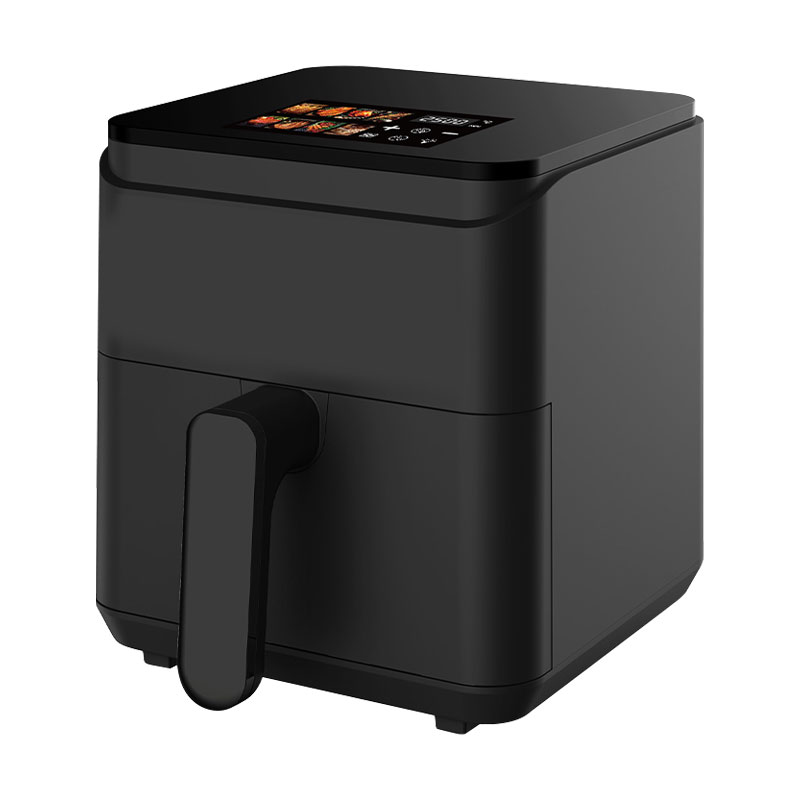
033-1 Mechanical Perspective Air Fryer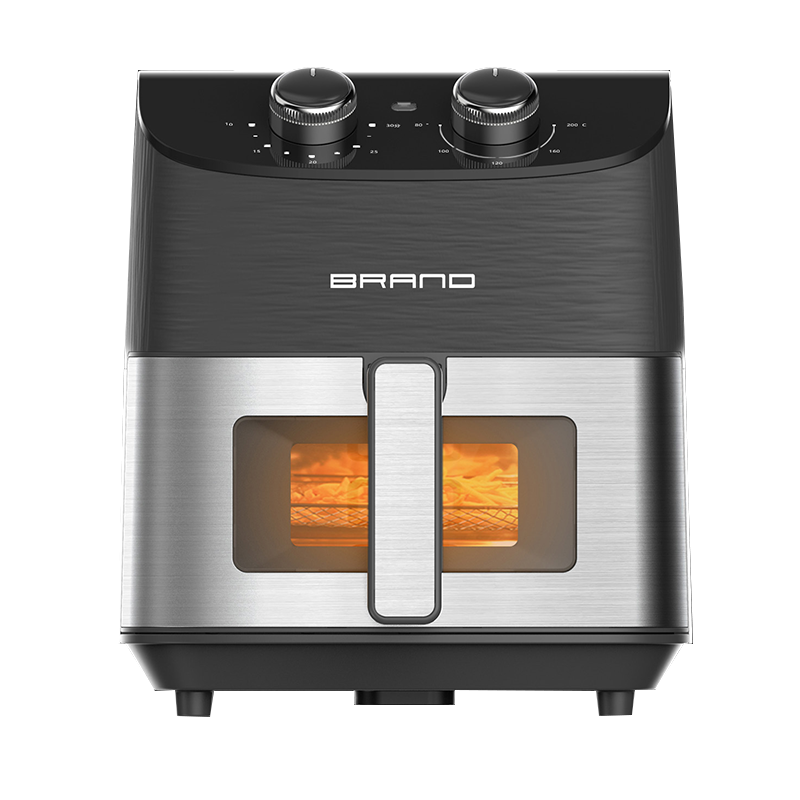
Product Overview: Practical Design for Everyday Cooking
The 033-1 Mechanical Perspective Air Fryer is a 6L air fryer designed for everyday family cooking and retail-ready wholesale supply. With a rated power of 1500W, it is built to generate strong cooking heat while maintaining a practical energy profile for home kitchens. The 6L basket capacity is a major advantage because it supports a wider range of cooking tasks than smaller personal-use models. Users can prepare fries, chicken wings, vegetables, frozen snacks, seafood, reheated leftovers, and many other foods with less oil than traditional deep frying.
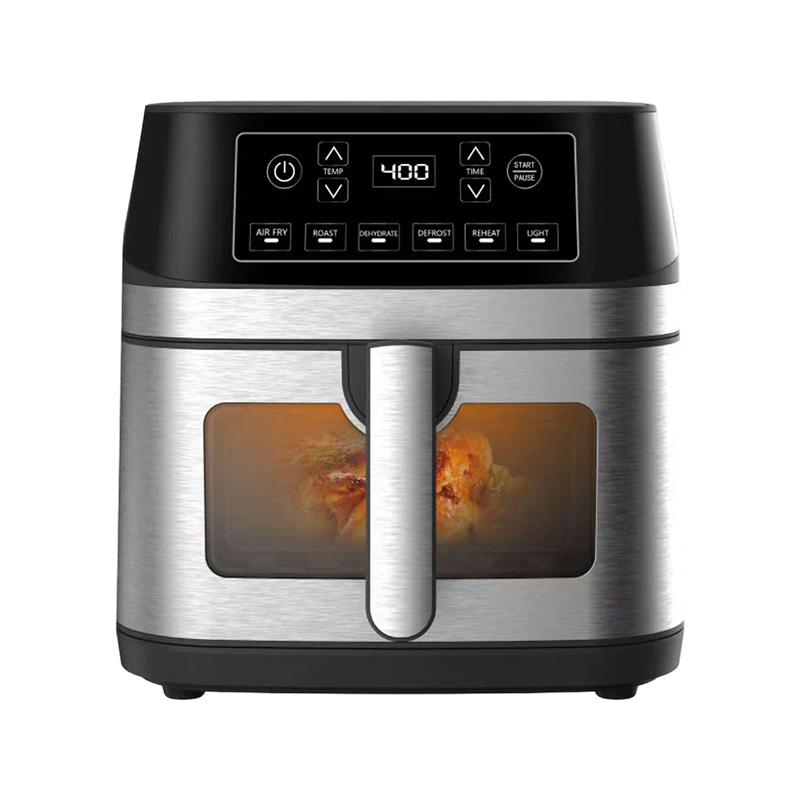
The “mechanical perspective” concept highlights two important user benefits. First, mechanical controls are familiar, simple, and intuitive. They appeal to users who prefer direct knobs rather than digital interfaces. Second, the perspective viewing design allows the cooking process to be observed more conveniently, helping users reduce unnecessary basket pulling and improving cooking confidence. These features support a better daily experience, especially for families, older users, and customers who prefer simple appliances that work without complicated programming.
In a competitive marketplace filled with digital touch panels and decorative features, this model focuses on high-value fundamentals: capacity, power, practical materials, stable construction, simple operation, and wholesale-friendly packing. For many distributors, these fundamentals are more important than excessive functions. Retail customers often choose an air fryer because they want reliable cooking, easy cleaning, and understandable controls. The GSE033/GSE033-1 air fryer is positioned to meet those expectations with a specification set suitable for mainstream markets.
Key Specifications
| Item No. | GSE033/GSE033-1 |
| Product Name | Air Fryer |
| Power | 1500W |
| Capacity | 6L |
| Material | PP + PA + Aluminum + ABS + PC |
| Packing | 1 piece per carton |
| Carton Size | 40.9 x 35.7 x 38.8 cm |
| Net Weight | 6.0 kg |
| Gross Weight | 7.0 kg |
| 20-foot Container Loading | 438 pieces |
| 40HQ Container Loading | 1192 pieces |
| MOQ | 1192 pieces |
| Delivery Time | 45 to 60 days |
Why a 6L Capacity Matters in the Air Fryer Market
Capacity is one of the most important purchase factors for consumers. A small air fryer may be sufficient for a single user, but families and frequent cooks often prefer a larger model that can prepare more food in one cycle. The 6L capacity of the GSE033/GSE033-1 gives users more flexibility than compact entry-level models. It can serve family meals more conveniently and reduce the need for repeated cooking batches. For retailers, a 6L air fryer often sits in a strong commercial position: large enough for family value, but still manageable for shipping, storage, and kitchen placement.
This capacity also supports different cooking occasions. A user can prepare snacks for guests, side dishes for dinner, or meal-prep portions with less effort. The air fryer category is no longer limited to novelty cooking; it has become a daily-use appliance. A 6L model better supports this shift because it can replace or supplement ovens, toaster ovens, pans, and deep fryers in routine home cooking. For wholesale programs, this creates a broader target audience and stronger shelf appeal.
Compared with lower-capacity competitors, a 6L model provides more perceived value. Consumers often compare dimensions, power, and basket size when shopping online or in-store. When a model offers practical capacity and simple operation at a competitive price, it becomes easier for distributors to promote. The GSE033/GSE033-1 is designed for this practical value segment, where end users want performance and convenience rather than unnecessary complexity.
1500W Power for Efficient Hot-Air Cooking
The 1500W power rating gives the air fryer the heating strength needed for fast, consistent cooking. In an air fryer, performance depends on the combination of heat output, airflow circulation, basket design, and temperature control. A 1500W heating system is well suited for a 6L appliance because it helps the cooking chamber reach the required temperature efficiently and supports crisping performance for common foods such as potatoes, chicken, and frozen snacks.
In consumer use, adequate power helps reduce waiting time and improve cooking satisfaction. Underpowered air fryers can take longer to preheat, struggle with larger portions, or produce uneven results. By contrast, a correctly powered 6L air fryer provides a balanced experience: strong enough for family portions while remaining appropriate for standard household electrical environments in many markets. This balance is important for international wholesale buyers because they must consider both customer expectations and electrical safety requirements.
From a competitive perspective, 1500W also creates a clear selling point. Buyers can position the appliance as an efficient kitchen helper capable of fast cooking with reduced oil. The product is not merely a container with a heater; it is a hot-air cooking system designed to deliver repeatable results. When combined with mechanical control simplicity and viewing convenience, the power specification strengthens the product’s marketability.
Mechanical Controls: Simple, Durable, and User-Friendly
Many modern appliances use digital panels, but mechanical controls remain highly relevant. They are easy to understand, direct to operate, and often preferred by users who do not want complex menus. The GSE033/GSE033-1 uses a mechanical control style that supports intuitive adjustment of cooking settings. For everyday users, this can reduce learning time and increase confidence. A customer can turn a knob, set the desired time or temperature, and start cooking without navigating multiple buttons or screens.
Mechanical controls can also be an advantage in certain wholesale and retail channels. They are suitable for value-focused product lines, supermarket promotions, household appliance programs, and markets where customers prefer robust simplicity. Digital displays may look advanced, but they can increase perceived complexity and add cost. Mechanical designs provide a cost-effective alternative while preserving essential air fryer performance. For distributors, this can improve price competitiveness and margin flexibility.
The simplicity of mechanical controls also helps after-sales communication. Retail support teams can explain operation quickly. Consumers can understand the product without long manuals. In large-volume programs, reducing customer confusion is important because it can lower returns and improve satisfaction. The GSE033/GSE033-1 therefore competes not only through specifications but also through usability, which is a major factor in repeat purchase and positive customer feedback.
Perspective Viewing Design: Better Control During Cooking
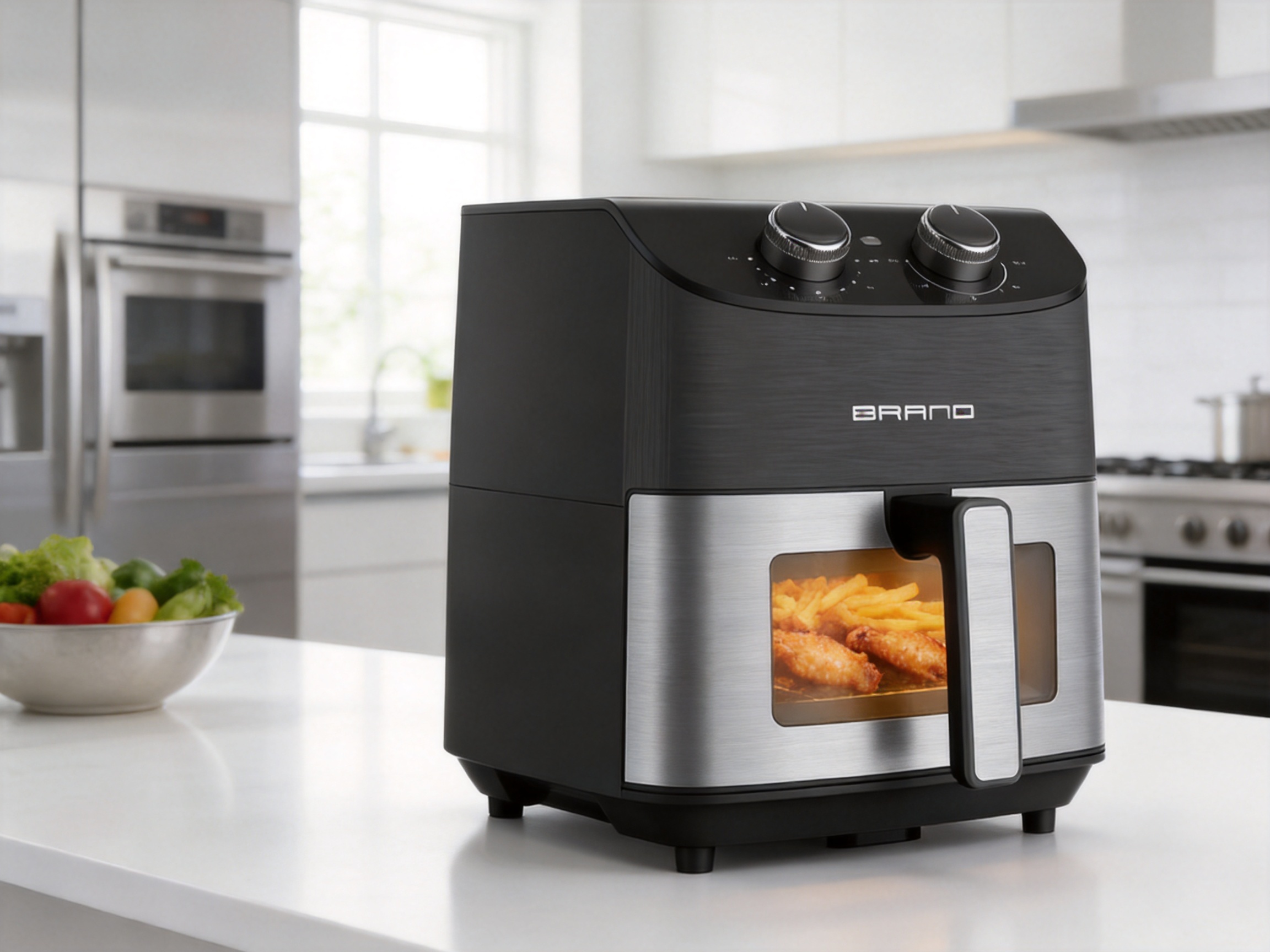
A frequent issue with conventional air fryers is that users must pull out the basket to check food progress. Every time the basket is removed, heat can escape and the cooking process may be interrupted. The perspective viewing design of this model supports easier observation, allowing users to monitor browning and texture development more conveniently. This feature can improve confidence, especially when cooking foods that are sensitive to time and color, such as pastries, fries, breaded snacks, or chicken wings.
The viewing feature gives the appliance a visible advantage on the sales floor. Consumers often respond positively to products that let them see what is happening inside. It creates a sense of transparency and control. For e-commerce listings, product images showing the perspective design can communicate the benefit quickly. For physical retail, the feature helps the product stand out from ordinary closed-basket air fryers.
Competitors may offer digital presets or decorative styling, but a viewing window addresses a real cooking behavior. Users naturally want to check food. By reducing unnecessary interruption, the design supports better heat retention and smoother operation. It also makes the cooking process more enjoyable, transforming the air fryer from a closed machine into an appliance that users can interact with visually. This practical improvement can become a strong differentiator in a crowded air fryer category.
Material Combination for Strength, Safety, and Function
The product uses PP, PA, aluminum, ABS, and PC materials. Each material serves a functional purpose in the appliance structure. PP and ABS are widely used in appliance housings and components because they support moldability, durability, and practical surface finishing. PA contributes mechanical strength and heat resistance in suitable components. Aluminum supports heat-related functions and lightweight structural efficiency. PC is known for impact resistance and transparency, making it relevant where visibility and durability are needed.
Material selection is critical for kitchen appliances because they must withstand heat, handling, cleaning, and repeated daily use. A good air fryer must not feel fragile, deform easily, or create user safety concerns. The combination of materials in the GSE033/GSE033-1 reflects the need to balance cost, strength, heat performance, appearance, and manufacturability. This balance is essential for mass-market products, where buyers need dependable quality without excessive retail pricing.
Compared with competitors that may rely on lower-grade plastics or less optimized structural design, a carefully selected material system can improve user confidence. The appliance has a net weight of 6.0 kg and a gross weight of 7.0 kg, suggesting a substantial build suitable for a 6L air fryer. For distributors, this supports a value proposition based on solid construction rather than lightweight, low-end positioning. In household appliance markets, physical feel and build quality strongly influence consumer trust.
Advantages Over Competing Air Fryer Models
The GSE033/GSE033-1 provides several competitive advantages that matter to both consumers and professional buyers. Its 6L capacity positions it above smaller entry-level air fryers while remaining practical for common home kitchens. Its 1500W power rating supports efficient heating for family-size portions. Its mechanical controls simplify use and appeal to a wide demographic. Its perspective viewing design gives users better visibility and improves the cooking experience. Its multi-material construction supports durability and functional performance.
Another advantage is wholesale readiness. The product is packed one piece per carton, with a carton size of 40.9 x 35.7 x 38.8 cm. Container loading is clearly defined, with 438 pieces for a 20-foot container and 1192 pieces for a 40HQ container. This level of specification clarity helps importers plan logistics, cost calculations, storage, and promotional schedules. Many competing products may look attractive but lack transparent bulk supply data, which can complicate purchasing decisions.
The MOQ of 1192 pieces aligns with 40HQ container loading, making it suitable for full-container wholesale programs. Delivery time of 45 to 60 days supports structured retail planning, especially for seasonal promotions and product launches. For large buyers, product quality is only one part of the decision. Lead time, loading quantity, carton dimensions, and production reliability are equally important. The GSE033/GSE033-1 offers a commercially organized product package that helps buyers manage procurement with confidence.
Manufacturing Strength Behind the Product
The manufacturer, CIXI GSTAR ELECTRIC APPLIANCE CO., LTD., has built its business around the design, development, and production of small electric kitchen appliances and daily household products. The company’s product experience includes blenders, slicers, choppers, food processors, smokeless grills, hot pots, air fryers, air ovens, and related items for household and hospitality use. This broad background creates manufacturing knowledge that benefits the air fryer line, including plastic molding coordination, metal component integration, electrical assembly, heating systems, and final inspection routines.
The company was founded in 2009 after years of export sales, sourcing, and product development experience. Its early work with innovative household products and international retail customers helped build strong awareness of global consumer expectations. Over time, the company moved from non-electric innovative products into electric kitchen appliances, expanding its technical capacity and product range. This development path is important because it combines market sensitivity with engineering practice. The result is a manufacturer that understands not only how to make products, but also how to make products that sell.
The company operates a wholly owned plant with a production area of approximately 15,000 square meters and a workforce of more than 200 experienced workers. It also has dedicated engineering and quality control personnel. This scale supports stable production, coordinated assembly, and repeatable quality management. For wholesale buyers, factory ownership and production capacity reduce uncertainty. A supplier with direct manufacturing capability can respond more effectively to product customization, production scheduling, quality feedback, and order follow-up.
Research and Development Capability
Research and development is a key strength behind competitive appliance manufacturing. The manufacturer has experience in developing products with its own innovations and has built a team capable of supporting design improvement and product engineering. For an air fryer, R&D work may include airflow structure evaluation, basket design, housing design, material choice, safety improvement, usability testing, and packaging optimization. These details influence the final product experience even when they are not immediately visible to consumers.
The company’s history shows a consistent emphasis on innovation. Before expanding deeply into electric appliances, it developed patented household products such as spiralizer drum graters, iced pitchers, and iced bowls. This innovation culture later supported development in electric products, including food processors, air ovens, and air fryers. The GSE033/GSE033-1 benefits from this practical development experience because it is designed around real consumer use rather than abstract technical specifications alone.
Compared with trading companies that depend entirely on outside factories, a manufacturer with internal R&D can provide stronger product support. It can refine details, adjust designs for market needs, and work with buyers as an engineering partner. This is particularly important for air fryers because different markets may require different plugs, labels, manuals, colors, packaging artwork, compliance documentation, or feature preferences. R&D capability helps transform a standard product into a market-ready retail solution.
Quality Control and Production Management
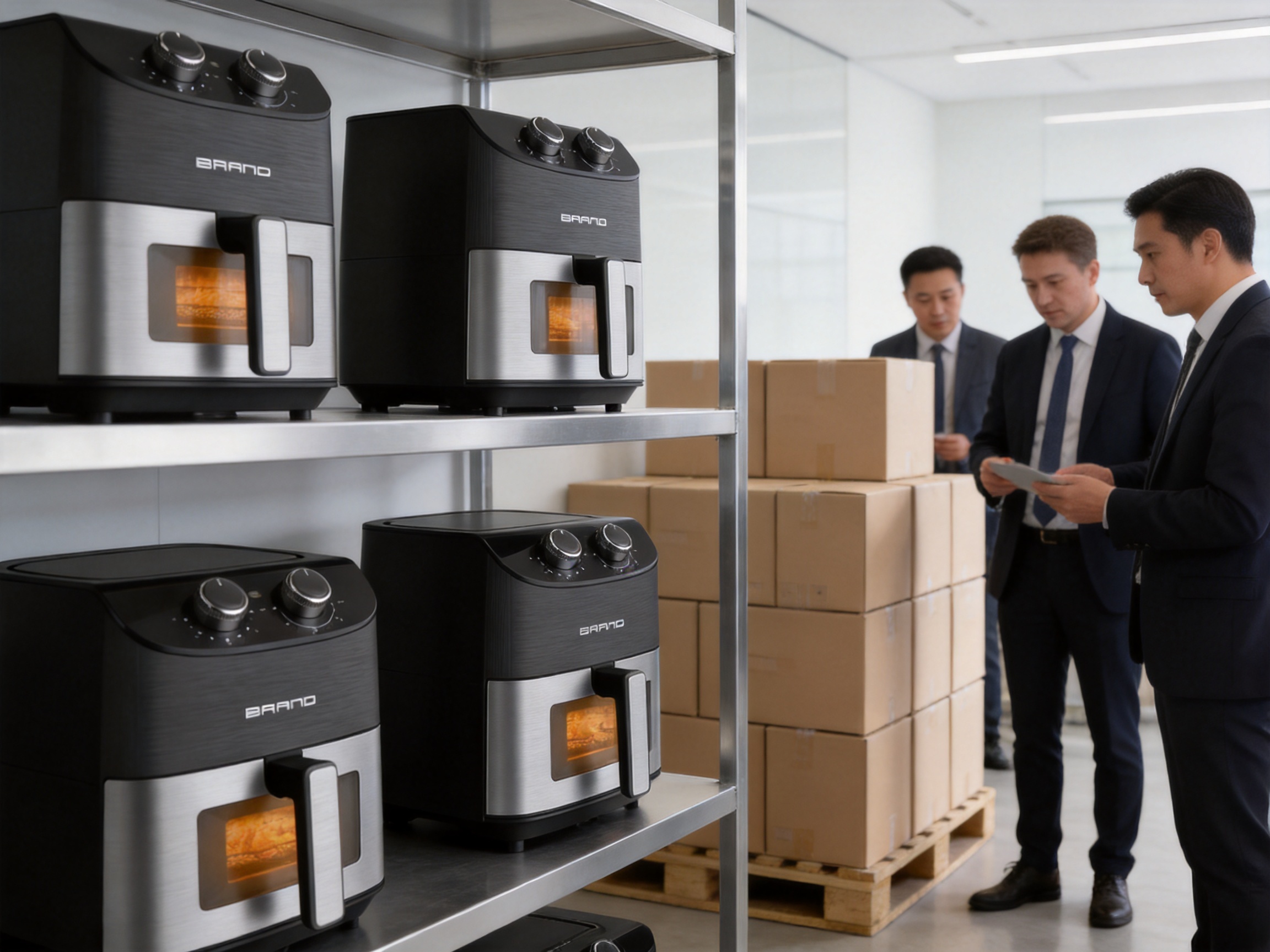
Air fryers involve heating elements, electrical wiring, plastics, moving parts, coatings, and user-contact surfaces. Quality control must therefore be systematic. The manufacturer has dedicated QC personnel and experience managing pre-production and in-production inspection. Effective quality control begins before mass production, with material confirmation, sample approval, component checking, and production line preparation. During production, inspection must verify assembly accuracy, appearance, function, packing, and safety-related details.
For the GSE033/GSE033-1, quality control supports product consistency across large orders. A single 40HQ order can include 1192 units, and each unit must match buyer expectations. Consistency is essential because retailers cannot afford high defect rates, inconsistent appearance, or unreliable performance. A manufacturer with organized QC processes helps reduce these risks. This is one of the most important advantages over less experienced competitors, especially in price-sensitive appliance categories where poor control can lead to costly after-sales issues.
Production management also affects delivery time. The quoted delivery period of 45 to 60 days is realistic for organized manufacturing, material preparation, assembly, inspection, and packing. For importers, dependable delivery is a business advantage. Retail promotions, seasonal sales, and warehouse schedules depend on predictable supply. A product may have attractive specifications, but if the supplier cannot deliver consistently, the buyer’s market opportunity is weakened. This air fryer is supported by a manufacturing system designed for volume supply.
Factory-Direct Value for Wholesale Buyers
Factory-direct supply gives buyers several advantages. It can reduce unnecessary intermediate costs, improve communication efficiency, and create more direct control over product details. The manufacturer’s experience with global retail customers and supermarket channels supports a practical understanding of wholesale requirements. Buyers may need packaging customization, private label options, product documentation, container loading plans, or promotional order timing. A factory with export experience can support these needs more effectively than a supplier with limited international exposure.
The air fryer’s MOQ of 1192 pieces is aligned with full 40HQ container loading. This is useful for buyers who prefer efficient freight planning. Full-container orders can improve logistics economy and simplify supply chain management. The carton size and weight information also allow buyers to calculate storage volume, warehouse handling, and landed cost more accurately. In wholesale trade, these details are not secondary; they directly affect profitability.
The combination of competitive product design and factory-direct production helps this model compete in markets where buyers demand both value and reliability. Low price alone is not enough. Retailers need products that customers will use successfully, review positively, and recommend. The GSE033/GSE033-1 provides a balanced offer: practical features for consumers and organized supply advantages for professional buyers.
Applications in Household and Light Commercial Environments
The primary application of the 033-1 Mechanical Perspective Air Fryer is household cooking. It is suitable for families, apartment kitchens, student housing, and consumers who want convenient cooking with less oil. It can prepare many popular foods quickly, often with less mess than stovetop frying. The basket-style cooking process also helps reduce the need for large quantities of oil, making cleanup easier and supporting modern preferences for lighter cooking.
The product may also be suitable for certain light commercial or hospitality-related uses where small appliances are needed for demonstration, tasting, staff rooms, or limited food preparation. The manufacturer has experience serving products for bars, restaurants, and hotels, including beverage dispensers, pitchers, slicers, and graters. While the air fryer is mainly a household appliance, this broader understanding of food service environments strengthens the company’s awareness of practical durability, ease of use, and repeat handling.
Retailers can position the appliance for multiple customer groups. Busy parents can use it for quick meals. Young professionals can use it for compact cooking. Older customers can appreciate the straightforward mechanical controls. Health-conscious consumers may value reduced-oil cooking. Gift buyers may see it as a practical home appliance. This wide appeal improves sell-through potential, which is one of the main reasons air fryers remain a strong category globally.
Consumer Benefits: Less Oil, Less Effort, More Flexibility
One of the main reasons consumers buy air fryers is the desire to enjoy crispy foods with less oil than traditional deep frying. Hot-air cooking can create appealing texture while reducing oil usage in many recipes. The GSE033/GSE033-1 supports this trend by providing a family-size cooking chamber and efficient heating. Users can prepare meals that feel indulgent while simplifying cleanup and reducing the inconvenience of oil disposal.
The appliance also reduces effort. Many foods can be cooked with minimal supervision. Mechanical controls make setup easy, and the viewing design helps users observe progress. This combination can improve cooking confidence for people who do not consider themselves skilled cooks. The air fryer becomes a reliable daily helper rather than a complicated appliance used only occasionally.
Flexibility is another important benefit. The air fryer can cook frozen snacks, vegetables, meat, seafood, bakery items, and leftovers. It can reheat food more effectively than a microwave in situations where crispness matters. It can supplement a traditional oven when cooking small or medium portions, saving time and kitchen heat. For many households, this flexibility is the reason the appliance earns permanent counter space.
Retail Positioning and Merchandising Potential
From a retail perspective, the GSE033/GSE033-1 has strong merchandising potential because its core features are easy to communicate. “6L capacity,” “1500W power,” “mechanical control,” and “viewing window” are simple selling points that customers can understand quickly. Products that require long explanations are harder to sell in busy retail environments. This model’s benefits are visible and practical, making it suitable for packaging callouts, online bullet points, store displays, and promotional catalogs.
The mechanical design also supports a value-focused price strategy. Retailers can position it as a dependable family air fryer without the premium cost associated with elaborate digital screens or unnecessary smart functions. In many markets, consumers are becoming more selective. They want useful features, not gimmicks. This product fits that demand by offering features that directly affect cooking experience and ease of use.
For e-commerce, the product can be promoted with lifestyle cooking images, specification charts, and simple usage explanations. The perspective window can be emphasized visually. The 6L basket capacity can be compared with typical food portions. The 1500W power can be used to communicate efficiency. Clear specifications reduce buyer hesitation and support conversion. For distributors building online product pages, these advantages are valuable.
Packaging, Loading, and Supply Chain Efficiency
Wholesale buyers pay close attention to packaging and logistics because freight costs can significantly affect final profitability. The GSE033/GSE033-1 is packed one piece per carton, with a carton size of 40.9 x 35.7 x 38.8 cm. This individual carton structure is practical for appliance distribution because it protects each unit and supports retail handling. The gross weight of 7.0 kg is manageable for warehouse and store operations.
Container loading is specified at 438 pieces for a 20-foot container and 1192 pieces for a 40HQ container. These figures allow buyers to forecast landed cost, sales volume, and warehouse requirements. The MOQ is 1192 pieces, matching the 40HQ loading quantity. This creates a straightforward purchasing structure for importers seeking full-container efficiency. When order quantity, container capacity, and MOQ align, procurement planning becomes simpler.
The delivery period of 45 to 60 days is appropriate for mass production and international wholesale programs. Buyers can plan seasonal launches, promotional events, and restocking cycles around this timeline. A product with clear logistics data is easier to integrate into a professional supply chain. This is one of the practical strengths that separates mature manufacturing programs from casual product sourcing.
Company Background and Global Market Experience
The company behind the product is located in Cixi, Ningbo, China, an area with strong manufacturing and export resources. Its development story began with export sales experience in electrical and household products, followed by sourcing work for international supermarket customers. This early exposure helped the founder understand the importance of quality, price, delivery, honesty, responsibility, and customer trust. These values later became important foundations for the manufacturing business.
In 2009, the company was founded to design and develop innovative household products, including items with patents and strong retail appeal. Its products were sold to well-known supermarket and retail channels across global markets. In 2018, the company moved into its own new factory, expanding its production foundation and supporting the transition into electric products. Since then, its electric kitchen appliances have gained market acceptance in many countries.
The company has achieved notable sales success with products such as a 3-in-1 food processor and has seen strong demand for air ovens and air fryers in Europe and South America. This market experience is relevant because it shows the company’s ability to respond to product trends and scale production for significant demand. The GSE033/GSE033-1 is not an isolated product; it is part of a broader manufacturing strategy focused on high-quality innovative products, competitive pricing, quick delivery, and strong after-sales service.
Advanced Manufacturing Processes and Operational Strengths
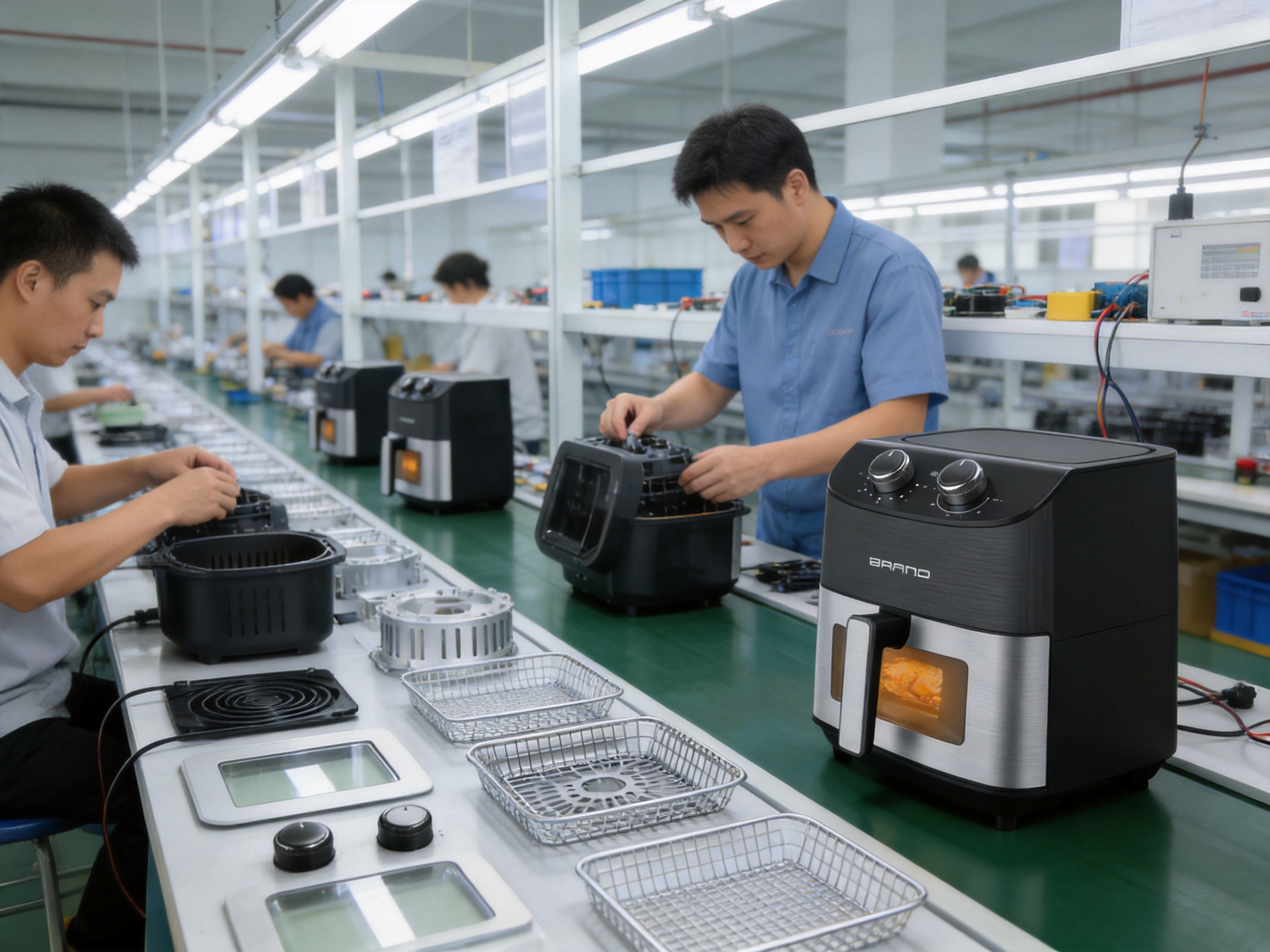
Modern air fryer manufacturing requires coordinated processes across design, tooling, material preparation, component assembly, electrical testing, inspection, and packaging. The manufacturer’s plant size and workforce allow it to organize these steps efficiently. A well-managed production process begins with product engineering and sample development. Tooling must produce accurate plastic parts with consistent fit. Metal and heating components must be prepared according to design requirements. Assembly workers must follow standardized procedures to ensure every unit is built correctly.
Quality is strengthened through process control rather than final inspection alone. During pre-production, materials and components should be checked to confirm they match the approved design. During production, line inspections help identify problems early. Functional testing verifies that the appliance operates properly. Appearance checks ensure that the product meets retail expectations. Packaging inspection confirms that each carton is complete, labeled, and suitable for shipment. These manufacturing disciplines help protect buyers from inconsistency.
The company’s engineering partnership approach is also important. It works closely with customers to meet demand and requirements. For wholesale buyers, this can include adapting product appearance, packaging design, manuals, labels, or market-specific preferences. Because the company designs and develops products, it can better understand technical feasibility and cost control. This creates a more productive relationship than simple trading, where communication may be slower and less technically informed.
How the Air Fryer Supports Private Label and OEM Programs
Private label programs require a product that is stable, appealing, and adaptable. The GSE033/GSE033-1 is suitable for such programs because its design is mainstream, its specifications are clear, and its value proposition is easy to communicate. A retailer or distributor can build a product line around family-size capacity, mechanical simplicity, and viewing convenience. The appliance can be positioned for daily cooking, healthy lifestyle promotion, holiday gift campaigns, or supermarket kitchen appliance events.
OEM and private label buyers often need reliable supply and consistent appearance across repeat orders. The manufacturer’s factory ownership, experienced workforce, and quality control team support this requirement. Because the company has supplied global retail channels before, it understands the importance of packaging, documentation, and delivery accuracy. This experience reduces risk for buyers launching their own appliance programs.
The product’s competitive design also provides room for market customization. Different buyers may request color adjustments, branding elements, packaging artwork, or instruction materials. The core appliance platform offers a practical foundation for such customization. For distributors looking to differentiate from competitors while controlling development cost, this is a valuable advantage.
Comparison With Common Competitor Weaknesses
Many air fryer competitors fall into one of several common weaknesses. Some models are too small for family use, causing customers to cook multiple batches. Some are overly complicated, with digital interfaces that increase cost without improving the basic cooking result. Some lack viewing convenience, forcing users to interrupt cooking frequently. Others may be offered by suppliers without strong manufacturing control, creating risks in quality, delivery, and after-sales response.
The GSE033/GSE033-1 addresses these weaknesses through a balanced design. Its 6L capacity is practical for families. Its 1500W power supports efficient cooking. Its mechanical controls reduce complexity. Its perspective viewing feature improves the user experience. Its detailed carton, loading, MOQ, and delivery information support professional wholesale planning. Its production background adds confidence for buyers concerned about consistency and supply reliability.
This balance is important because the best wholesale products are not always the most technically complicated. They are products that meet real needs, can be produced consistently, and can be sold profitably. The GSE033/GSE033-1 focuses on these fundamentals, making it a strong alternative to overdesigned or underbuilt competitors.
Safety, Usability, and Consumer Confidence
Consumer confidence is essential for any electrical kitchen appliance. Users want an air fryer that feels stable, operates predictably, and is easy to understand. Mechanical controls help by making operation straightforward. The perspective window helps users observe food without unnecessary interruption. The 6L capacity gives the appliance practical usefulness. The material combination supports structural integrity and heat-related performance.
Although specific certification details are not provided here, responsible appliance manufacturing generally requires attention to electrical safety, material suitability, thermal performance, and user instructions. The manufacturer’s experience in global appliance markets supports awareness of these requirements. For buyers, it is important to confirm certification needs according to the target market, such as regional electrical standards, plug requirements, labeling rules, and packaging regulations.
A well-designed air fryer also supports safe behavior through intuitive use. When controls are simple and food progress can be observed, users may be less likely to misuse the appliance. Clear instructions and practical design reduce confusion. This contributes to better customer reviews and lower after-sales pressure.
Sustainability and Reduced-Oil Cooking Trends
Air fryers fit into several modern consumer trends. One is reduced-oil cooking. While air frying does not replace every cooking method, it can help users prepare many crispy foods with less oil than deep frying. This reduces oil consumption and simplifies cleanup. Another trend is energy-conscious cooking. For many small and medium meals, an air fryer may heat faster than a full-size oven, making it convenient for daily use.
The product also supports home cooking habits. As more consumers prepare meals at home, they look for appliances that save time and reduce effort. The 6L capacity helps families cook practical portions, while the mechanical design keeps operation simple. Retailers can connect the appliance to themes such as family convenience, healthier cooking, quick meals, and modern kitchen efficiency.
From a supply chain perspective, clear packing and container loading information also contributes to planning efficiency. Efficient loading helps buyers manage freight utilization. While sustainability depends on many factors beyond one product, optimized logistics and durable product design are positive elements in responsible wholesale planning.
Ideal Buyers and Market Channels
The GSE033/GSE033-1 is suitable for importers, wholesalers, supermarket chains, department stores, online retailers, appliance distributors, private label brands, and promotional product programs. Its feature set is mainstream enough for broad markets while offering the perspective viewing advantage to stand out. The product can be placed in small appliance aisles, seasonal cooking promotions, online marketplace stores, and household goods catalogs.
For supermarket chains, the air fryer offers a strong value item that can attract household shoppers. For e-commerce sellers, its specifications and visible design feature create clear listing content. For appliance distributors, the model provides a family-size product that can complement smaller and larger air fryer options. For private label brands, the product gives a dependable platform for branded kitchen appliance expansion.
The manufacturer’s location and export experience support international cooperation. Buyers can contact the company through its listed phone and email channels for commercial discussions, specification confirmation, sampling, packaging requirements, and order planning. For any international order, buyers should confirm target-market compliance requirements before mass production to ensure smooth import and retail distribution.
Q&A Section
Q1: What is the capacity of the 033-1 Mechanical Perspective Air Fryer?
The air fryer has a 6L capacity, making it suitable for family meals, snacks, side dishes, and everyday household cooking. This capacity gives it a practical advantage over smaller models that may require multiple cooking batches.
Q2: What is the power rating of the product?
The product is rated at 1500W. This power level supports efficient hot-air cooking for a 6L air fryer and helps provide the heat needed for crisping, roasting, reheating, and cooking common foods.
Q3: Why are mechanical controls an advantage?
Mechanical controls are simple, familiar, and easy to operate. They reduce user confusion, make the appliance suitable for a wide range of customers, and can improve value positioning compared with more expensive digital-control models.
Q4: What does the perspective viewing design do?
The perspective viewing design allows users to observe food during cooking more conveniently. This can reduce the need to pull out the basket repeatedly, helping maintain heat and improving user confidence.
Q5: What materials are used in the product?
The air fryer uses PP, PA, aluminum, ABS, and PC. This material combination supports durability, moldability, heat-related function, structural strength, and visibility where required.
Q6: What makes this air fryer competitive for wholesale buyers?
It combines 6L capacity, 1500W power, mechanical simplicity, viewing convenience, clear packing data, defined container loading, and factory-backed production. These elements help buyers manage both retail appeal and supply chain efficiency.
Q7: What is the packing quantity and carton size?
The air fryer is packed one piece per carton. The carton size is 40.9 x 35.7 x 38.8 cm, with a net weight of 6.0 kg and a gross weight of 7.0 kg.
Q8: What are the container loading quantities?
A 20-foot container can load approximately 438 pieces, while a 40HQ container can load approximately 1192 pieces. The MOQ is 1192 pieces, matching the 40HQ loading quantity.
Q9: What is the expected delivery time?
The delivery time is generally 45 to 60 days, depending on order requirements, production scheduling, packaging confirmation, and other commercial details.
Q10: Why is the manufacturer a strong partner for air fryer programs?
The manufacturer has experience in small electric kitchen appliance development and production, a wholly owned factory, an experienced workforce, R&D capability, QC personnel, and international retail supply experience. These strengths support product consistency, customization, and wholesale reliability.
Conclusion: A Balanced Air Fryer for Competitive Retail Programs
The 033-1 Mechanical Perspective Air Fryer is a practical and commercially attractive appliance for modern kitchen programs. It offers the key features consumers want: family-friendly 6L capacity, efficient 1500W power, simple mechanical operation, and a perspective viewing design that improves cooking confidence. Its material combination supports daily-use durability, while its defined packing and container data support professional wholesale planning.
Its advantages over competitors come from balance rather than unnecessary complexity. It avoids the weakness of undersized models, the cost burden of overcomplicated digital interfaces, and the inconvenience of fully closed cooking baskets. At the same time, it is backed by a manufacturer with broad small appliance experience, factory ownership, R&D capability, QC systems, and international market knowledge. This makes it suitable not only as a consumer product but also as a dependable platform for importers, retailers, and private label brands.
For buyers seeking a wholesale air fryer that combines usability, value, manufacturing strength, and clear supply chain planning, the GSE033/GSE033-1 is a strong candidate. It reflects the direction of the air fryer market: practical capacity, healthier cooking convenience, user-friendly design, and reliable production support. In a category where competition is intense, this model stands out by focusing on what matters most to both end users and professional buyers.
References
1. Appliance Design Handbook: Principles of Small Kitchen Appliance Engineering and User Safety.
2. International Home Appliance Market Review: Air Fryer Growth, Consumer Preferences, and Retail Trends.
3. Materials in Household Electrical Appliances: Applications of PP, PA, ABS, PC, and Aluminum.
4. Quality Control Practices for Small Electrical Appliance Manufacturing.
5. Wholesale Supply Chain Planning for Kitchen Appliances: Carton Data, Container Loading, and Lead Time Management.