
 English
 中文简体
中文简体 Español
 English
 中文简体
中文简体 Español
The 7-litre mechanical air fryer represented by the GSE34-1 model is designed for consumers who want practical cooking performance, generous capacity, simple controls, and dependable everyday operation. Rather than relying on an electronic touchscreen interface, this appliance uses a mechanical control system that makes the cooking process straightforward and familiar. The model is available in a version with a viewing window and a corresponding version without a window, giving distributors and retailers flexibility when building a product range.
Air fryers have become an important part of the small kitchen appliance market because they combine speed, convenience, and versatility. Consumers use them to prepare vegetables, poultry, seafood, snacks, frozen foods, and many other dishes with less oil than conventional deep frying. However, not every air fryer is equally suitable for a household, retail, or private-label program. Important considerations include usable capacity, heating power, ease of operation, housing materials, production consistency, packaging efficiency, certifications, and the supplier’s ability to support long-term commercial cooperation.
The GSE34-1 addresses these requirements with a 7-litre cooking chamber, 1500-watt rated power, durable multi-material construction, and a compact carton format. Its mechanical design is particularly suitable for buyers who value uncomplicated operation, clear product positioning, and reduced dependence on complex electronic components. The viewing-window version also offers an additional visual feature that can improve user interaction during cooking.
Product Overview
The product is identified as the GSE34-1 Air Fryer, with the related item numbers GSE34-1 and GSE34-1D. The GSE34-1 is the mechanical model with a window, while the GSE34-1D is the mechanical model without a window. Both versions are associated with the same general product platform and are rated at 1500 watts with a 7-litre capacity.
A 7-litre air fryer occupies an attractive position between compact personal appliances and larger family-oriented models. Smaller air fryers may be convenient for one or two people, but they often require food to be prepared in multiple batches. Larger units can provide more space but may demand additional counter space, packaging volume, and transportation cost. A 7-litre format provides a practical compromise: it is large enough for family portions and entertaining, while remaining suitable for ordinary residential kitchens.
The mechanical control system is one of the defining characteristics of the product. Instead of a fully digital user interface, the appliance is operated through physical controls. This approach can appeal to consumers who prefer tactile adjustment and direct feedback. It is also easy to explain in retail listings and product packaging because the operating concept is immediately understandable: the user selects a temperature, sets a cooking time, and monitors the food as needed.
The window option adds another practical feature. A viewing window allows users to observe food during cooking without opening the basket as frequently. This can help users check browning, monitor delicate foods, and reduce unnecessary interruptions to the cooking cycle. The window also gives the appliance a more visibly interactive appearance, which may be useful for product photography and retail presentation.
Key Specifications
| Item number | GSE34-1 / GSE34-1D |
| Product name | Mechanical air fryer with window / mechanical air fryer without window |
| Rated power | 1500W |
| Capacity | 7L |
| Main materials | PP, PA, ABS, and PC |
| Packaging quantity | 1 piece per carton |
| Carton size | 37.5 x 37 x 34.5 cm |
| Net weight | 6.0 kg |
| Gross weight | 7.0 kg |
| Reported container loading | 530 pieces per 20-foot container; approximately 1,000 pieces per 40-foot high-cube container |
| Minimum order quantity | 1,000 pieces |
| Reported certifications | CE, GS, CB, ETL, RoHS, LFGB, and FDA, subject to applicable model and market verification |
The specification profile demonstrates that this model has been developed for both consumer use and commercial distribution. A single unit per carton simplifies inventory handling, while the stated carton dimensions support container planning and warehouse organization. The difference between net and gross weight is relatively limited, indicating that the individual product and its packaging can be handled without requiring unusually heavy-duty logistics procedures.
As with all electrical appliances, certification information should be confirmed against the final production configuration, target market, voltage, plug type, labeling requirements, and applicable test reports. Buyers should request current documentation before placing a commercial order. This is particularly important when the same product platform is adapted for different regions.
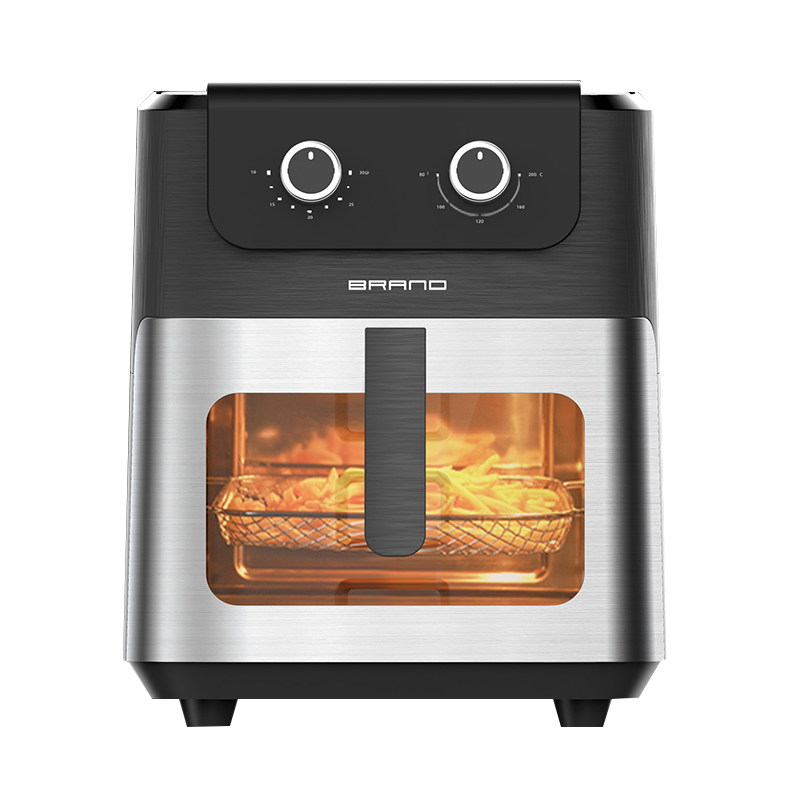
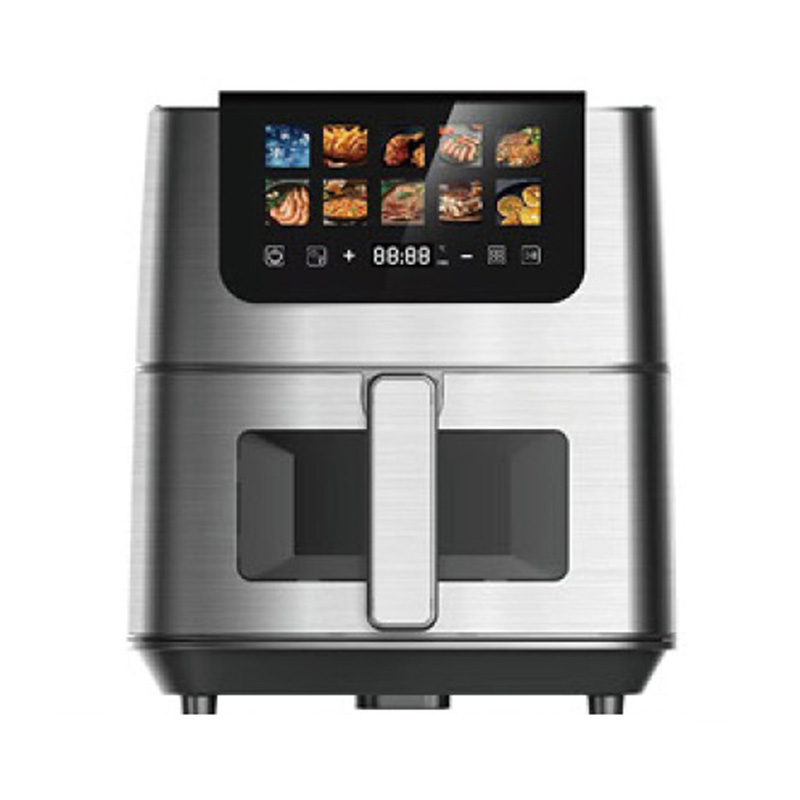
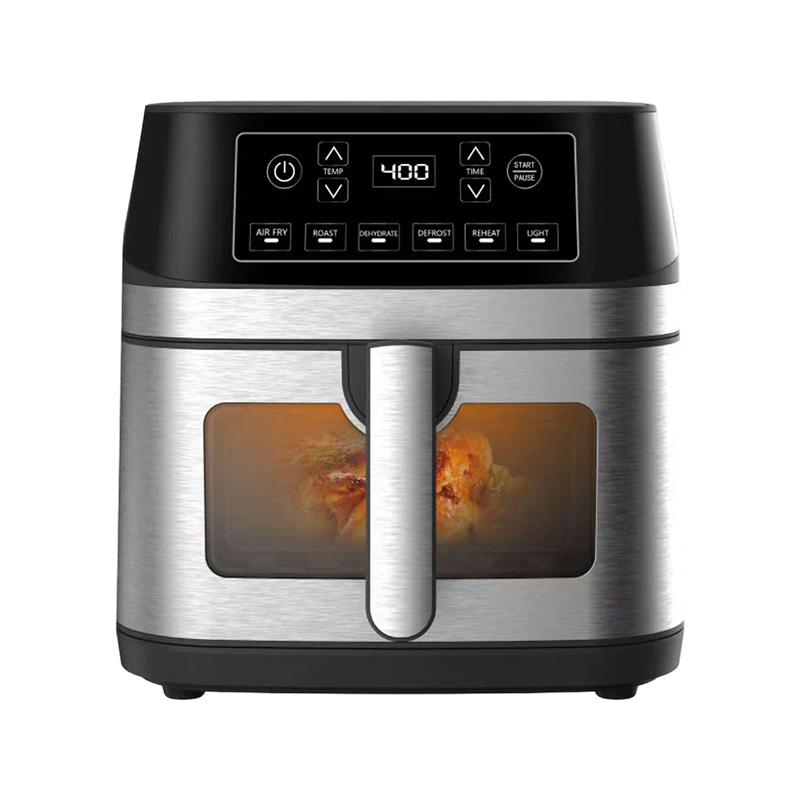
GSE34-1 Air Fryer (Mechanic with window)
How the Mechanical Design Supports Everyday Use
Mechanical controls have continued to maintain a place in the small appliance market because they offer simplicity. A consumer does not need to navigate menus, identify icons, or learn a multi-step digital interface. Physical controls can be adjusted quickly, even when the user is wearing cooking gloves or has limited experience with kitchen appliances.
The straightforward control concept may also reduce the learning curve for older users, first-time air fryer owners, and households that prefer uncomplicated equipment. For retailers, this makes the product easier to position as a dependable daily-use appliance rather than a complicated cooking system.
Mechanical operation can also be attractive to buyers who are concerned about the long-term serviceability of products with multiple electronic functions. Digital air fryers may offer presets, touchscreens, connectivity, and recipe programs, but those features can add complexity and influence the product’s cost structure. A mechanical model focuses its value on core functions: heating, circulating hot air, timing, and cooking control.
This does not mean that mechanical controls eliminate every possible service issue. All electrical appliances require appropriate component selection, thermal protection, wiring control, and production testing. However, a simpler user interface can support a clear product architecture and reduce the number of functions that must be explained to consumers.
Cooking Capacity and Household Versatility
The 7-litre capacity is one of the product’s strongest commercial features. Capacity is a major factor when consumers compare air fryers, because it determines whether the appliance can accommodate a useful portion in one cycle. A model that is too small may require repeated cooking, which reduces convenience and increases preparation time.
A 7-litre cooking space is suitable for a broad selection of food categories. Depending on the food type and preparation method, users may prepare chicken portions, vegetables, fries, seafood, pastries, reheated foods, and snack items. The appliance can be marketed to families, couples who enjoy batch cooking, home entertainers, and consumers who want an alternative to a conventional oven for smaller portions.
The capacity also gives wholesalers and retailers more positioning options. It can be promoted as a family-size appliance, a practical weekday cooking solution, or a flexible countertop appliance for preparing meals and snacks. The same product can therefore serve several market segments without requiring a highly specialized product concept.
Capacity should always be presented accurately. The stated 7-litre figure describes the product’s nominal internal capacity, while actual usable space may depend on the basket design, food arrangement, and recommended fill level. Clear user instructions should explain that overcrowding can affect air circulation and cooking consistency. This type of guidance helps consumers achieve better results and supports positive product reviews.
Heating Power and Air-Frying Performance
With a rated power of 1500 watts, the product provides a substantial electrical input for a 7-litre countertop appliance. Power affects heating speed, temperature recovery, and the appliance’s ability to maintain cooking conditions after cold food is added. The actual cooking result also depends on airflow, thermostat performance, basket geometry, insulation, and the quality of the heating assembly.
The 1500-watt rating places the product in a practical range for household air frying. It offers enough power for everyday cooking while avoiding the very high electrical demand associated with some larger ovens. This can make the appliance easier to integrate into ordinary kitchen circuits, although the final suitability depends on local voltage, frequency, plug configuration, and electrical standards.
Air frying works by circulating heated air around the food. The process can create a browned exterior and a crisp texture with less added oil than deep frying. Consumers may use a small amount of oil for seasoning or surface browning, but the appliance’s central value is that it reduces the need for immersion in hot oil.
For product buyers, the combination of capacity and power is important. A large basket with insufficient heating power may require longer cooking times, while high power in a very small chamber may produce an imbalanced user experience. The 7-litre and 1500-watt combination is intended to provide a useful balance for regular household cooking.
Advantages of the Viewing Window
The GSE34-1 window version offers a visible point of differentiation in a crowded air fryer market. Many products compete through similar claims, such as large capacity, rapid cooking, or low-oil preparation. A viewing window provides a tangible feature that consumers can see immediately in product photography, showroom displays, and demonstrations.
Visual monitoring can improve convenience. Users can check whether food is approaching the desired color without fully removing the basket. This may help maintain heat inside the cooking chamber and reduce the need to interrupt the process. For foods with narrow browning windows, the ability to observe progress can be particularly useful.
The window may also make the appliance more engaging for families. Children and adults can observe food during preparation, while cooks can learn how different foods change during a cooking cycle. Product images showing visible food preparation may communicate the appliance’s purpose more effectively than images of a fully closed housing.
From a merchandising perspective, the window model can be positioned as the premium variation within a mechanical range. The non-window GSE34-1D can serve buyers who prioritize a simpler appearance or a potentially different cost target, while the GSE34-1 can appeal to customers who want added visibility. Offering both models can help distributors serve multiple price points without changing the fundamental product concept.
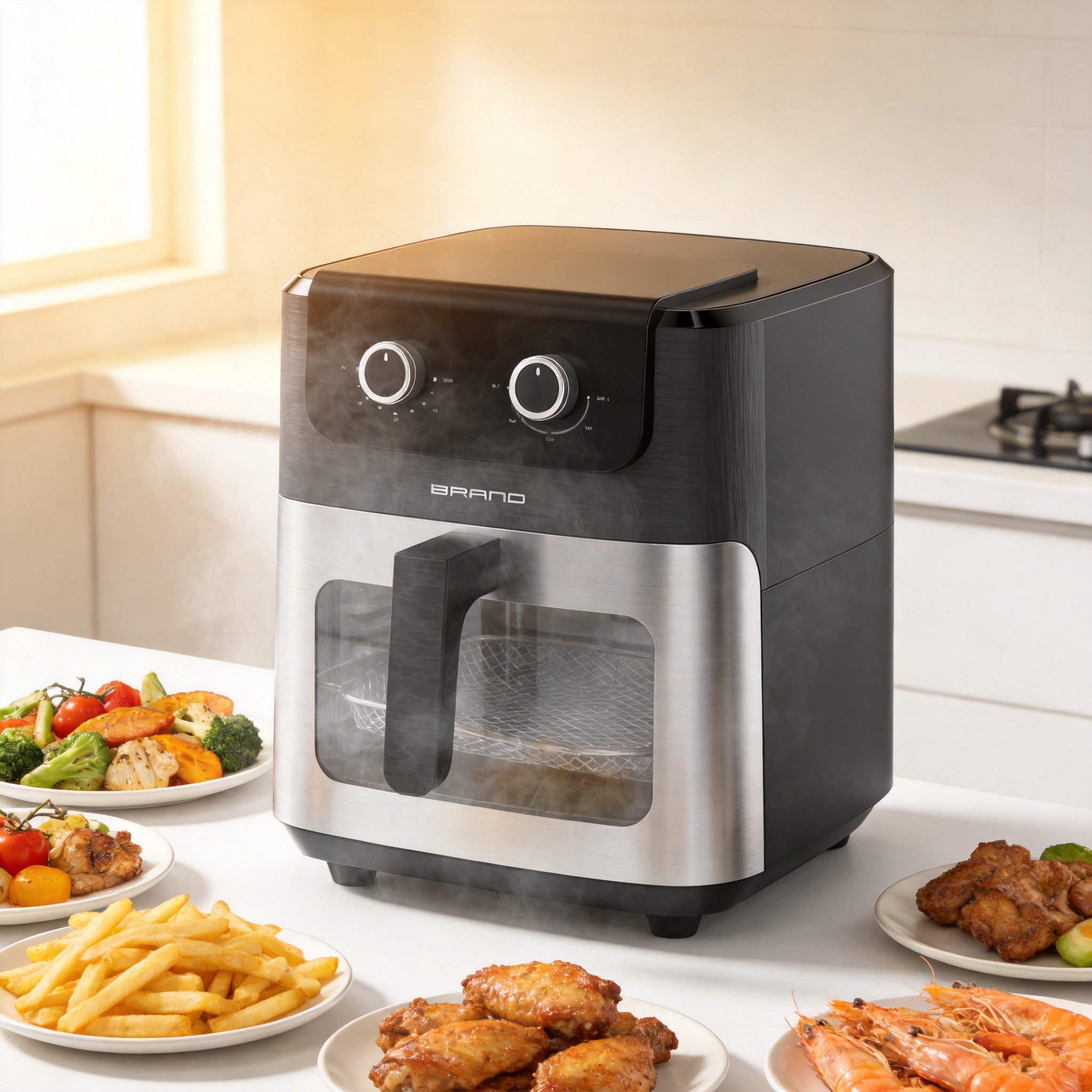
Materials and Product Construction
The listed material combination includes PP, PA, ABS, and PC. Each material can contribute different functional characteristics to the finished appliance. Polypropylene is commonly used in kitchen appliance components where light weight, moldability, and chemical resistance are important. Polyamide can support selected structural or heat-related applications. ABS is often used for rigid external components and housing parts, while polycarbonate can be suitable for transparent or impact-resistant elements, including a viewing window when the final design calls for it.
The use of multiple engineering and appliance-grade plastics enables designers to assign materials according to the requirements of each component. External housings require dimensional stability and an attractive surface. Internal supports may need rigidity and resistance to repeated handling. Transparent parts require optical clarity and impact performance. The final result depends not only on the material names but also on grade selection, formulation, molding conditions, component thickness, and quality inspection.
For commercial buyers, a multi-material construction can support a balanced product. The appliance can remain manageable in weight while achieving a solid appearance and functional durability. At 6.0 kilograms net weight, the product has enough physical presence to feel substantial without becoming excessively difficult for a consumer to move on a kitchen counter.
Material compliance is also important. The stated RoHS, LFGB, and FDA references indicate that the product has been positioned for markets where restrictions on hazardous substances and food-contact suitability may be relevant. Nevertheless, buyers should confirm which components are covered by each document. Food-contact claims should be supported by appropriate test reports for the basket, tray, coating, and any other parts that may contact food.
Comparison with Competing Air Fryer Formats
The air fryer market includes compact analog models, digital touchscreen models, dual-basket models, oven-style units, and multifunctional cooking systems. Each format serves a different consumer need. The GSE34-1 is best understood as a practical mechanical basket-style air fryer with a generous capacity and optional visual monitoring.
| Comparison factor | 7-litre mechanical model | Compact personal air fryer | Digital multifunction model |
| Capacity positioning | Family-oriented and versatile | Suitable for smaller portions | Often varies from medium to large |
| User interface | Physical mechanical controls | Usually mechanical or digital | Often touchscreen or electronic |
| Operating simplicity | Direct and easy to understand | Generally simple | May require more learning |
| Visual monitoring | Available on the window version | Depends on model | Usually depends on design |
| Feature emphasis | Capacity, practicality, and core cooking | Compactness and entry-level value | Presets, programs, and multifunction use |
| Commercial positioning | Broad household and retail appeal | Space-conscious or budget segment | Feature-oriented or premium segment |
Compared with compact models, the 7-litre version can reduce the number of cooking batches required by a household. Compared with highly electronic models, it provides a more direct operating experience. Compared with oven-style air fryers, the basket format can be easier to understand and may offer a more focused product proposition.
Its competitive strength is therefore not based on a single advanced function. Instead, it comes from a combination of useful capacity, accessible controls, optional viewing, manageable weight, and a clear value proposition. This combination can be especially effective in markets where consumers want practical appliances rather than unnecessary complexity.
Manufacturing and Product Development Strengths
The manufacturer, CIXI GSTAR ELECTRIC APPLIANCE CO., LTD., has developed from a trading and product-sourcing background into a manufacturer and developer of small kitchen appliances. According to the supplied company information, the business began its factory operation in 2009 and later expanded into electric product design and development.
The company’s experience includes air fryers, air ovens, blenders, slicers, choppers, food processors, smokeless grills, hot pots, and other kitchen or hospitality-related products. This breadth is relevant to the GSE34-1 because a supplier with experience across multiple appliance categories can draw on knowledge of heating systems, plastic housings, food-contact components, packaging, assembly, and retail requirements.
The company profile describes a dedicated factory, a substantial production area, experienced workers, engineering personnel, and a quality-control team. The supplied information gives different figures for workforce and facility size in different sections, so buyers should confirm current production capacity directly during qualification. Even with that qualification, the overall profile indicates a supplier organized around product development, manufacturing, and quality management rather than simple product reselling.
The reported research and development structure is another important strength. The company profile refers to engineers working in an R&D department and describes a history of developing products with its own design and innovation. For an OEM or private-label buyer, this can support discussions about product revisions, color changes, packaging adjustments, control layouts, regional plug configurations, and other commercial requirements.
A manufacturer’s technical capability is particularly valuable in the air fryer category because the product combines several disciplines. Engineers must consider thermal performance, airflow, electrical safety, insulation, plastic molding, mechanical controls, basket fit, surface temperature, noise, and packaging protection. A supplier familiar with these elements can respond more effectively to product improvement requests than a company that only coordinates finished goods from outside factories.
Manufacturing Process Considerations
Although exact factory procedures should be verified through an audit, a modern air fryer production process generally includes several controlled stages. The first stage is product engineering. At this point, designers define the housing structure, heating assembly, fan system, control mechanism, basket dimensions, viewing window, safety features, and user interface.
Tooling and injection molding follow the engineering phase. The PP, PA, ABS, and PC components require molds designed for dimensional accuracy, surface quality, and repeatable assembly. Molding parameters such as temperature, pressure, cooling time, and material drying can influence the appearance and strength of parts. Consistent control of these variables helps reduce warping, sink marks, short shots, flash, and color variation.
After molding, components may undergo visual inspection and dimensional checks. Critical areas include control openings, basket guides, mounting points, ventilation paths, window seating, and interfaces between housing sections. Accurate dimensions are important because poor fit can cause noise, loose components, difficult assembly, or inconsistent cosmetic results.
The electrical assembly stage typically involves installation of the heating element, motor and fan assembly, thermostat or temperature control, timer, wiring, thermal protection devices, and power cord. Assembly workers must follow defined routing and fastening procedures to prevent wires from contacting hot surfaces or moving components. Electrical connections should be checked for secure attachment and appropriate insulation.
Mechanical controls require their own inspection. Temperature and timer knobs should turn smoothly, provide clear adjustment, and remain securely attached during repeated use. The control mechanism should correspond accurately to the intended operating range. A well-designed mechanical interface helps the user understand the product while also reducing assembly variation.
The cooking basket and internal components must be checked for smooth operation. The basket should insert and remove without unnecessary force, while the safety interlock or operating mechanism, if included in the final design, should function consistently. The viewing-window version requires additional attention to seal fit, clarity, heat resistance, surface cleanliness, and resistance to movement during normal handling.
Final assembly is normally followed by visual inspection, electrical safety testing, functional testing, and packaging inspection. Depending on the market and customer requirements, testing may include power consumption, leakage current, dielectric strength, grounding continuity, temperature performance, timer operation, abnormal operation, and endurance checks.
A capable manufacturer should maintain records for incoming materials, in-process inspections, finished-product tests, and corrective actions. These records support traceability and make it easier to identify the source of a problem if a production variation occurs. Buyers should ask for details about inspection frequency, sampling standards, test equipment calibration, and procedures for handling nonconforming products.
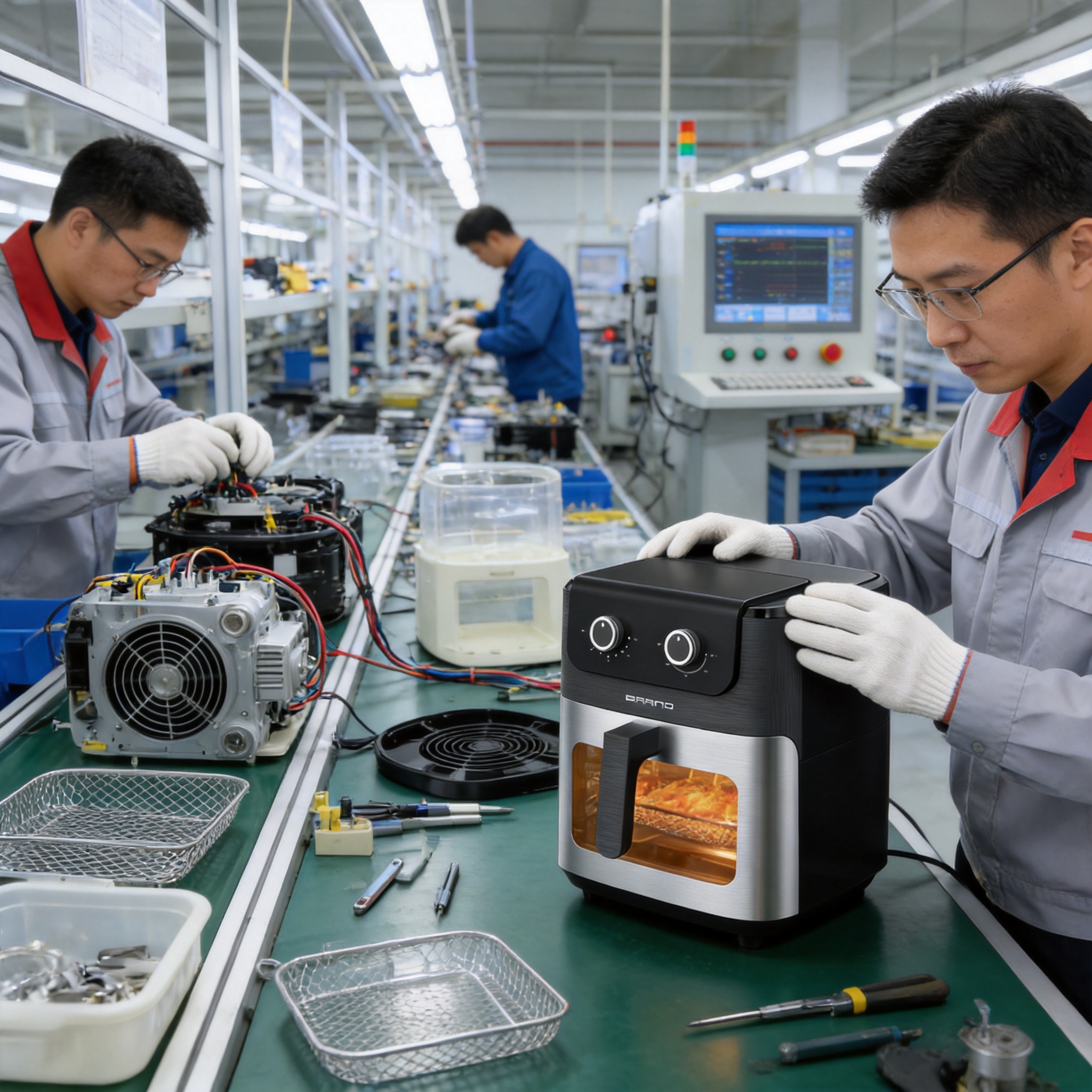
Quality Control and Reliability
Quality control is central to the long-term performance of an air fryer. A product may look attractive in a catalog but still require careful control of heating stability, electrical connections, plastics, mechanical controls, and packaging. The manufacturer’s reported QC personnel and engineering resources are therefore meaningful considerations for importers and brand owners.
Incoming quality control should cover plastic resin, heating elements, motors, thermostats, switches, power cords, fasteners, baskets, and packaging materials. Materials should be checked against approved specifications. Differences in plastic color, component dimensions, electrical ratings, or surface coatings can affect both appearance and performance.
In-process inspection can identify problems before the completed product reaches final testing. Examples include checking wiring routes, screw torque, fan alignment, control installation, basket fit, housing assembly, and window installation. Early inspection is generally more efficient than discovering defects after packaging.
Finished-product inspection should combine appearance and function. Cosmetic checks may include color consistency, scratches, deformation, gaps, labels, control markings, and packaging condition. Functional tests may include power-on operation, timer response, heating behavior, fan operation, and control adjustment.
Reliability also depends on packaging. The carton size of 37.5 x 37 x 34.5 centimeters provides a defined basis for drop-test planning, pallet arrangement, and container loading. Protective inserts should prevent the appliance from moving excessively during transportation. Particular attention should be paid to the basket, control knobs, viewing window, and external corners because these areas may be vulnerable to impact.
For buyers ordering at commercial scale, a pre-shipment inspection can provide an additional quality checkpoint. The inspection can verify quantities, product appearance, carton markings, accessories, instruction manuals, electrical specifications, and a sample of functional operations. A production approval sample should be retained so that later batches can be compared against the agreed standard.
Certifications and Market Readiness
The supplied product information lists CE, GS, CB, ETL, RoHS, LFGB, and FDA. These references suggest that the product has been considered for multiple international markets and for both electrical and food-contact compliance areas. However, certifications are not automatically interchangeable. Requirements vary by country, voltage system, plug type, test standard, labeling rule, and importer responsibility.
CE marking is generally associated with applicable European Union conformity requirements, while GS is a voluntary safety mark used in certain European product contexts. CB certification can facilitate the recognition of electrical safety test results among participating countries. ETL is commonly associated with North American product safety evaluation. RoHS concerns restrictions on specific hazardous substances, while LFGB and FDA references may relate to food-contact materials or relevant testing requirements.
A responsible buyer should confirm the certificate holder, model number, rated voltage, factory address, applicable standard, testing laboratory, expiration or validity status, and whether the certificate covers the exact GSE34-1 or GSE34-1D configuration. If the product is modified for a particular customer, updated testing may be necessary.
Market readiness also includes documentation. Product manuals should explain installation, operation, cleaning, food preparation, temperature and time adjustment, safe handling, and disposal. Packaging should include the correct warnings, importer information, electrical rating, certification marks, and language versions required by the destination market.
Commercial Benefits for Importers and Distributors
The product’s commercial value begins with its broad target audience. A 7-litre air fryer can be offered through appliance stores, department stores, online marketplaces, homeware distributors, supermarket programs, and private-label channels. Its design is easy to communicate, and the window version provides a visible feature for digital and physical merchandising.
The mechanical configuration may also support an accessible price strategy. A product with fewer electronic interface functions can be positioned below advanced touchscreen models while still delivering the central air-frying experience. This can appeal to consumers who are purchasing their first air fryer or who prioritize function over connectivity.
The product can be offered in a two-model assortment. The GSE34-1 with window can be presented as the feature-oriented model, while the GSE34-1D without window can serve a value-focused segment. Retailers can maintain a coherent range without introducing unrelated designs or significantly different operating concepts.
The stated minimum order quantity of 1,000 pieces is suited to buyers planning a structured launch, regional distribution, or private-label program. It may be less suitable for very small trial orders, but it can help support consistent production planning and packaging preparation. Buyers should discuss whether the MOQ applies equally to color, logo, plug, packaging, and model variations.
Container loading information is useful for landed-cost planning. The supplied data indicates approximately 530 pieces per 20-foot container and approximately 1,000 pieces per 40-foot high-cube container. Actual loading quantities may vary according to packaging design, pallet use, container restrictions, and final carton dimensions, so freight planning should be confirmed before shipment.
Private-Label and Customization Potential
Small kitchen appliances are often sold under retailer, distributor, or brand-owner labels. A manufacturer with engineering and production resources can potentially support more than basic logo printing. Customization may include housing colors, control markings, warning labels, packaging artwork, instruction manuals, plug configurations, language versions, and product bundles.
Customization should be managed through a formal approval process. The buyer and manufacturer should agree on a technical specification, approved artwork, color references, packaging structure, label placement, accessory list, and inspection standard. Any change to the heating system, basket coating, plastic material, electrical rating, or control layout may affect compliance and should be assessed before mass production.
The viewing-window model may be especially suitable for private-label presentation because the product can be shown in use. High-quality photography can display the appliance, basket, controls, and visible cooking area. The non-window model can provide a second stock-keeping unit for a simpler product assortment.
Brand owners should also consider after-sales support. The manufacturer’s stated commitment to customer service and engineering cooperation can be valuable, but commercial agreements should define spare parts, warranty handling, defect reporting, replacement procedures, response times, and responsibilities for market-specific compliance.
Consumer Safety and Responsible Use
An air fryer is a heating appliance and must be used responsibly. Consumers should place it on a stable, heat-resistant surface with adequate clearance around ventilation openings. The appliance should not be operated near water, curtains, or other materials that could be affected by heat. The power cord should be kept away from hot surfaces.
Users should follow the instruction manual when selecting temperature and cooking time. Food should not be packed so tightly that air circulation is blocked. The basket should not be overfilled, and hot components should be handled with appropriate protection. The appliance should be allowed to cool before cleaning or storage.
Cleaning instructions should distinguish between removable food-contact parts and the main electrical body. Water should not enter the electrical housing. Non-abrasive tools and approved cleaning methods should be recommended to protect surfaces and coatings. Regular cleaning can help reduce residue, smoke, and odors during later cooking cycles.
For distributors, clear safety information is not merely a legal requirement. It is also part of the customer experience. A well-written manual can reduce misuse, improve cooking results, and lower avoidable service requests. Manuals should use simple language and include clear illustrations where appropriate.
Sustainability and Lifecycle Considerations
Air fryers can support more efficient meal preparation when consumers use them instead of heating a larger oven for small portions. The actual energy benefit depends on cooking time, temperature, food quantity, household electricity rates, and the alternative appliance being compared. Product claims should therefore be expressed carefully and supported by testing.
Long product life is another important sustainability factor. Durable housings, stable controls, reliable heating components, and replaceable or serviceable parts can reduce the need for premature replacement. Manufacturers and buyers should consider whether selected components, such as knobs, baskets, power cords, or heating assemblies, can be supplied as spare parts.
Packaging efficiency also affects environmental impact. A one-piece carton protects the product while providing a defined logistics footprint. Improved carton design, recyclable materials, reduced unnecessary inserts, and accurate packaging dimensions can help reduce waste and transportation inefficiency. Any packaging change should be evaluated against drop protection and product safety.
RoHS-related compliance and responsible material selection are relevant to international distribution. Buyers should maintain documentation for restricted substances and ask suppliers to notify them of material changes. Clear change-control procedures help protect consistency across long production programs.
Why the Manufacturer Is Suitable for Appliance Buyers
The company profile presents a history of product sourcing, factory development, innovation, and international sales. This background can be useful for buyers seeking a supplier that understands both manufacturing and commercial distribution. Experience with supermarkets, home-shopping channels, and export markets may help the manufacturer understand packaging, pricing, delivery schedules, and retailer expectations.
The company’s product range demonstrates familiarity with both electric and non-electric kitchen products. This is important because air fryer production involves many of the same product-development disciplines found in food processors, blenders, grills, and hot pots. The supplier’s broader experience can contribute to component sourcing, industrial design, assembly planning, and quality evaluation.
The reported engineering and QC teams are also relevant. Product development is not complete when a sample is created. A successful commercial program requires repeatable tooling, controlled assembly, stable suppliers, testing, documentation, and ongoing communication. Engineering support helps address technical questions, while quality personnel help monitor production execution.
The company’s stated goal of working closely with customers as an engineering partner is appropriate for private-label and OEM relationships. Buyers should evaluate this capability through sample reviews, factory audits, technical meetings, pilot production, and documentation checks. Strong cooperation is demonstrated through measurable processes rather than statements alone.
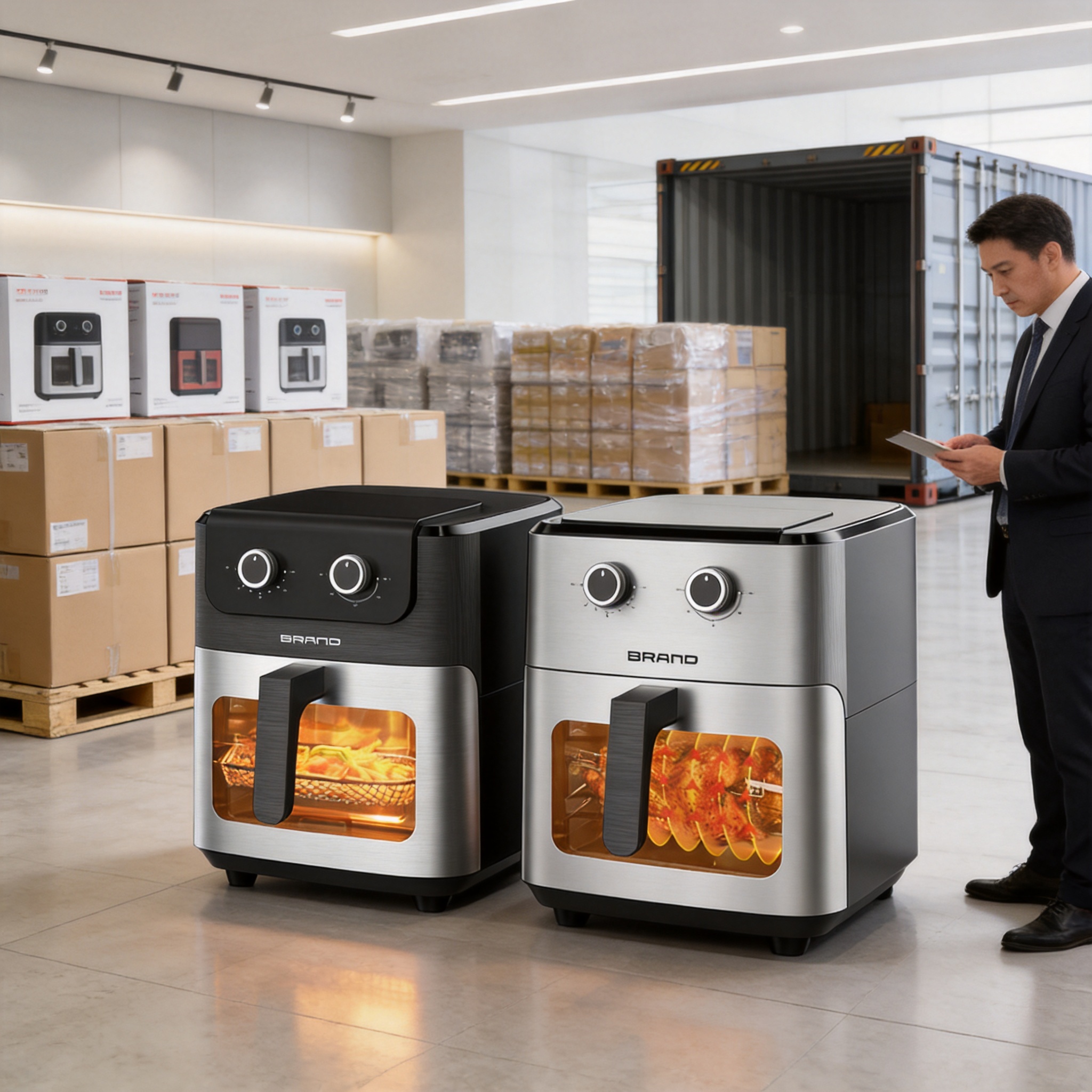
Purchasing Checklist for the 7-Litre Air Fryer
Before ordering, buyers should confirm the exact model. The window and non-window versions should be listed separately in purchase documents so that production, packaging, certification, and inspection requirements remain clear.
Voltage and frequency should be confirmed for the destination market. The correct plug, cord length, fuse arrangement, markings, and manual language should be specified. If the product will be sold in several regions, each configuration should be reviewed separately.
Buyers should request a complete technical file, including the rated power, capacity, material information, component list, safety documents, test reports, product drawings, packaging specifications, and user manual. The final approved sample should match the production configuration.
Quality expectations should be defined before production. These may include acceptable cosmetic limits, control operation, basket fit, window clarity, heating performance, noise level, carton quality, label placement, and sampling standards. Written criteria reduce misunderstandings between the buyer and factory.
Logistics should be planned using confirmed carton dimensions and loading quantities. Buyers should verify whether cartons are palletized, how many units fit in each container, and what shipping marks are required. The stated 530-piece 20-foot and 1,000-piece 40-foot high-cube figures should be treated as planning references until confirmed against final packaging.
After-sales arrangements should include spare-parts availability, warranty terms, complaint handling, replacement policies, and technical support. Air fryer programs can involve large retail volumes, so prompt communication is important when a market reports a recurring issue.
Recommended Product Positioning
The GSE34-1 can be positioned as a practical family-size air fryer for consumers who want straightforward controls and visible cooking progress. Suggested product messages may focus on its 7-litre capacity, 1500-watt power, mechanical operation, viewing window, everyday versatility, and easy-to-understand design.
The model should not be positioned solely as a budget appliance. Its value also comes from usability and product balance. The combination of a generous cooking chamber, physical controls, optional window, and established manufacturing support gives it relevance across entry-level and mid-range retail programs.
For online selling, product pages should show the appliance from multiple angles, display the controls clearly, explain the window function, state the capacity accurately, and provide a concise cooking-use overview. Buyers should avoid unsupported claims about cooking speed, energy savings, or health benefits unless such claims are supported by appropriate testing.
For physical retail, the window version can benefit from front-facing placement and packaging graphics that show food inside the cooking chamber. The non-window model can be positioned beside it as an alternative for customers who prefer a more economical or minimal design.
Q&A
What is the capacity of the air fryer?
The nominal capacity is 7 litres. This makes the appliance suitable for family meals, larger portions, snacks, vegetables, poultry, seafood, and many other everyday foods. Actual usable capacity depends on the food type and the recommended arrangement inside the basket.
What is the difference between GSE34-1 and GSE34-1D?
The GSE34-1 is the mechanical air fryer with a viewing window. The GSE34-1D is the mechanical air fryer without a viewing window. Both are listed with a 1500-watt rating and 7-litre capacity, but buyers should confirm the final technical configuration and packaging for each model.
Does the product use digital controls?
No. The product is designed with mechanical controls. This provides direct, physical adjustment and a simple operating experience without relying on a touchscreen or complex electronic menu system.
Why is the viewing window useful?
The viewing window allows users to observe food during cooking without opening the basket as often. It can help users monitor browning and make the appliance more visually engaging. The window version may also provide a useful merchandising difference compared with basic closed-housing models.
What is the rated power?
The listed rated power is 1500 watts. Actual electrical requirements must be matched to the voltage and frequency of the destination market. Buyers should confirm the final rating label and plug configuration before ordering.
Which materials are used?
The listed materials are PP, PA, ABS, and PC. These plastics may be assigned to different components according to their required strength, heat resistance, rigidity, appearance, or transparency. The final material grades and food-contact applications should be confirmed through the technical documentation.
Is the air fryer suitable for international distribution?
The supplied information lists CE, GS, CB, ETL, RoHS, LFGB, and FDA references. These indicate broad international market consideration, but buyers must verify the exact certificates, test reports, model numbers, voltage, plug, and destination-market requirements for the final product.
What is the minimum order quantity?
The stated minimum order quantity is 1,000 pieces. Buyers should confirm whether this quantity applies to each model, color, plug type, packaging version, or customized configuration.
How many units fit in a shipping container?
The supplied information indicates approximately 530 pieces in a 20-foot container and approximately 1,000 pieces in a 40-foot high-cube container. Final loading quantities depend on carton design, palletization, shipping restrictions, and the confirmed packaging configuration.
Can the product be customized?
Potential customization may include packaging, labels, manuals, colors, logos, plug types, and selected product details. Any customization should be reviewed technically and commercially before production. Changes affecting electrical, heating, food-contact, or safety characteristics may require additional testing.
What should buyers inspect before shipment?
Buyers should inspect model identity, quantity, appearance, control operation, basket fit, window condition where applicable, power rating, accessories, labels, manuals, carton markings, and basic functional performance. A pre-shipment inspection can be compared with an approved reference sample and written quality standard.
Who is the manufacturer?
The manufacturer identified in the supplied materials is CIXI GSTAR ELECTRIC APPLIANCE CO., LTD., located in Cixi, Ningbo, China. The company profile describes experience in designing, developing, and manufacturing small kitchen appliances and related hospitality products.
Conclusion
The GSE34-1 7-litre mechanical air fryer offers a clear and commercially practical product proposition. Its 1500-watt power supports everyday air-frying applications, while the 7-litre capacity gives it broader household appeal than many compact models. The mechanical controls make operation straightforward, and the viewing-window version provides a visible feature that can improve both user convenience and retail presentation.
The product’s use of PP, PA, ABS, and PC supports a balanced approach to housing, structural, and transparent components. Its one-piece carton format, manageable product weight, and stated container-loading information support distribution planning. The corresponding non-window model also allows buyers to create a two-level product range based on feature preference and target price.
Behind the product is a manufacturer with experience in small kitchen appliance development, export-oriented production, engineering, and quality control. The company’s history across air fryers, air ovens, food processors, blenders, grills, and other appliances provides a useful foundation for continued product development and OEM cooperation.
For importers, distributors, and private-label buyers, the most important next steps are technical verification, sample approval, certification review, factory assessment, packaging confirmation, and a clearly documented quality standard. When these steps are completed carefully, the GSE34-1 platform can serve as a dependable foundation for a family-oriented air fryer program that emphasizes usability, capacity, simple operation, and international commercial potential.
References
1. Product specification sheet for the GSE34-1 and GSE34-1D mechanical air fryer models, including capacity, power, materials, packaging, weight, and loading information.
2. Manufacturer-provided company profile describing product development, factory operations, engineering resources, quality-control personnel, and international market experience.
3. General principles of hot-air cooking, countertop appliance operation, and household food preparation.
4. International electrical appliance conformity and safety documentation practices, including certification review, model verification, and market-specific labeling.
5. General quality-control practices for plastic injection molding, electrical assembly, functional testing, packaging inspection, and pre-shipment inspection.