
 English
 中文简体
中文简体 Español
 English
 中文简体
中文简体 Español
In modern kitchens, speed, versatility, hygiene, and consistency have become essential expectations rather than optional conveniences. Home cooks want to prepare fresh vegetables quickly, small restaurants need reliable prep tools that save labor, and retailers seek compact appliances that combine real usefulness with marketable value. The Electric Slicer Shredder Chopper Juicer Mixer in One is designed to answer these needs with a practical multifunctional structure, combining several common food preparation tasks in a single electric vegetable cutter.
This appliance is positioned within the electrical home appliance and daily necessities categories, which means it is not merely a seasonal gadget or a single-use kitchen accessory. It is intended to become a frequent-use preparation tool for households, apartments, dormitory kitchens, small catering spaces, and food service environments that need efficient cutting, shredding, chopping, juicing, and mixing support. With a 70-watt power rating, stainless steel cutting components, food-contact material options, and multiple international certifications, the product balances convenient performance with manufacturing discipline.
Unlike traditional manual graters, basic slicers, or bulky food processors that may take up excessive counter space, this product focuses on integrated usefulness. Its value comes from its ability to reduce the number of separate tools required for everyday food preparation. Instead of using one tool for slicing cucumbers, another for shredding carrots, another for chopping onions, and another for mixing small quantities, users can rely on one compact electric appliance designed around quick setup, repeated use, and easy operation.
The product is supplied by CIXI GSTAR ELECTRIC APPLIANCE CO., LTD., a manufacturer specializing in small electric kitchen appliances and household kitchen electric appliances. The company designs, develops, and manufactures product lines such as blenders, slicers, choppers, food processors, smokeless grills, hot pots, air fryers, and air ovens. Its experience also extends to hospitality and food service products, including ice buckets, beverage dispensers, pitchers, slicers, and graters. This background gives the company a strong understanding of both domestic kitchen habits and commercial procurement expectations.
Electric Slicer Shredder Chopper Juicer Mixer in one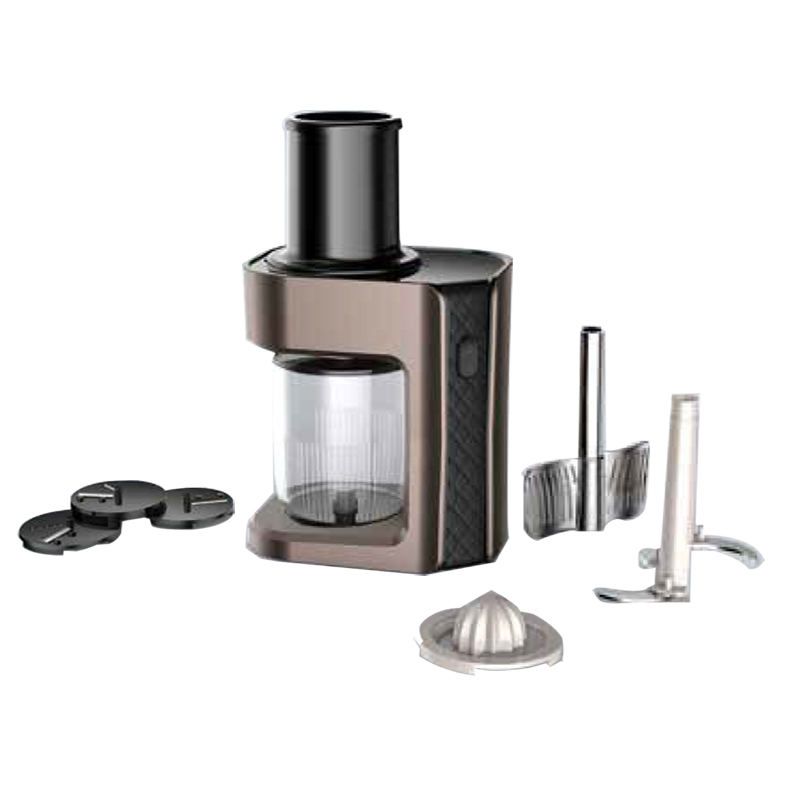
Product Overview
The Electric Slicer Shredder Chopper Juicer Mixer in One is identified by Item No. GSE001-1. It is categorized as an electric vegetable cutter and is designed as a multifunctional preparation appliance. The product name itself reflects the combined functions that make it valuable: slicing, shredding, chopping, juicing, and mixing. These functions support many everyday kitchen tasks, including salad preparation, vegetable side dishes, fruit-based drinks, minced ingredient preparation, and pre-processing for soups, sauces, casseroles, and stir-fry meals.
Its structure uses ABS, SS304 stainless steel, and PS materials. ABS is commonly valued in appliance housings because it offers good toughness, impact resistance, and formability. SS304 stainless steel is widely used in kitchen and food-contact applications because of its corrosion resistance, durability, and clean appearance. PS can be used for specific transparent or formed components depending on design requirements. The combination reflects a product strategy that considers strength, usability, and food preparation suitability.
With a rated power of 70 watts, the appliance is designed for practical household and light-duty preparation rather than high-energy industrial operation. This power level supports efficient cutting and mixing tasks while maintaining an accessible and manageable appliance profile. For many consumers, a lower-power multifunctional product can be attractive because it may feel safer, less intimidating, and more suitable for everyday routines than oversized machines that are difficult to store, assemble, or clean.
The product is packed at four pieces per carton, with a carton measurement of 58.7 x 42 x 42.8 cm. The net weight is 11.4 kg per carton, and the gross weight is 13.2 kg per carton. These logistics details matter for wholesalers, importers, and retailers because carton volume, weight, loading quantity, and minimum order quantity all influence procurement planning, warehouse arrangement, freight estimation, and retail distribution.
| Item No. | GSE001-1 |
| Product Name | Electric Slicer Shredder Chopper Juicer Mixer in One |
| Category | Electric Vegetable Cutter |
| Power | 70 W |
| Material | ABS + SS304 + PS |
| PCS/Carton | 4 pcs/carton |
| Carton Measurement | 58.7 x 42 x 42.8 cm |
| Net Weight | 11.4 kg/carton |
| Gross Weight | 13.2 kg/carton |
| 20 ft Container Loading | 1824 pcs |
| 40 HQ Container Loading | 2568 pcs |
| MOQ | 2000 pcs |
| Certifications | CE, GS, CB, ETL, RoHS, LFGB, FDA |
Why Multifunctionality Matters
The kitchen appliance market is crowded with products that promise convenience, but many fail to deliver long-term value because they solve only one problem. A basic manual slicer can slice vegetables, but it cannot chop or mix. A small chopper can mince ingredients, but it usually cannot produce consistent shreds. A blender can mix liquids, but it is not always effective for controlled slicing or shredding. When consumers purchase multiple single-purpose tools, they often face storage clutter, repetitive cleaning, and inconsistent user experience.
The Electric Slicer Shredder Chopper Juicer Mixer in One addresses this problem by integrating several functions into one appliance. This does not only save space; it also simplifies the cooking process. A user preparing a vegetable salad may slice cucumbers, shred carrots, chop herbs, and mix a dressing using one appliance system rather than moving between several tools. A family preparing soup may chop vegetables, shred root ingredients, and process small amounts of aromatics more efficiently. A café or small food stand may use it for repeated preparation tasks where consistent texture is important.
Multifunctionality also makes the product easier to promote in retail channels. Consumers are more likely to see value in an appliance that can support breakfast, lunch, dinner, and snack preparation. It can help prepare fruit mixtures, shredded vegetables, chopped salad ingredients, and fresh side dishes. For retailers, this creates broader selling points than a narrow appliance that appeals only to one cooking style.
Compared with competitors that offer separate slicing or chopping devices, this model provides a more complete food preparation concept. It is not presented as a luxury item; it is a practical daily-use appliance. The inclusion of juicing and mixing functions further expands its usefulness beyond vegetables alone, allowing fruit-based preparation and simple blended mixtures. This wider functional range can help importers and distributors position the product across multiple market segments, including healthy cooking, family meals, compact kitchens, and convenience-focused consumers.
Advantages Over Many Competing Kitchen Preparation Tools
1. A Combined Function Platform
The most obvious advantage is the product’s multifunctional design. Many competing tools require consumers to choose between a slicer, shredder, chopper, juicer, or mixer. This product combines these capabilities, reducing the need for several separate purchases. For consumers, this can mean lower total cost, less storage burden, and a more streamlined kitchen experience. For retailers, it creates a strong value proposition: one appliance, multiple preparation possibilities.
In markets where kitchen space is limited, such as city apartments and small homes, compact multifunctional appliances can be more attractive than large countertop machines. A device that supports several common kitchen tasks helps users keep counters clear and cabinets organized. Competitors that focus only on one function may appear less practical when compared directly against a product that covers more daily cooking needs.
2. Practical Power for Everyday Use
The 70-watt power rating reflects a practical approach to daily kitchen preparation. Instead of relying on high power as a marketing number, the appliance is designed for targeted tasks such as slicing, shredding, chopping, juicing, and mixing in a convenient format. In many homes, users do not need a large, heavy-duty processor for every meal. They need a reliable tool that can assist quickly without requiring complicated assembly or excessive noise and power consumption.
Competitors sometimes emphasize high wattage, but higher wattage does not automatically mean better suitability for every kitchen. High-power appliances can be heavier, louder, more expensive, and more difficult to clean. A balanced power design can be more suitable for fresh vegetables, fruits, and lighter food preparation tasks. This makes the product appealing to users who value convenience and efficiency rather than oversized machinery.
3. Food-Preparation Materials
The use of ABS, SS304 stainless steel, and PS shows a materials approach aligned with small kitchen appliance requirements. SS304 stainless steel is especially important because cutting and shredding elements must resist corrosion and maintain clean contact with foods. Stainless steel components also give users confidence because they are familiar in kitchen knives, graters, bowls, and other preparation tools.
ABS contributes to the structural quality of the appliance housing and supports durable molding. It allows the product to be made with consistent shapes, ergonomic details, and an attractive finish. PS may support transparent or formed accessory components depending on the final configuration. When compared with lower-quality tools using weaker plastics or non-stainless metal parts, the material selection helps this product stand out as a better long-term kitchen solution.
4. Certification Support for International Markets
The product is associated with CE, GS, CB, ETL, RoHS, LFGB, and FDA certifications. For importers, distributors, and retail buyers, certification support is a major advantage. It helps reduce market-entry uncertainty and demonstrates that the manufacturer understands international compliance expectations. Certifications can support electrical safety, material safety, restricted substance control, and food-contact suitability depending on specific market requirements and documentation.
Many competing low-cost appliances may appear attractive at first glance but lack the certification background needed for major retail channels or regulated markets. For professional buyers, non-compliance can create delays, testing expenses, shipment risks, or rejected listings. A product with broad certification coverage is easier to evaluate for international distribution and can be more suitable for supermarkets, chain stores, television shopping channels, online marketplaces, and branded private-label programs.
5. Strong Carton Planning and Export Readiness
The product’s packaging details show that it has been considered from a wholesale and export perspective. Four pieces per carton, defined carton measurements, net and gross weights, and container loading information help buyers plan logistics efficiently. Procurement teams need these details to calculate freight, storage, pricing, and delivery schedules. A supplier that provides clear specifications makes the buying process more professional.
Some competitors may present attractive product images but fail to provide reliable packing or loading data early in the purchasing process. This can slow down quotation approval and create uncertainty. By supplying detailed carton and loading information, this product demonstrates readiness for larger-volume orders. The stated minimum order quantity of 2000 pieces also aligns with wholesale and factory-direct procurement patterns.
Designed for Daily Kitchen Scenarios
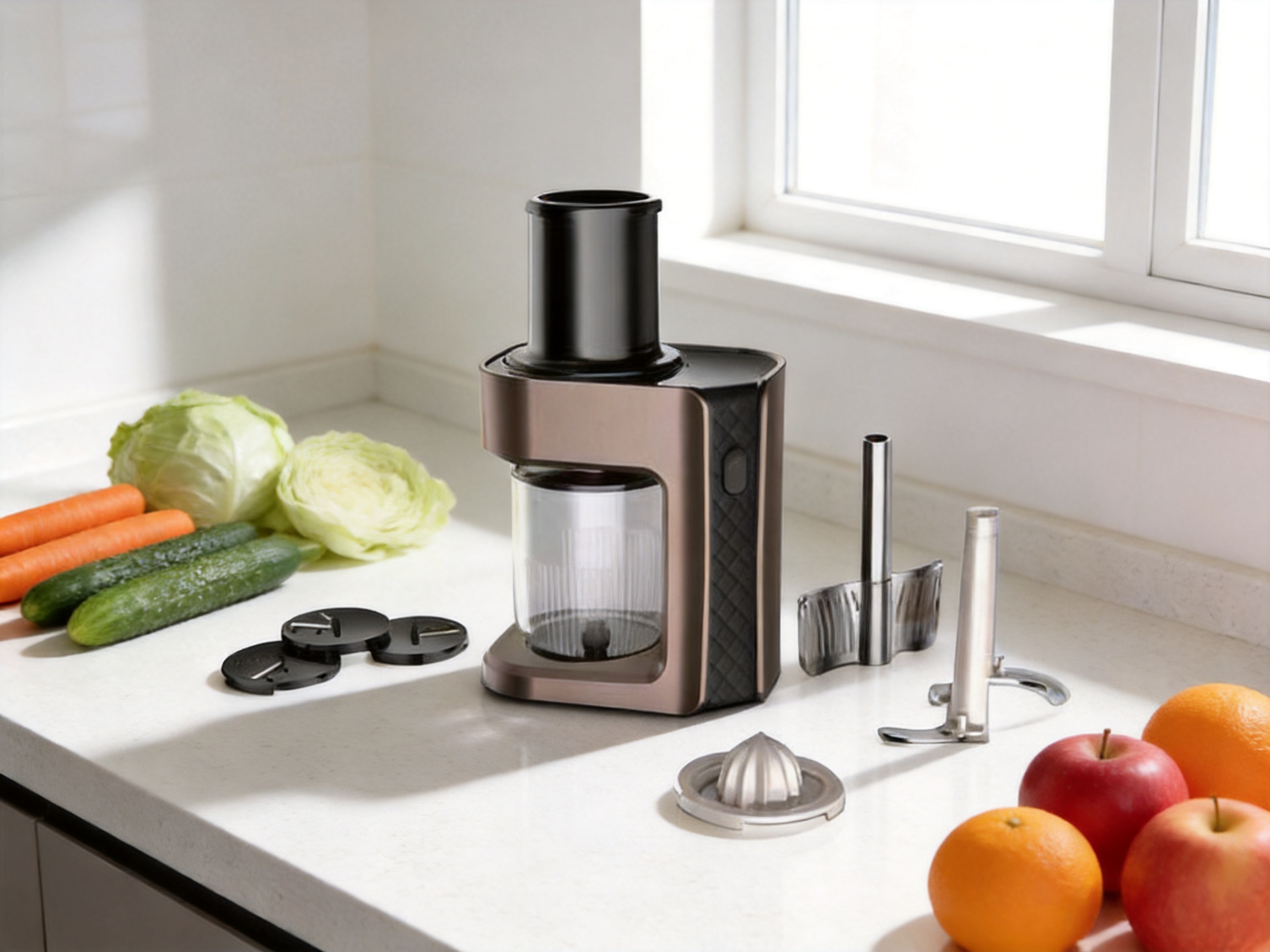
The best kitchen appliances are those that users naturally reach for again and again. A product may look impressive, but if it is difficult to assemble, hard to clean, or too specialized, it often ends up stored away. This electric vegetable cutter is designed around common preparation scenarios that occur in everyday cooking. These include preparing vegetables for salads, chopping ingredients for sauces, shredding vegetables for side dishes, mixing food components, and processing fruit for fresh drinks or snack preparation.
For families, the appliance can help reduce preparation time during busy mornings or evenings. A parent preparing lunch boxes may quickly process carrots, cucumbers, cabbage, or fruit. A home cook preparing dinner may use it to process vegetables before stir-frying or baking. For users who want to eat more fresh produce, reducing the labor involved in cutting vegetables can be meaningful. If healthy food is easier to prepare, it is more likely to become part of the routine.
For small food service environments, the appliance can help with light preparation tasks where manual cutting would take too long. Cafés, small hotels, breakfast bars, snack counters, and office kitchens may benefit from a compact electric tool that assists with repeated ingredient preparation. While it is not presented as a heavy industrial machine, its multifunctional capacity can support small-scale efficiency.
For gift and retail markets, the product is also attractive because it is easy to explain. Customers immediately understand what slicing, shredding, chopping, juicing, and mixing mean. The appliance does not require complicated education to demonstrate its value. Retail staff can describe its benefits in simple terms, and online product pages can show clear use cases. In competitive e-commerce environments, easy-to-understand value is a major advantage.
Manufacturing Strength Behind the Product
A kitchen appliance is only as reliable as the factory system behind it. CIXI GSTAR ELECTRIC APPLIANCE CO., LTD. has developed from product sourcing experience into a dedicated manufacturing enterprise. The company’s history includes long-term involvement in small electric appliances, TV shopping products, innovative household goods, and export-oriented kitchen products. This background is important because it combines market insight with production experience.
The company was founded with a focus on design and development, especially for innovative household products. Early experience with supermarket supply and international buyers helped build an understanding of price, quality, inspection, and delivery discipline. Over time, the company moved into a larger factory and expanded its electric product development. Its product scope now includes blenders, slicers, choppers, food processors, smokeless grills, hot pots, air fryers, and air ovens. This broad product base supports stronger component knowledge, production planning, testing procedures, and market awareness.
The company operates a substantial production area, with information indicating a wholly owned plant of around 15,000 square meters and factory facilities that support large-scale manufacturing. The building area is described as reaching approximately 18,000 square meters. The workforce includes experienced production workers, an R&D department with engineers, and a quality control team. These resources are essential for building appliances that must satisfy both end-user expectations and importer requirements.
Manufacturing strength is not only about having machines and workers. It is also about controlling the complete process from concept to shipment. For this product, that means design evaluation, material selection, mold development, component inspection, assembly control, performance testing, safety review, packaging verification, and shipping preparation. A manufacturer experienced in export appliances understands that each step affects the final product experience.
Research and Development Capability
The company’s R&D capability is an important strength for the Electric Slicer Shredder Chopper Juicer Mixer in One. Multifunctional appliances require careful design because different functions must work together without making the product too complicated. Engineers must consider motor performance, cutting structure, material durability, user operation, cleaning convenience, assembly stability, and cost control. A successful product must be simple enough for daily users but robust enough for repeated use.
R&D also helps a manufacturer respond to market trends. Consumers increasingly want healthier cooking, fresh food preparation, compact appliances, and products that reduce time in the kitchen. At the same time, retailers want attractive designs, efficient packaging, stable quality, and competitive pricing. A company with its own engineering team can adjust product details, explore new accessories, improve user experience, and support private-label development according to buyer requirements.
The company’s experience with innovative TV shopping products is especially relevant. TV shopping products must demonstrate clear benefits quickly and visually. They must solve recognizable problems and perform in a way that customers can understand. That mindset supports the development of multifunctional kitchen appliances because buyers and users need to see immediate value. A product that slices, shreds, chops, juices, and mixes can be demonstrated effectively in live sales, online videos, retail displays, and product pages.
Quality Control and Production Discipline
Quality control is essential for any electric kitchen appliance because the product interacts with food, electricity, moving parts, and daily user handling. A strong QC department helps ensure that each production batch meets required standards. The company has a dedicated quality control team that supports inspection and production monitoring. Quality work can include incoming material checks, in-process inspection, finished product testing, packaging checks, and shipment verification.
For this product, important quality considerations include the stability of the motor, the fit of attachments, the sharpness and durability of stainless steel parts, the surface quality of plastic components, the safety of electrical construction, and the cleanliness of food-contact materials. Carton strength and packing arrangement also matter because products must travel through international shipping, warehousing, and retail distribution.
Quality control also protects brand reputation for distributors and retailers. When a buyer imports thousands of units, consistent quality is more important than a perfect sample. A reliable factory must reproduce the approved sample through mass production. This requires trained workers, controlled assembly procedures, clear inspection criteria, and responsive management. The manufacturer’s experience with large-volume orders, including successful sales of food processor products in international markets, supports confidence in its production capability.
Advanced Manufacturing Process
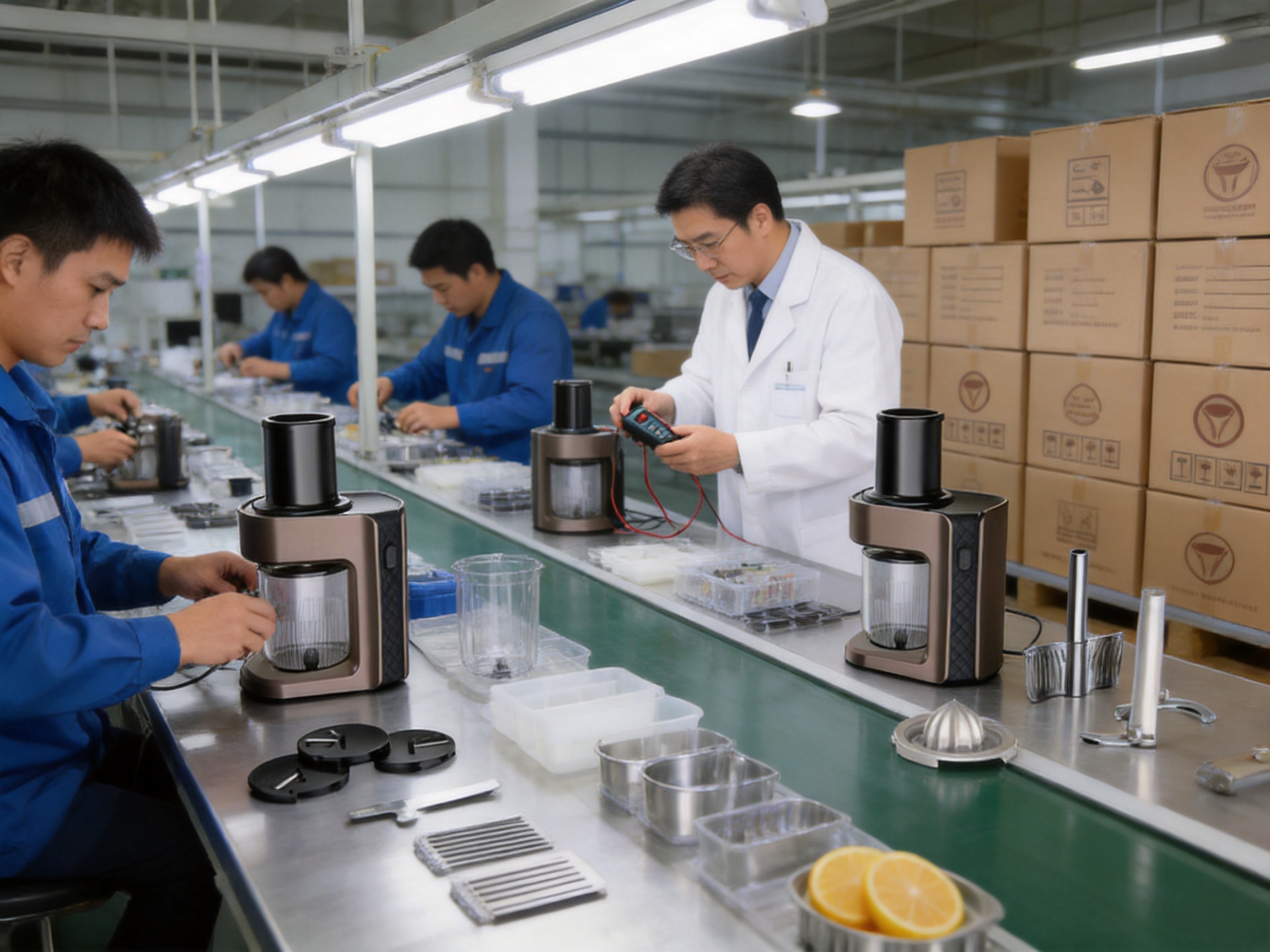
The manufacturing process for a multifunctional electric vegetable cutter involves several coordinated stages. First, product design and engineering determine the structure, power system, housing, functional attachments, and user operation method. Design engineers must balance performance, safety, appearance, manufacturability, and cost. They must also consider how the product will be assembled and inspected in large quantities.
Second, material selection and component sourcing are conducted according to product requirements. ABS, SS304 stainless steel, and PS must be selected and processed in ways that support durability and food preparation use. Stainless steel cutting components require proper forming and finishing. Plastic housings and accessories require stable molding quality so that parts fit together correctly. Electrical components must match the power rating and safety expectations.
Third, molding and forming processes create the structural parts. Plastic injection molding is commonly used for appliance housings and accessory parts. Mold precision affects the final assembly experience, visual quality, and durability of the product. Consistent molding helps prevent loose fits, warping, or assembly difficulty. For stainless steel parts, forming and finishing must support effective cutting and corrosion resistance.
Fourth, assembly lines combine the motor, housing, functional parts, switches, electrical wiring, and accessories. Workers follow assembly procedures to ensure that each unit is built consistently. In-process inspection can identify issues before they move further down the line. For a multifunctional product, correct part fit is especially important because accessories must connect properly and users must be able to change functions without confusion.
Fifth, performance and safety checks are performed. These may include power-on testing, motor operation checks, function checks, visual inspection, and packaging confirmation. Products intended for international markets must align with relevant certification and buyer requirements. The presence of multiple certifications indicates that the product and manufacturer are prepared for compliance-driven markets.
Finally, packaging and logistics preparation ensure that products are protected and efficiently packed for shipment. The specified carton measurement and loading quantities help buyers prepare shipping plans. Good packaging reduces transport damage, supports warehouse handling, and improves retail readiness. A professional manufacturer understands that product quality must be protected until the item reaches the consumer.
Importance of Material Engineering
Material engineering plays a central role in the performance of this appliance. ABS, SS304 stainless steel, and PS each serve different purposes. ABS is valued for its balance of strength, moldability, and surface finish. In a kitchen appliance, housing material must withstand handling, minor impacts, assembly pressure, and repeated cleaning. It also contributes to the perceived quality of the product when users touch and operate it.
SS304 stainless steel is a key advantage for food preparation components. Cutting and shredding parts must remain stable when exposed to moisture, vegetable acids, cleaning water, and repeated friction. Stainless steel helps maintain sanitary appearance and supports long-term usability. In comparison, lower-grade metal parts may rust, discolor, or lose user trust over time. SS304 gives the product a stronger professional image.
PS can support shaped components where clarity, rigidity, or specific design properties are useful. In a multifunctional appliance, different parts may require different material characteristics. A transparent part may help users observe food movement or contents. A rigid component may help guide food into the cutting area. Material selection must be matched to real use rather than chosen only for cost.
The combination of these materials reflects an understanding that a kitchen appliance must perform both mechanically and visually. Consumers judge products not only by function but also by touch, appearance, cleaning feel, and confidence in food contact. Better materials can reduce complaints, improve repeat satisfaction, and support stronger retail reviews.
Safety and Compliance Value
Safety is a central concern for electric kitchen appliances. Users interact with moving blades or cutting parts, electrical power, and food-contact surfaces. A responsible product must be designed to reduce foreseeable risks and meet the requirements of target markets. Certification support, including CE, GS, CB, ETL, RoHS, LFGB, and FDA, is therefore a major competitive strength.
CE marking is commonly associated with European market compliance. GS certification is recognized as a mark related to tested safety in certain markets. CB certification supports international recognition of electrical product testing. ETL is relevant for North American market acceptance. RoHS addresses restrictions on hazardous substances. LFGB and FDA relate to food-contact expectations in their respective regulatory environments. Together, these certifications create a strong compliance foundation for global buyers.
For distributors, certifications reduce uncertainty. They also help support product listing, customs clearance, retail approval, and consumer trust. In many markets, buyers cannot simply select the cheapest product; they need documentation that supports legal sale and safe use. A low-priced competitor without suitable certifications may create hidden costs and risks. This product’s certification profile makes it more suitable for serious procurement programs.
Market Applications
The Electric Slicer Shredder Chopper Juicer Mixer in One can serve several market channels. In household retail, it can be marketed as a multifunctional kitchen helper for fresh meals. In e-commerce, it can be positioned with keywords related to electric vegetable cutter, food preparation appliance, slicer shredder chopper, and compact kitchen appliance. In supermarket and department store channels, it can be presented as a practical appliance for daily cooking and healthy eating.
For TV shopping and live-commerce channels, the product has strong demonstration potential. Slicing, shredding, chopping, juicing, and mixing are visible actions that audiences can understand quickly. Demonstrators can show how the appliance reduces manual labor and supports different recipes. This makes the product suitable for video-based selling formats where immediate visual proof matters.
For private-label importers, the product offers a strong foundation because it combines useful functions with export-ready specifications. Buyers can evaluate packaging, branding, instruction manuals, plug types, color options, and accessory configurations according to market demand. A manufacturer with R&D and production capabilities can support adaptations for different regions and retail strategies.
For hospitality and light commercial markets, the appliance may support food preparation in environments that need compact tools. Small hotels, bars, cafés, and breakfast service areas often need practical preparation support without investing in large industrial machines. A multifunctional product can help reduce tool count and improve preparation efficiency for lighter tasks.
Healthy Cooking and Consumer Lifestyle Trends
One reason electric vegetable cutters have become popular is the growing interest in healthier eating. Many consumers want to eat more vegetables and fruits, but they struggle with preparation time. Washing, peeling, slicing, shredding, and chopping can feel tedious after a long workday. If an appliance makes these tasks faster and easier, consumers are more likely to prepare fresh food at home.
This product supports that lifestyle by making fresh ingredient preparation more accessible. Shredded carrots, sliced cucumbers, chopped cabbage, fruit mixtures, and blended ingredients can become part of everyday meals. Families can prepare colorful dishes more quickly, and individuals can add fresh produce to their diets without feeling that cooking is too time-consuming.
The appliance also supports creative home cooking. Users can experiment with vegetable textures, fruit combinations, dressings, sauces, and mixed ingredients. Different textures can improve meals: thin slices for salads, shreds for slaws, chopped ingredients for fillings, and mixed components for dips or spreads. A multifunctional appliance encourages variety, which helps prevent repetitive meals.
Compared with pre-cut packaged foods, home preparation can be fresher and more customizable. Consumers can choose ingredients, control portion size, reduce additives, and prepare food closer to eating time. A product that simplifies preparation can therefore support both convenience and quality.
Why Buyers Should Consider This Product
Wholesale buyers, distributors, and retailers evaluate products differently from end users. They need to consider product appeal, certification, factory reliability, packaging, loading quantity, price competitiveness, and after-sales support. The Electric Slicer Shredder Chopper Juicer Mixer in One offers several advantages that match these procurement priorities.
First, the product has broad consumer appeal because it solves common kitchen tasks. Second, it is easy to explain and demonstrate. Third, it provides multiple functions in one appliance, increasing perceived value. Fourth, it uses recognized material categories such as SS304 stainless steel for food preparation components. Fifth, it has certification support for international markets. Sixth, it comes from a manufacturer with experience in small kitchen appliances, export supply, R&D, and quality control.
The company’s sole tenet emphasizes high-quality innovative products, competitive pricing, quick delivery, and quality after-service. These values matter to buyers because long-term cooperation depends on more than one shipment. Importers need suppliers who respond to requirements, maintain consistency, support engineering communication, and solve problems quickly. A factory that works closely with customers as engineering partners can help buyers develop products suitable for their markets.
The minimum order quantity of 2000 pieces is suitable for serious wholesale programs. Container loading information also supports large-scale planning. Buyers can calculate cost per unit, shipping efficiency, and retail pricing more accurately. This transparency improves procurement confidence and shortens the evaluation process.
Competitive Pricing Through Manufacturing Integration
Competitive pricing is not achieved only by reducing material quality. A stronger approach is to improve manufacturing efficiency, control processes, and design products for stable mass production. The company’s manufacturing background gives it the ability to manage production costs while maintaining product value. This is especially important in small electric appliances, where consumers are price-sensitive but still expect safety and durability.
Factory-direct manufacturing can reduce unnecessary trading layers and improve communication between buyers and production teams. When buyers discuss product details directly with the manufacturer, they can receive more accurate answers about materials, packaging, production schedules, and customization options. This direct communication also helps resolve technical questions more efficiently.
The company’s experience with large retail customers and international markets supports cost awareness. Supplying supermarkets and major retail channels requires balancing price, quality, delivery, and compliance. A product that is too expensive may not sell, but a product that is too cheap and unreliable can damage the buyer’s reputation. The ideal solution is a well-engineered product with stable quality and competitive cost.
Packaging, Logistics, and Supply Chain Advantages
Packaging and logistics are often overlooked by consumers, but they are vital for business buyers. The Electric Slicer Shredder Chopper Juicer Mixer in One is packed four pieces per carton. The carton measurement is 58.7 x 42 x 42.8 cm, with a net weight of 11.4 kg and a gross weight of 13.2 kg. These figures help buyers estimate warehouse space, pallet arrangements, transportation costs, and container utilization.
The stated 20 ft container loading quantity is 1824 pieces, while the 40 HQ loading quantity is 2568 pieces. These numbers are useful for import planning, especially when buyers are comparing several product options. Efficient loading can improve landed cost and retail margin. A product with unclear or inefficient packing may become less attractive once freight costs are calculated.
Good packaging also protects the product during long-distance shipment. Small electric appliances can be exposed to vibration, stacking pressure, temperature changes, and multiple handling stages. Proper carton strength and internal protection reduce the risk of damage. For retailers, reduced damage means fewer returns, fewer customer complaints, and smoother inventory management.
Company Experience and Long-Term Reliability
CIXI GSTAR ELECTRIC APPLIANCE CO., LTD. has a development story rooted in international trade, product sourcing, and manufacturing. The founder’s early experience in selling electrical appliances and sourcing products for supermarket customers helped form a practical understanding of market demand. Later exposure to TV shopping and innovative product development encouraged the company to focus on original design and practical consumer value.
The company began by designing and developing non-electric innovative household products, including spiralizer drum graters, iced pitchers, and iced bowls. These products achieved strong international sales and reached well-known supermarket and retail channels. This early success showed the company’s ability to identify consumer-friendly ideas and manufacture products that buyers could sell in volume.
After moving to a larger factory, the company expanded into electric products. This step required stronger engineering, compliance knowledge, electrical testing, and production management. The company’s later success with food processors, air ovens, and air fryers demonstrates its ability to adapt to changing market trends. In 2021, a 3-in-1 food processor achieved strong sales in Korean and Southeast Asian markets. In 2022, air ovens and air fryers became hot-selling products in Europe and South America. These results show that the company can develop products that meet international demand.
For buyers considering the Electric Slicer Shredder Chopper Juicer Mixer in One, this history matters. It indicates that the product is supported by a manufacturer with real market experience rather than a short-term assembler. Long-term reliability depends on company culture, production investment, engineering ability, and commitment to customer relationships. The company welcomes new partners and aims to build mutual benefit through quality, price, delivery, and service.
Use Cases and Recipe Possibilities
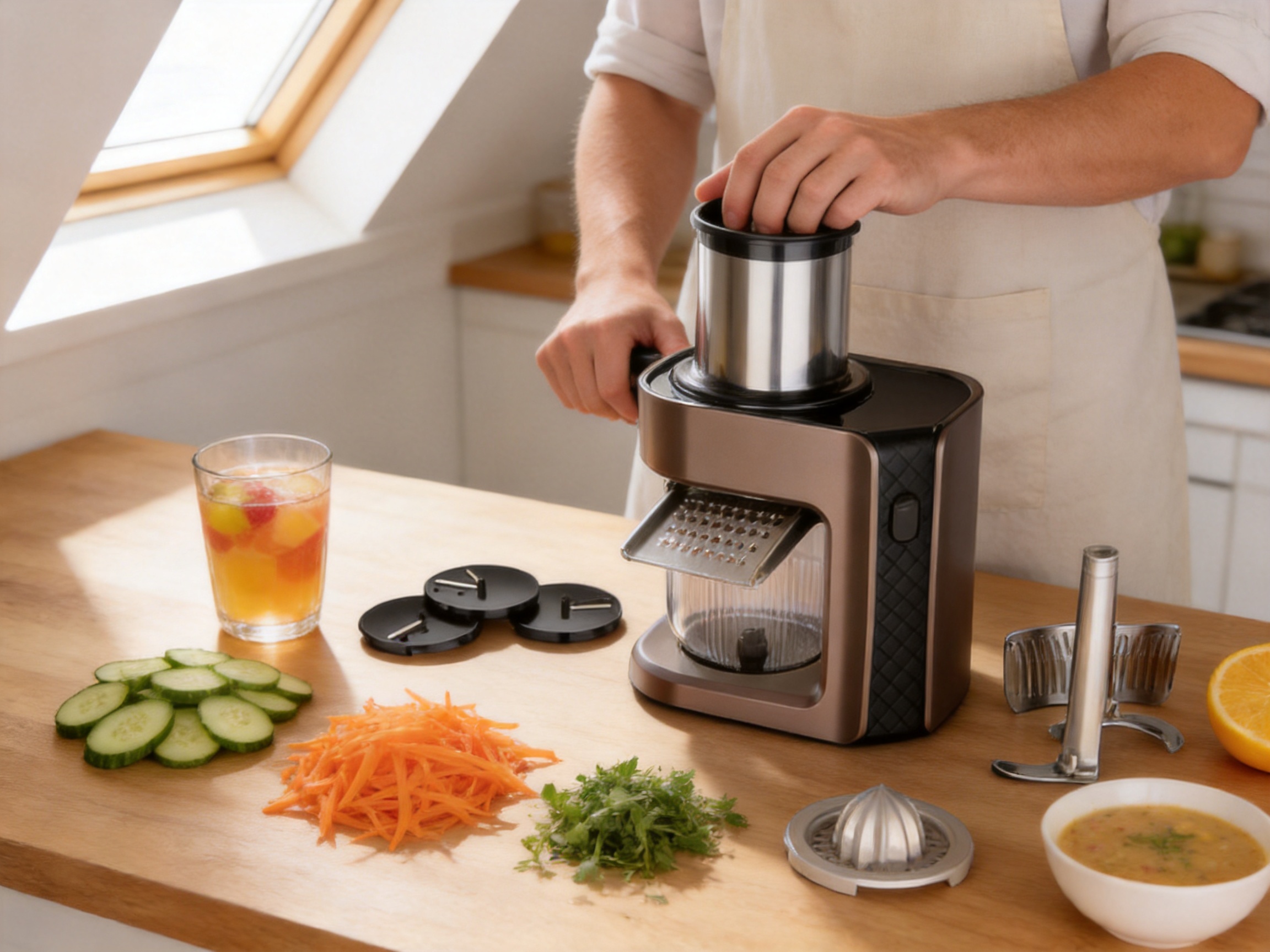
A multifunctional food preparation appliance becomes more valuable when users understand how many meals it can support. For breakfast, it can help prepare fruit mixtures, vegetable toppings, or ingredients for omelets. For lunch, it can support salad preparation, sandwich fillings, shredded vegetable bowls, and quick side dishes. For dinner, it can help process vegetables for stir-fries, soups, casseroles, dumpling fillings, and sauces.
In family kitchens, children and adults may prefer different textures. Some may enjoy finely chopped vegetables in sauces, while others prefer crisp slices in salads. A multifunctional appliance gives the cook more flexibility. It can also make meal preparation more engaging because users can experiment with ingredients and textures.
For vegetarian and health-focused cooking, slicing and shredding functions are especially useful. Vegetables such as carrots, cucumbers, zucchini, cabbage, potatoes, and radishes can be prepared in different forms. Chopping can support herbs, onions, garlic, and other aromatic ingredients. Mixing can help combine dressings, dips, and simple preparations. Juicing expands the appliance’s role into beverages and fruit-based recipes.
For meal prep routines, the product can help users prepare several ingredients at once and store them for later. Shredded vegetables can be kept for salads or quick cooking. Chopped ingredients can be prepared ahead for weekday meals. This can save time and reduce reliance on processed convenience foods.
Ease of Demonstration for Retail and Online Sales
A product that performs visible tasks has strong sales potential in modern commerce. Online marketplaces, social media stores, livestream sales, and retail demonstrations all benefit from products that can be shown clearly. The Electric Slicer Shredder Chopper Juicer Mixer in One is suitable for this style of selling because each function can be demonstrated in a simple way.
A short demonstration can show vegetables going in and sliced or shredded ingredients coming out. Chopping can be shown with common ingredients. Juicing and mixing can demonstrate fresh food preparation. These visual results help customers understand the product without reading long technical explanations. In a competitive online marketplace, clear demonstration can improve conversion.
The product name itself is rich in searchable function words. Buyers looking for slicers, shredders, choppers, juicers, mixers, or electric vegetable cutters may all find relevance in this appliance. This gives distributors and retailers broader keyword opportunities. A single-function product may attract only one type of search, while this multifunctional product can appear in several consumer need categories.
After-Sales Service and Engineering Partnership
After-sales support is a critical part of appliance business. Even well-made products require communication about spare parts, manuals, packaging, certification documents, product updates, and buyer feedback. The manufacturer emphasizes high-quality after service and close cooperation with customers as engineering partners. This approach is valuable for importers who need stable support after placing orders.
Engineering partnership means the factory can help buyers refine product details rather than only accepting fixed designs. For example, buyers may request packaging adjustments, instruction language changes, market-specific compliance documents, plug variations, or color preferences. An experienced manufacturer with R&D and QC teams can evaluate these requests and provide practical solutions.
Long-term service also helps improve future production. Customer feedback can identify opportunities to improve usability, packaging, or accessory design. A manufacturer that listens to buyers can make continuous improvements and maintain competitiveness. This is especially important in kitchen appliances, where market trends change quickly and consumer expectations continue to rise.
Comparison with Traditional Manual Tools
Manual kitchen tools still have a place in many kitchens, but they require more effort and time. Manual graters, slicers, and choppers can be tiring when preparing large quantities. They may also create inconsistent results depending on user skill. Some manual tools expose fingers to sharp surfaces, which can make users cautious or uncomfortable.
The Electric Slicer Shredder Chopper Juicer Mixer in One reduces the manual effort required for common preparation tasks. Electric assistance can improve speed and consistency, especially for repetitive slicing or shredding. It also provides broader functionality than most manual tools. Instead of storing several manual devices, users can choose one electric appliance that supports multiple tasks.
Compared with manual tools, the product may be especially appealing to elderly users, busy parents, and people who cook frequently. It can reduce hand fatigue and make fresh food preparation feel less burdensome. For consumers who have avoided certain recipes because of preparation time, this appliance can make those recipes more approachable.
Comparison with Large Food Processors
Large food processors can be powerful, but they are not always convenient for everyday use. They may be heavy, expensive, difficult to store, and time-consuming to clean. Many users own large appliances but avoid using them for small tasks because setup and cleanup feel excessive. This creates a gap in the market for compact multifunctional tools.
The Electric Slicer Shredder Chopper Juicer Mixer in One fits this gap. It provides useful preparation functions without positioning itself as an oversized kitchen machine. Its 70-watt design and multifunctional format are suitable for daily preparation routines. Users can choose it for quick vegetable or fruit processing rather than pulling out a large appliance.
For retailers, this positioning is important. The product can be sold to consumers who already own a blender or food processor but still want a more convenient tool for slicing and shredding. It can also appeal to first-time appliance buyers who need a practical entry-level multifunctional product.
Environmental and Practical Efficiency
Efficiency in the kitchen is not only about speed. It also includes reducing unnecessary purchases, avoiding wasted ingredients, and supporting better meal planning. A multifunctional appliance can reduce the need for multiple separate tools, which may lower material consumption at the household level. It can also help users process fresh ingredients before they spoil, reducing food waste.
RoHS certification support further reflects attention to restricted hazardous substances in electrical products. For markets concerned with environmental compliance, this is a meaningful advantage. Consumers and retailers increasingly care about responsible material use and product safety. Compliance documentation supports confidence in the product’s market suitability.
Practical efficiency also includes storage. A compact multifunctional appliance can help users keep kitchens organized. In smaller homes, every cabinet and counter area matters. Products that combine functions can be more attractive than collections of single-use gadgets. This increases the likelihood that the appliance will remain accessible and frequently used.
Procurement Considerations for Importers
Importers evaluating this product should consider several factors. The MOQ is 2000 pieces, which supports volume purchasing and factory production planning. Buyers should confirm target market requirements, plug types, packaging languages, instruction manual details, and certification documentation needed for their sales channels. They should also review sample performance and confirm accessory configuration before mass production.
The manufacturer’s contact information and factory address support direct business communication. Professional buyers may request quotations, lead times, packaging artwork specifications, inspection procedures, and shipping details. Because the product has defined carton data and container loading quantities, importers can estimate landed cost efficiently.
Buyers should also consider marketing strategy. The product’s multifunctional nature allows it to be promoted across several themes: healthy cooking, time-saving food preparation, compact kitchen convenience, family meals, fresh salads, fruit drinks, and meal prep. Strong product photography, demonstration videos, and clear user instructions can significantly improve sales performance.
Q&A Section
Q1: What is the main purpose of the Electric Slicer Shredder Chopper Juicer Mixer in One?
The main purpose is to simplify everyday food preparation by combining slicing, shredding, chopping, juicing, and mixing functions in one electric vegetable cutter. It is designed for users who want faster preparation of vegetables, fruits, and mixed ingredients without relying on several separate tools.
Q2: What makes this product different from ordinary slicers or choppers?
Ordinary slicers or choppers usually perform only one or two tasks. This product integrates multiple food preparation functions, giving users more flexibility. It can support salads, side dishes, fruit preparation, chopped ingredients, and mixed recipes, making it more practical for daily kitchen use.
Q3: Is the 70-watt power rating suitable for home use?
Yes. The 70-watt rating is designed for practical household and light-duty kitchen preparation. It supports common tasks such as slicing, shredding, chopping, juicing, and mixing while keeping the appliance manageable for everyday users.
Q4: What materials are used in the product?
The appliance uses ABS, SS304 stainless steel, and PS. ABS supports durable housing and molded structure, SS304 stainless steel is suitable for food preparation components because of its corrosion resistance, and PS may be used for specific shaped or transparent parts depending on product configuration.
Q5: Why is SS304 stainless steel important?
SS304 stainless steel is widely used in kitchen applications because it resists corrosion and maintains a clean food-contact surface. For cutting, shredding, and slicing components, stainless steel helps improve durability and user confidence.
Q6: What certifications support this product?
The product is associated with CE, GS, CB, ETL, RoHS, LFGB, and FDA certifications. These certifications support international market acceptance, electrical safety expectations, restricted substance compliance, and food-contact material confidence depending on market requirements.
Q7: Is this product suitable for wholesalers and importers?
Yes. The product includes clear carton data, container loading quantities, and a wholesale MOQ of 2000 pieces. Its multifunctional appeal, certification support, and export-ready packaging information make it suitable for distributors, retailers, and importers.
Q8: How many pieces are packed in one carton?
There are four pieces per carton. The carton measurement is 58.7 x 42 x 42.8 cm, with a net weight of 11.4 kg and a gross weight of 13.2 kg.
Q9: What are the container loading quantities?
The stated loading quantity for a 20 ft container is 1824 pieces, and the stated loading quantity for a 40 HQ container is 2568 pieces. Buyers should confirm final loading details with the supplier during order planning.
Q10: What manufacturing strengths support the product?
The product is supported by a manufacturer with experience in small electric kitchen appliances, R&D engineering, quality control, export supply, and large-scale production. The company operates a substantial production facility and produces various household kitchen appliances for international markets.
Conclusion
The Electric Slicer Shredder Chopper Juicer Mixer in One is a practical multifunctional appliance designed for modern food preparation. It responds to the needs of consumers who want fresh meals with less effort and buyers who need marketable, export-ready kitchen products. By combining slicing, shredding, chopping, juicing, and mixing, it offers stronger everyday value than many single-purpose competitors.
Its advantages include a balanced 70-watt power design, ABS + SS304 + PS material construction, broad certification support, clear carton and loading specifications, and suitability for multiple sales channels. It can serve home kitchens, small food preparation environments, e-commerce platforms, TV shopping demonstrations, supermarket programs, and private-label projects.
Behind the product is a manufacturer with extensive experience in small electric kitchen appliances, innovation-driven development, production expansion, R&D engineering, and quality control. This manufacturing foundation supports consistent supply, competitive pricing, and long-term cooperation with buyers. For importers, retailers, and distributors looking for a versatile food preparation appliance with strong market appeal, this electric vegetable cutter offers a compelling combination of functionality, compliance, and factory-backed value.
References
1. International Electrotechnical Commission. Safety Standards and Conformity Assessment Principles for Household Electrical Appliances.
2. European Committee for Electrotechnical Standardization. General Safety Considerations for Household and Similar Electrical Appliances.
3. U.S. Food and Drug Administration. Food-Contact Material Guidance and Compliance Principles.
4. German Food and Feed Code Reference Materials. LFGB Food-Contact Safety Evaluation Principles.
5. RoHS Compliance Reference Guide. Restricted Hazardous Substances in Electrical and Electronic Equipment.
6. Kitchen Appliance Manufacturing Handbook. Materials, Motor Systems, Assembly Control, and Quality Inspection Practices.
7. Household Food Preparation Market Review. Consumer Trends in Healthy Cooking, Compact Appliances, and Multifunctional Kitchen Tools.