
 English
 中文简体
 Español
 English
 中文简体
 Español

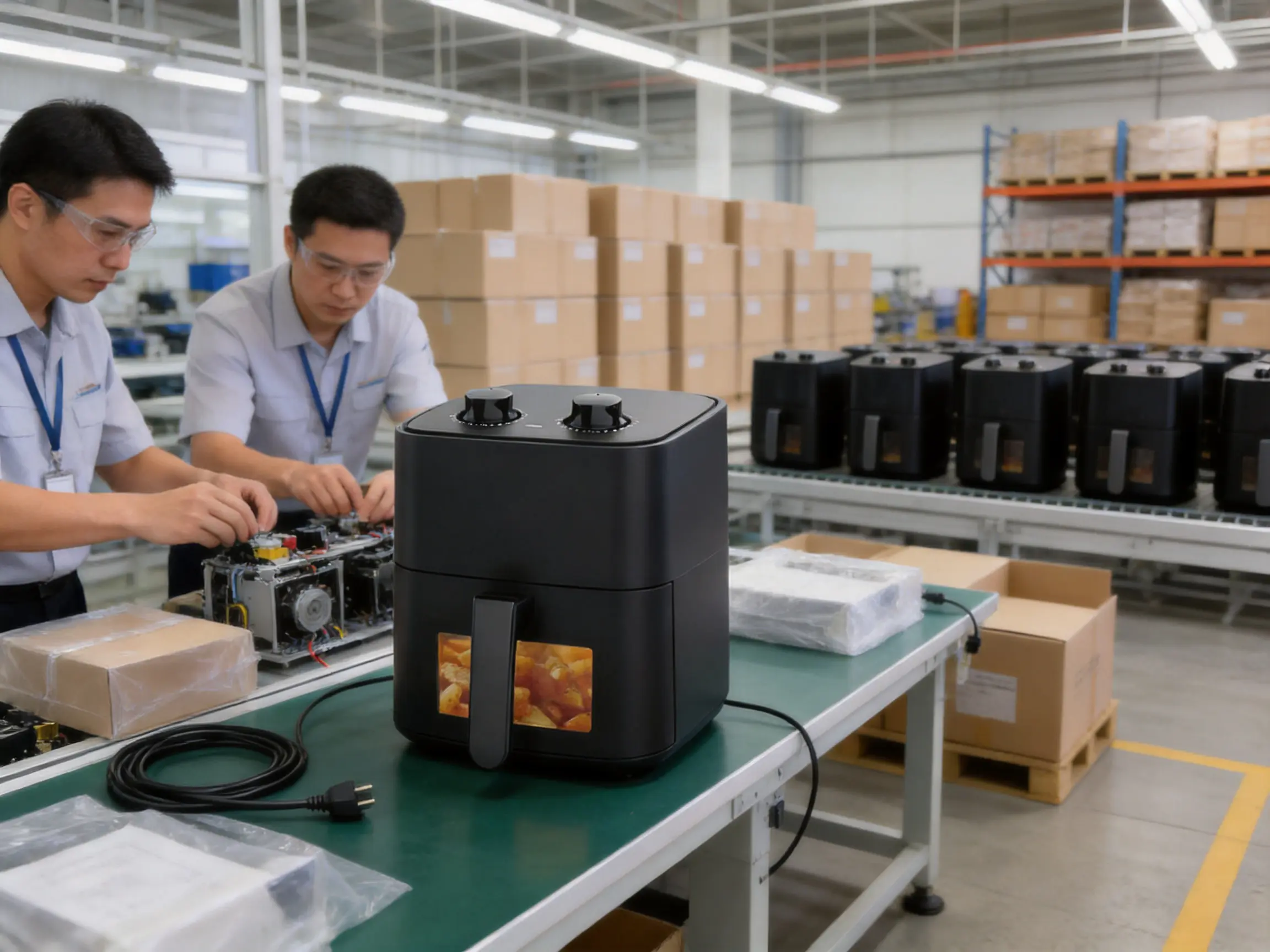
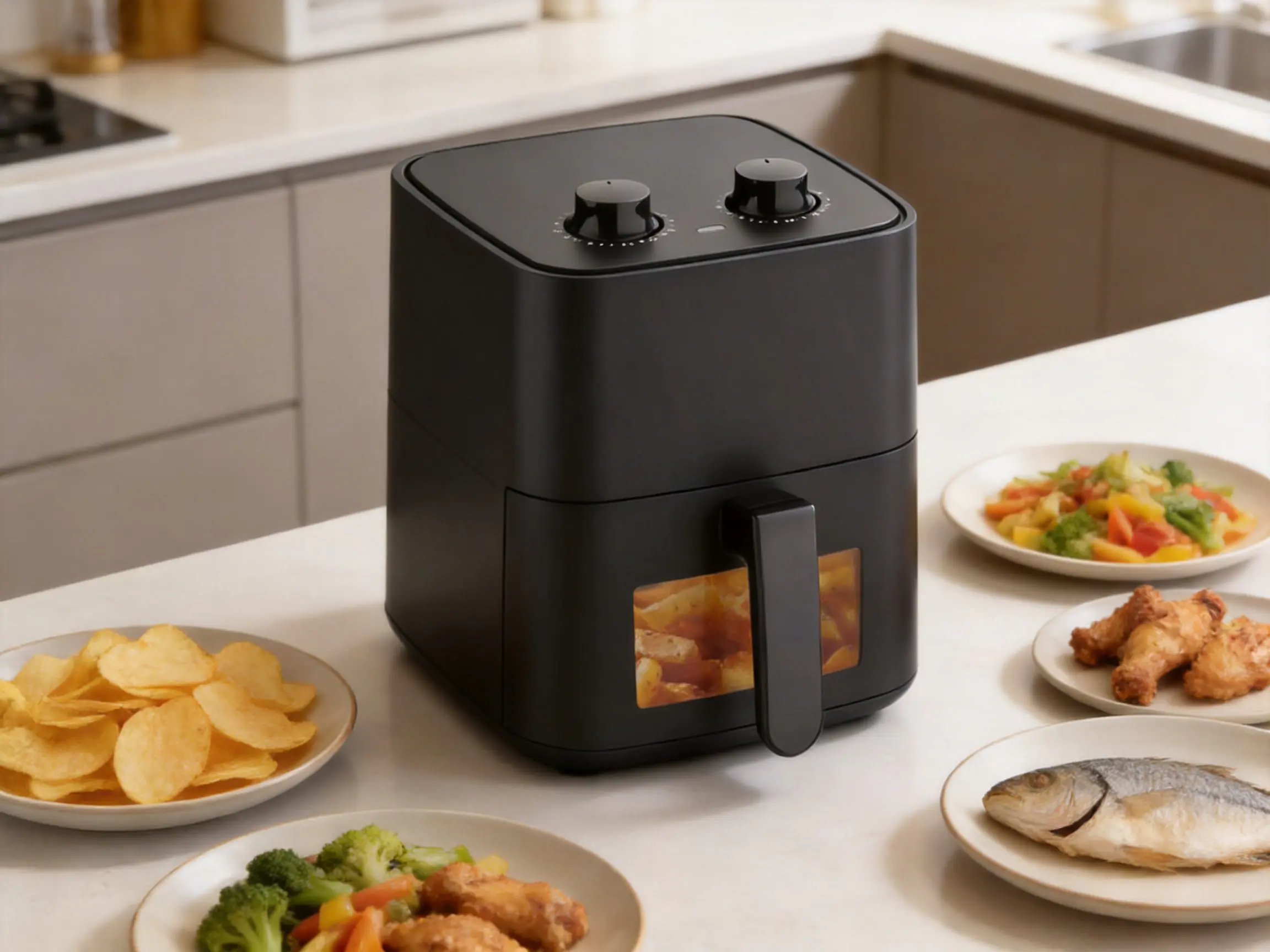
Modern households increasingly seek cooking appliances that combine practical performance, simple operation, compact dimensions, and dependable safety. The GSE100-1T mechanical air fryer is designed to meet these expectations with a straightforward control system, a 3.8-litre cooking capacity, adjustable temperature control, and several protective functions. It is suitable for preparing everyday foods such as chips, vegetables, chicken, fish, snacks, and other ingredients that benefit from circulating hot air.
Unlike complicated touchscreen appliances that may require users to learn digital menus, this model uses separate mechanical controls for temperature and time. The result is an appliance that is easy to understand, easy to operate, and suitable for a broad range of consumers. Its design also includes a viewing window, automatic shut-off, overheat protection, non-slip feet, and a power-off function activated when the outer pot is detached.
For retailers, importers, distributors, hospitality buyers, and private-label customers, the product offers a balanced combination of consumer-friendly features and commercially practical specifications. Its 220–240V operating range, 1100–1300W power rating, 50/60Hz compatibility, and four-unit carton packing support distribution in suitable international markets. The manufacturer’s experience in small kitchen appliances, product development, quality control, and export-oriented production further strengthens the product’s potential in the competitive air fryer category.
Product Overview
The GSE100-1T is a mechanical air fryer developed for daily household use. Its primary cooking method is hot-air circulation, allowing users to prepare food with little or no added oil compared with conventional deep frying. The appliance is intended to provide a convenient alternative to frying pans, countertop ovens, and traditional oil fryers.
The unit has a 3.8-litre capacity, making it appropriate for individuals, couples, and small families. This capacity provides a useful middle ground: it is more practical for routine meals than very small personal air fryers, while remaining more compact than large family-size models. Its product dimensions are approximately 316 × 222 × 272 millimetres, allowing it to fit on many kitchen worktops without occupying excessive space.
The air fryer uses a mechanical temperature control system with an operating range from 80°C to 200°C. This broad range allows users to select lower settings for gentle heating and higher settings for roasting, browning, and crisping. A separate mechanical time control can be adjusted according to the cooking requirement and customer preference.
A viewing window is incorporated into the design so that users can observe food during cooking. This feature can reduce the need to repeatedly remove the cooking container, helping preserve heat and making it easier to monitor browning and cooking progress.
The product is designed for the 220–240V electrical market and has a rated power range of 1100–1300W. It is compatible with both 50Hz and 60Hz supply frequencies. These specifications make it suitable for many regions using the corresponding voltage standard, subject to local certification, plug, and regulatory requirements.
| Product name | Mechanical Air Fryer |
| Model | GSE100-1T |
| Category | Air Fryer |
| Control type | Mechanical temperature and time controls |
| Temperature range | 80–200°C |
| Capacity | 3.8 litres |
| Rated voltage | 220–240V |
| Rated power | 1100–1300W |
| Frequency | 50/60Hz |
| Product dimensions | 316 × 222 × 272mm |
| Gift box dimensions | 279 × 243 × 298mm |
| Carton dimensions | 573 × 500 × 314mm |
| Carton quantity | 4 pieces per carton |
| Container loading reference | 3,060 pieces per 40HQ container |
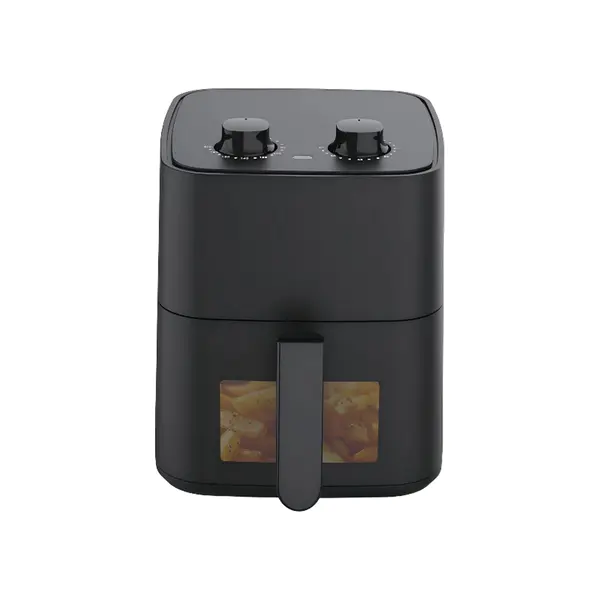
GSE100-1T
Practical Mechanical Operation
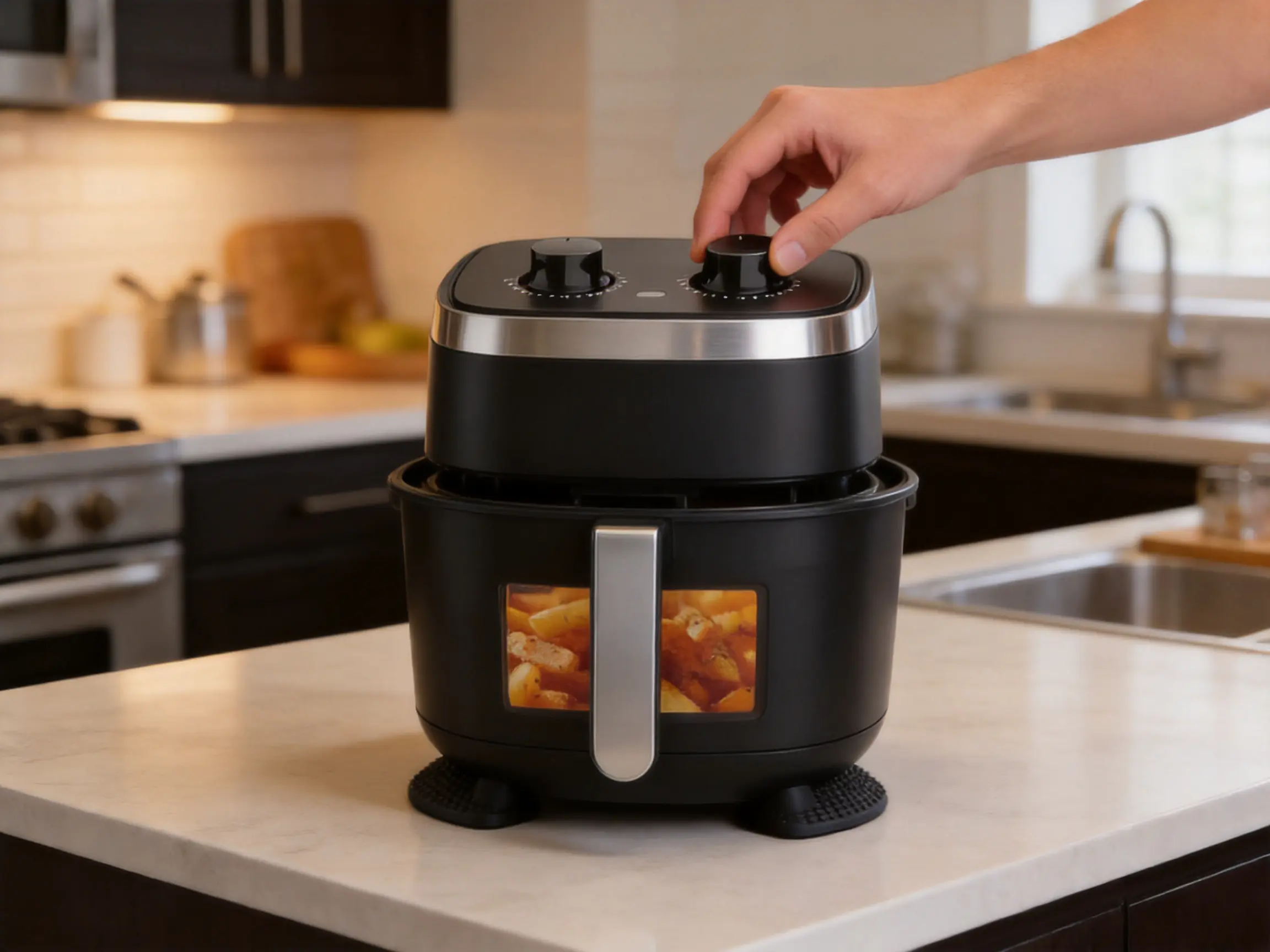
One of the strongest advantages of the GSE100-1T is its uncomplicated mechanical interface. The appliance uses separate controls for temperature and cooking time, allowing users to make adjustments without navigating digital menus, touchscreens, or preset programs. This approach is particularly useful for consumers who value direct operation.
Mechanical controls can also be commercially attractive because they communicate the product’s purpose immediately. A user can select the required temperature and time by turning the corresponding control. This makes the appliance approachable for first-time air fryer users and for people who prefer familiar knobs over electronic interfaces.
The separate temperature and time controls provide flexibility for a broad range of recipes. Lower temperatures can be selected for warming or gradual cooking, while higher temperatures can be used for crisping and roasting. The time control allows the user to set a cooking period suited to the type and quantity of food.
The design also supports private-label and customized product programs. The supplied product information indicates that the button arrangement can be configured according to customer demands. For importers and brand owners, this may offer opportunities to adapt control markings, packaging presentation, or operating instructions for different markets, subject to engineering review and production confirmation.
Compared with some app-connected or fully digital air fryers, a mechanical model does not depend on software, wireless connectivity, or a mobile device. This can simplify consumer use and reduce the number of electronic functions that require explanation. It also supports a product positioning based on reliability, accessibility, and daily convenience.
Temperature Flexibility from 80°C to 200°C
The 80–200°C temperature range is a central performance feature. It covers the temperatures commonly associated with reheating, baking-style preparation, roasting, and crisping. Users can adjust the setting according to the ingredients, portion size, desired texture, and recipe instructions.
A lower setting can be useful when gently warming prepared food or handling ingredients that should not be exposed immediately to intense heat. A medium setting may be suitable for vegetables, pastries, and reheating a variety of meals. Higher settings can help create a browned or crisp surface on foods such as potatoes, chicken pieces, breaded snacks, and similar products.
Temperature adjustability is important because different foods require different cooking approaches. A fixed-temperature appliance would offer less control and could be less versatile in everyday use. The mechanical dial on this model allows users to make practical changes without relying only on automatic presets.
As with any air fryer, actual cooking performance may vary according to food composition, starting temperature, quantity, placement, and preparation method. The temperature range should therefore be considered a control range rather than a guarantee that every food will cook at an identical internal temperature. Clear instructions and sensible user practices remain important.
3.8-Litre Capacity for Everyday Meals
The 3.8-litre capacity gives the GSE100-1T a practical position in the market. Small-capacity air fryers can be convenient for single portions but may require multiple cooking cycles when preparing food for more than one person. Very large units can offer additional volume but may use more worktop space and appeal mainly to larger households.
A 3.8-litre model can support everyday portions while maintaining a relatively compact footprint. It may be suitable for preparing snacks, side dishes, small batches of vegetables, chicken portions, fish, frozen foods, or reheated meals. The actual usable food quantity depends on the food type and the need to allow sufficient hot-air circulation around the ingredients.
For retailers, this capacity is easy to communicate. Consumers generally understand the difference between personal, medium-size, and family-size air fryers, and a 3.8-litre product can be presented as a versatile household appliance rather than a niche single-serving device.
The product dimensions of 316 × 222 × 272mm support a space-efficient positioning. It can be presented as a countertop appliance for kitchens where storage and worktop area are important considerations. The dimensions may also help distributors develop packaging and shelf-display strategies that use warehouse and retail space efficiently.
Viewing Window for Cooking Visibility
The integrated viewing window provides a direct visual connection between the user and the food. Instead of relying only on a timer or repeatedly opening the cooking compartment, users can check the appearance of their meal during the cooking process.
Visibility can be valuable when preparing foods with different browning preferences. Users can observe whether the surface is becoming golden, whether ingredients need to be rearranged, or whether the cooking cycle should be adjusted. This feature may also help new users become familiar with the appliance because they can see how food changes as hot air circulates.
Repeatedly opening a cooking appliance can allow heat to escape and interrupt the cooking process. A viewing window does not eliminate the need to inspect or turn food when appropriate, but it can reduce unnecessary opening during routine cooking. It also contributes to the product’s visual differentiation compared with basic opaque models.
For product presentation, the window is an easy-to-understand benefit. Retail descriptions, packaging, demonstrations, and sales training can all explain the feature without requiring technical language. A consumer can immediately understand the advantage of being able to see the food.
Safety and Convenience Features
Power-Off Protection When the Outer Pot Is Detached
The product includes a power-off protection function that operates when the outer pot is detached. This is an important practical feature because it helps prevent continued operation when the cooking container is removed from its normal position.
During everyday use, consumers may remove the pot to check, shake, turn, or serve food. A protective power-off function can help reduce the risk of the heating and air-circulation system operating unnecessarily while the container is separated from the main body. Users should still follow the operating instructions and avoid touching hot surfaces.
Overheating Protection
The air fryer is equipped with safety overheat protection. This protection is intended to help reduce the risk associated with excessive temperature conditions during operation. Overheat protection is a valuable feature in countertop heating appliances because it adds a further layer of control beyond the user’s selected temperature and time settings.
Safety systems must always be used together with correct operation. The appliance should be placed on a stable, heat-resistant surface with adequate clearance around ventilation areas. Users should not cover air inlets or outlets, operate the appliance near water, or use it if the power cord or housing is damaged.
Automatic Shut-Off
Automatic shut-off activates when the cooking cycle is complete. This function helps prevent the appliance from continuing to heat indefinitely after the selected time has elapsed. It supports convenience for busy users and provides a clear end point for the cooking cycle.
Automatic shut-off is especially useful in routine meal preparation. Once the timer reaches the selected setting, the appliance can stop operating without requiring the user to remain beside it to switch it off manually. Nevertheless, consumers should not leave any heating appliance unattended for extended periods and should follow local safety guidance.
Non-Slip Feet
Non-slip feet help the appliance remain stable on the worktop. Stability is important when users insert or remove the cooking container, adjust the controls, or shake food during cooking. A stable base can make the product feel more secure and comfortable in daily operation.
The appliance should still be placed on a level, dry, and heat-resistant surface. Non-slip feet are a supportive design feature, not a substitute for proper placement or careful handling.
Power-Off Memory Function
The product specification includes a power-off memory function. This feature is intended to preserve selected operating information in the event of a power interruption or temporary loss of electrical supply, subject to the exact implementation confirmed for the production version.
Power interruptions can be inconvenient during cooking. A memory function may help reduce the need to reset controls after a short interruption, improving user convenience in regions where electrical supply can be inconsistent. Buyers should confirm the detailed behavior of this function, including the duration of memory retention and restart requirements, during technical approval.
Disabled Ring Alert Function
The ring alert function is specified as disabled. This can be beneficial for consumers who prefer quieter operation or who do not want an audible end-of-cycle signal. It may also suit environments where sound should be minimized, such as open-plan living spaces, offices, guest rooms, or certain hospitality settings.
Because users will not rely on a ring alert, the automatic shut-off and visual or physical status of the controls become more important. Product instructions should clearly explain how users can identify that the cooking cycle has ended.
Advantages Compared with Competing Product Types
The air fryer market includes compact personal models, large digital appliances, multifunction countertop ovens, and traditional deep fryers. The GSE100-1T competes by offering a focused combination of mechanical simplicity, practical capacity, adjustable heating, and safety-oriented construction.
Compared with Basic Personal Air Fryers
Very small air fryers may be attractive because of their low footprint, but they can limit the quantity of food prepared in one cycle. The 3.8-litre capacity of this model provides more flexibility for households that need to prepare portions beyond a single snack or side dish.
The viewing window also adds a feature that is not always present on basic compact models. Users can monitor food without depending entirely on opening the drawer or container. Separate temperature and time controls provide direct adjustment rather than restricting users to a small number of preset functions.
Compared with Complex Digital Models
Digital air fryers can offer touch controls, preset menus, displays, and additional programming. These features may appeal to some consumers, but they can also increase interface complexity and require more user education. A mechanical appliance offers a more direct operating experience.
The GSE100-1T does not depend on a digital display or mobile application for basic cooking. This can make it suitable for users who prefer physical controls, have limited interest in connected appliances, or want an appliance that can be understood quickly by different members of a household.
For distributors, a mechanical interface may also simplify sales communication. The key functions can be demonstrated in a few steps: select the temperature, select the time, monitor the food through the window, and remove the pot when cooking is complete.
Compared with Traditional Deep Fryers
Traditional deep frying requires a larger quantity of cooking oil and involves handling hot oil. An air fryer uses circulating heated air as its primary cooking method, offering a different approach to achieving a browned or crisp exterior. This may appeal to consumers who want to reduce the amount of oil used in routine cooking.
The air fryer format can also simplify cleanup compared with handling a container of hot oil. Users should still clean the cooking components according to the manual and prevent food residue from accumulating. The product is not intended to eliminate all cooking preparation or cleaning requirements, but it can provide a convenient alternative to oil-based frying.
Compared with Larger Countertop Ovens
Large countertop ovens can accommodate more food and multiple cooking functions, but they generally require more space and may take longer to preheat. The GSE100-1T is more focused: it is designed for hot-air cooking in a compact countertop format.
This focused design may be advantageous for consumers who already have a conventional oven but want a dedicated appliance for quick snacks, side dishes, reheating, and small meals. It may also suit smaller kitchens, student accommodation, rental properties, and hospitality rooms where a full-size oven is not practical.
Designed for Ease of Retail Presentation
A successful small appliance must be understandable not only in the home but also at the point of sale. The GSE100-1T has several features that can be communicated clearly through packaging, product photography, demonstrations, and online listings.
The 3.8-litre capacity establishes the product’s intended household positioning. The 80–200°C range demonstrates adjustability. The separate temperature and time knobs make the control system immediately visible. The viewing window provides a distinct visual feature, while automatic shut-off, overheat protection, and pot-detachment power-off protection support a safety-focused product message.
The compact product size can be highlighted for consumers with limited kitchen space. The 220–240V, 50/60Hz electrical specification provides a clear starting point for market selection, although importers must always verify local requirements, certification, plug configuration, labeling, and energy regulations before commercial launch.
The product is supplied in a gift box measuring approximately 279 × 243 × 298mm, with four pieces packed per carton. The carton measures approximately 573 × 500 × 314mm. These details are useful for warehouse planning, pallet calculations, freight quotations, container loading, and retail packaging development.
Manufacturing and Product Development Strengths
The manufacturer, CIXI GSTAR ELECTRIC APPLIANCE CO., LTD., is based in Cixi, Ningbo, China, and specializes in small electric kitchen appliances. Its product range includes blenders, slicers, choppers, food processors, smokeless grills, hot pots, air fryers, and air ovens. The company also produces selected equipment for bars, restaurants, and hotels, including ice buckets, beverage dispensers, pitchers, slicers, and graters.
This product breadth is relevant to the GSE100-1T because air fryer development benefits from experience across heating appliances, food-preparation equipment, plastic components, mechanical assemblies, user interfaces, and packaging requirements. A manufacturer with several related product categories can apply knowledge gained from different appliance projects to design reviews and production planning.
The company reports that its development history began with non-electric innovative products and later expanded into electric appliances. This background indicates experience with both mechanical product design and electrically powered kitchen equipment. The combination is useful for a mechanical air fryer, where the consumer interface is intentionally simple but the internal system still requires coordinated heating, air circulation, safety protection, and structural assembly.
Dedicated Factory Development
According to the supplied company information, the business established its own factory and later moved into a new facility in 2018. The reported factory and production-area figures have changed as the business expanded, with the company describing a substantial owned plant, dedicated production space, and a workforce of experienced employees.
The company information also states that the business has more than 200 experienced workers, engineering personnel in its research and development department, and dedicated quality-control staff. These resources support the full product-development cycle, including concept refinement, engineering review, sample production, testing coordination, manufacturing preparation, inspection, and after-sales communication.
For buyers, the value of an in-house manufacturing structure is not limited to production volume. It can also improve communication between product designers, engineering staff, purchasing teams, production supervisors, and quality-control personnel. Faster internal communication can help address design changes, packaging adjustments, component availability, and production issues more efficiently than a fragmented supply chain.
Research and Development Capability
The company reports a dedicated R&D department with engineers responsible for the development of electric appliances. Product engineering for an air fryer may involve mechanical structure, thermal performance, airflow, component fit, electrical safety, control usability, noise considerations, material selection, and packaging protection.
The GSE100-1T’s design demonstrates an emphasis on practical functions rather than unnecessary complexity. Mechanical controls, a viewing window, pot-detachment protection, overheat protection, automatic shut-off, and non-slip feet each address recognizable consumer needs. This type of feature selection can help maintain a clear product proposition while avoiding excessive interface complexity.
For customers seeking OEM or private-label cooperation, an engineering team may also provide a foundation for discussing market-specific requirements. Such requirements may include control markings, language versions, plug types, packaging artwork, manuals, color changes, labeling, testing documentation, or other approved adaptations. Any modification should be reviewed for tooling, certification, minimum order quantity, lead time, and production impact.
Quality-Control Organization
The supplied company profile identifies a dedicated QC department. Quality control for a small electric kitchen appliance typically involves several stages rather than one final inspection. Incoming materials and components may be checked against specifications, assembly processes may be monitored, and finished units may undergo appearance, function, electrical, and packaging inspections.
For an air fryer, relevant inspection points may include control operation, power performance, heating behavior, timer response, fan operation, pot fit, safety cutoff functions, cord and plug condition, housing appearance, viewing-window installation, and packaging integrity. The exact inspection plan depends on the approved product specification, applicable market standards, and customer requirements.
A structured quality process is particularly important for products shipped internationally. Units may pass through long supply chains involving factory handling, container loading, sea transport, warehouse storage, retail distribution, and final consumer delivery. Consistent assembly and protective packaging help reduce the risk of damage and customer complaints.
Production Planning and Export Support
The stated container-loading reference of approximately 3,060 pieces per 40HQ container provides an initial logistics planning figure. Actual loading quantities may vary depending on packaging revisions, pallet use, shipping configuration, and final carton dimensions. Nevertheless, the figure can help buyers begin discussions about order planning and freight efficiency.
Four units per carton creates a manageable commercial pack for warehouse handling and distribution. It can be suitable for importers that sell through retail stores, e-commerce channels, regional distributors, or project-based procurement. Buyers should confirm carton strength, gross and net weights, palletization, drop-test expectations, and shipping marks before mass production.
The company describes a customer-oriented business model based on innovative products, competitive pricing, delivery responsiveness, after-sales service, and cooperation with customers as engineering partners. For an air fryer buyer, this approach may be useful when developing a product line that includes several related kitchen appliances rather than a single standalone item.
Recommended Use Cases
Household Cooking
The primary use case is everyday household cooking. The air fryer can be used for side dishes, snacks, vegetables, chicken, fish, reheating, and other foods suitable for circulating hot air. Its mechanical controls allow different members of a household to operate it without extensive training.
Small Kitchens and Apartments
The compact dimensions make the product suitable for smaller kitchens, apartments, dormitories, rental homes, and other locations where worktop space is limited. It can supplement a conventional oven or provide a convenient cooking option where a full-size oven is not available.
Hospitality and Guest Accommodation
Subject to local commercial-use requirements and the customer’s approved application, the product may also be considered for guest accommodation, staff kitchens, offices, and similar environments. The disabled ring alert function may be attractive in locations where quieter operation is preferred.
Retail and Private-Label Programs
The clear feature set makes the product suitable for retail and private-label programs. Buyers can position it around simple controls, practical capacity, adjustable temperature, visible cooking, compact size, and multiple protective functions. Packaging and instructions can be adapted for the target market following technical approval.
Guidance for Importers and Distributors
Before placing a commercial order, importers should confirm the destination market’s electrical and safety requirements. These may include product certification, electromagnetic compatibility, materials compliance, energy labeling, plug standards, language requirements, recycling marks, and packaging regulations. The 220–240V and 50/60Hz specifications provide useful technical information but do not replace local compliance evaluation.
Buyers should also confirm the final rated power, cable and plug configuration, operating instructions, warranty terms, spare-parts policy, and inspection procedure. If the product is to be sold under a private label, artwork approval should cover the product housing, gift box, carton, manual, rating label, barcode, and any safety markings.
Packaging should be reviewed for both retail presentation and transport protection. The gift box dimensions should be checked against the final product configuration, accessories, manuals, and internal protective materials. The outer carton should be evaluated for compression strength, stacking, moisture exposure, and handling during international transportation.
Product training should explain that the capacity is measured in litres and that the recommended food load depends on the type of ingredient. Overfilling may restrict air circulation and affect cooking results. Consumers should be instructed to use heat-resistant tools, avoid touching hot surfaces, keep ventilation openings clear, and clean the appliance as directed.
Operational Considerations for Consumers
Before first use, the consumer should read the instruction manual, remove all packaging materials, inspect the appliance, and place it on a stable, level, heat-resistant surface. Adequate clearance should be maintained around the appliance so that air can circulate and heat can dissipate safely.
Food should be prepared in a way that supports even hot-air circulation. Depending on the recipe, ingredients may need to be arranged in a single layer or shaken during cooking. The viewing window can help users monitor appearance, but it does not replace proper food-safety practices or checking that food has reached an appropriate internal temperature.
At the end of the selected cooking period, the automatic shut-off function is designed to stop operation. Users should handle the outer pot and food carefully because surfaces and contents may remain hot after the heating cycle ends. The pot-detachment protection should not be deliberately bypassed or modified.
Cleaning should be performed only after the appliance has cooled and has been disconnected from the power supply where appropriate. Water should not be allowed to enter electrical components. Food residue should be removed according to the manufacturer’s instructions, and abrasive cleaning methods should be avoided if they could damage the surface or viewing window.
Why the Product Offers Commercial Potential
The air fryer category continues to attract consumers who want convenient countertop cooking and alternatives to conventional frying. A product does not need to include every possible digital feature to compete effectively. Many buyers value ease of use, understandable controls, appropriate capacity, compact design, and dependable safety functions.
The GSE100-1T addresses these priorities with a clear mechanical operating system and a useful collection of practical features. Its 3.8-litre capacity is broad enough for everyday household applications without moving into the size and space requirements of a large countertop oven. Its 80–200°C range supports varied cooking tasks, while the viewing window gives the product a visible point of differentiation.
From a sourcing perspective, the manufacturer’s experience in small appliances, investment in product development, dedicated QC resources, and reported production capacity provide a foundation for long-term cooperation. The company’s wider product range may also allow buyers to build a coordinated kitchen-appliance portfolio, including food processors, blenders, choppers, hot pots, grills, air ovens, and related products.
The combination of product simplicity and manufacturing capability is especially relevant for distributors serving customers with different levels of technical familiarity. A mechanical air fryer can be sold through traditional retail, online marketplaces, catalogues, wholesale channels, and private-label programs. Its benefits can be explained in concise consumer language while still offering meaningful technical specifications for professional buyers.
Frequently Asked Questions
What type of appliance is the GSE100-1T?
It is a mechanical air fryer designed for countertop household cooking. It uses hot-air cooking and has separate mechanical controls for temperature and time.
What is the capacity?
The stated capacity is 3.8 litres. The practical food quantity depends on the ingredient, recipe, and the space required for hot-air circulation.
What temperature range does it offer?
The temperature can be adjusted from 80°C to 200°C. This range supports warming, reheating, roasting, browning, and crisping applications.
Does the product have digital controls?
No. The product is specified as a mechanical model with separate temperature and time controls. This provides direct operation without requiring a touchscreen or mobile application.
Can users see the food while it cooks?
Yes. The product includes a viewing window that allows users to monitor the food during cooking.
Does it shut off automatically?
Yes. The specification includes automatic shut-off when the cooking cycle is complete.
What happens if the outer pot is removed?
The product includes power-off protection when the outer pot is detached. Users should still follow the instruction manual and should not attempt to defeat or modify the protection mechanism.
Does the air fryer include overheating protection?
Yes. Safety overheat protection is listed among the product’s functions.
Does the product make a ring sound when cooking ends?
The ring alert function is specified as disabled. Buyers should confirm the final user-interface behavior and manual wording for their specific production order.
What are the electrical specifications?
The stated specifications are 220–240V, 1100–1300W, and 50/60Hz. Importers must confirm local certification, plug, labeling, and regulatory requirements before sale.
What are the product dimensions?
The stated product size is approximately 316 × 222 × 272 millimetres. The gift box is approximately 279 × 243 × 298 millimetres.
How many units are packed in one carton?
The stated packing configuration is four pieces per carton. The carton size is approximately 573 × 500 × 314 millimetres.
How can buyers use the product for private-label programs?
Buyers can discuss approved requirements such as packaging artwork, language versions, labels, manuals, plug configuration, and selected design adaptations with the manufacturer. Any changes should be confirmed for tooling, compliance, minimum order quantity, cost, and lead time.
Who manufactures the product?
The product is supplied by CIXI GSTAR ELECTRIC APPLIANCE CO., LTD., a Cixi, Ningbo-based manufacturer specializing in small electric kitchen appliances and related food-service products.
What should be confirmed before mass production?
Buyers should confirm the final specification, samples, electrical and safety compliance, packaging, product markings, inspection standards, warranty arrangements, spare parts, shipping configuration, and destination-market requirements.
Conclusion
The GSE100-1T mechanical air fryer is designed around practical cooking, direct control, and everyday convenience. Its 3.8-litre capacity, 80–200°C temperature range, separate mechanical controls, viewing window, automatic shut-off, overheat protection, pot-detachment power-off protection, non-slip feet, and power-off memory function create a well-balanced feature set for household use.
Its strongest competitive position is its simplicity. It offers the core benefits consumers expect from an air fryer without requiring a complex digital interface. The product can appeal to users who want adjustable cooking control, visible food preparation, compact dimensions, and easy operation.
For commercial buyers, the product is supported by a manufacturer with experience across small kitchen appliances, product development, engineering, quality control, and international supply. The company’s reported factory resources, R&D personnel, QC organization, and broad product portfolio provide a useful foundation for OEM, wholesale, distribution, and private-label cooperation.
With appropriate market certification, packaging approval, user instructions, and quality verification, the GSE100-1T can serve as a practical addition to a modern countertop-appliance range. It offers a focused solution for consumers seeking convenient hot-air cooking and for buyers seeking a commercially understandable product with manufacturing support behind it.
References
1. Product specification supplied for the GSE100-1T mechanical air fryer, including electrical ratings, dimensions, capacity, functions, and packing information.
2. Company profile supplied for CIXI GSTAR ELECTRIC APPLIANCE CO., LTD., including manufacturing history, product categories, factory development, engineering resources, and quality-control organization.
3. General household countertop-appliance safety principles concerning heat-resistant placement, ventilation, electrical protection, hot-surface handling, and cleaning procedures.
4. General guidance for air-fryer operation, including temperature adjustment, food spacing, hot-air circulation, cooking supervision, and safe handling of heated containers.
5. General export product-planning considerations covering electrical certification, labeling, packaging, inspection, logistics, and destination-market compliance.